

Gleason Score Explained: What Your Prostate Cancer Grade Means

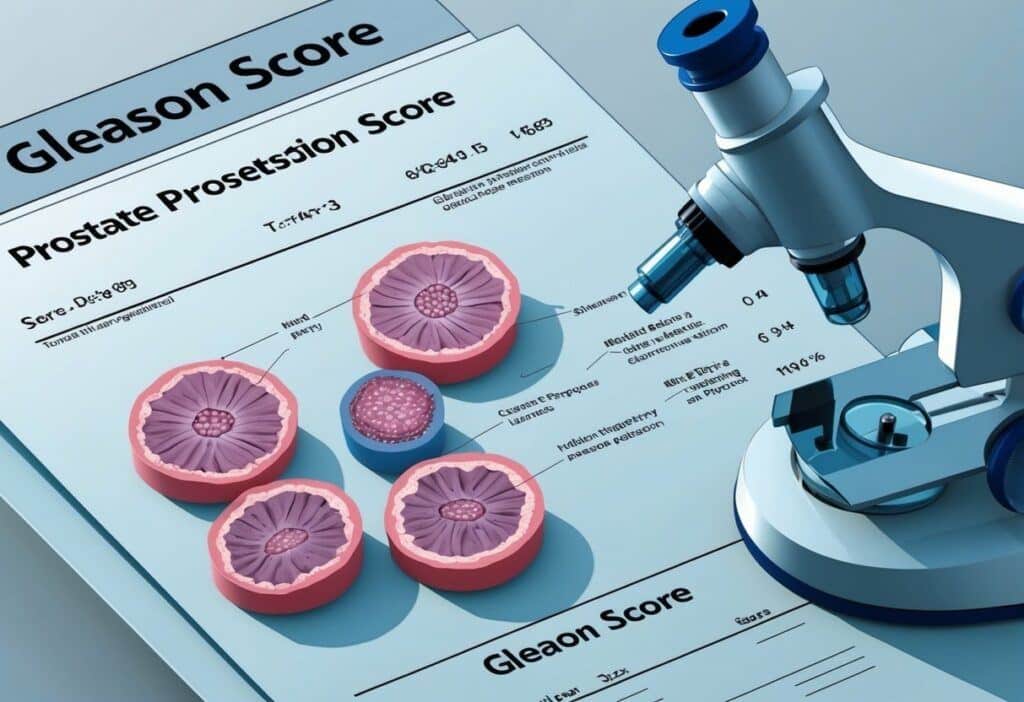
When Michael received his prostate biopsy results showing “Gleason 3+4=7, Grade Group 2,” he felt completely lost. Was 7 out of 10 good or bad? What did the 3+4 mean? Why was there also a “Grade Group”? His doctor explained that his cancer wasn’t high-risk but also wasn’t something they could simply watch—it fell in a middle ground requiring careful decision-making. Michael’s confusion is nearly universal among men receiving prostate cancer diagnoses. The Gleason scoring system, while crucial for determining treatment, uses terminology that seems designed to mystify rather than clarify.
Understanding your Gleason score is critical because it profoundly affects your treatment options and long-term outlook. The five-year biochemical recurrence-free progression probabilities for radical prostatectomy Grade Groups 1-5 were 96%, 88%, 63%, 48%, and 26% Johns Hopkins Pathology. This dramatic variation—from 96% cancer-free survival with Grade Group 1 to just 26% with Grade Group 5—shows why the grade matters enormously. Your score helps determine whether you can safely watch the cancer, whether you need aggressive treatment immediately, and what kind of treatment offers the best chance of cure.
How Pathologists Grade Prostate Cancer Cells
After your prostate biopsy removes 10-12 tiny tissue samples, a pathologist examines them under a microscope. They’re looking at the architecture and organization of prostate cancer cells, comparing them to normal prostate tissue. Cancer cells have different sizes and shapes, which also are called patterns. The pathologists find the two most common patterns of cancer cells in the sample and assign grades to them. If the cancer cells look similar to healthy cells, then the cancer cells are low grade. Low-grade cancer grows slowly. If the cancer cells look very different from healthy cells, then the cancer cells are high grade. High-grade cancer grows quickly Mayo Clinic.
The grading system originally ran from 1 to 5, with Grade 1 cells looking nearly normal and Grade 5 cells looking wildly abnormal. However, modern pathology rarely assigns Grades 1 or 2 anymore—the cellular changes are so minimal that experts don’t consider them true cancer. Currently the lowest score assigned to a tumor is grade 3. Grades below 3 show normal to near normal cells MedlinePlus. This means in practice, prostate cancer grades run from 3 to 5, with 3 being the least aggressive and 5 being the most aggressive.
What makes the Gleason system unique is that it combines two grades rather than using a single grade. Prostate cancer is almost always heterogeneous—different areas have different grades. The pathologist identifies the most common pattern (primary grade) and the second most common pattern (secondary grade), then adds them together. To calculate the Gleason score of a prostate biopsy, pathologists add the most common grade from the samples with the highest grade from the samples Mayo Clinic. This approach gives more information than a single grade would, because knowing both the predominant pattern and the worst pattern helps predict behavior.
Decoding Your Gleason Score
Your Gleason score appears as an equation: 3+4=7, or 4+3=7, or 3+3=6, for example. In this example, the first number is the most common cancer grade in the tissue sample. The second number is the next most common cancer grade. The third number is the Gleason score Mayo Clinic. Understanding what each number means helps you grasp what your biopsy actually found.
Let’s break down the most common scores. Gleason 6 (3+3=6) means all the cancer the pathologist saw was Grade 3—the least aggressive grade of true cancer. These cells form recognizable glands that still somewhat resemble normal prostate architecture. They grow slowly and very rarely spread beyond the prostate. Gleason 7 comes in two flavors: 3+4=7 and 4+3=7. While both add to 7, they’re not the same. Overall, someone with a Gleason score of 7 that comes from adding 3 + 4 is felt to have a less aggressive cancer than someone with a Gleason score of 7 that comes from adding 4 + 3. That is because the person with a 4 + 3 =7 grade has more grade 4 cells than grade 3 cells. Grade 4 cells are more abnormal and more likely to spread than grade 3 cells MedlinePlus.
Grade 4 cells show more disrupted architecture—they form fused glands, poorly-formed glands, or cribriform (sieve-like) patterns that look distinctly abnormal. Having more Grade 4 (4+3) versus more Grade 3 (3+4) creates meaningfully different cancer behaviors. Gleason 8 (4+4=8 or 3+5=8 or 5+3=8) indicates high-grade cancer with significant architectural disruption. Gleason 9-10 (4+5=9, 5+4=9, or 5+5=10) represents the most aggressive prostate cancers, where Grade 5 patterns show sheets of cells with little or no gland formation, or areas of necrosis (dead tissue).
The order matters because it tells you what predominates. If most of your cancer is the less aggressive pattern with only a minor component of the more aggressive pattern, that’s different from having mostly aggressive cancer with a minor less-aggressive component. This nuance is why simply hearing “Gleason 7” isn’t enough—you need to know whether it’s 3+4 or 4+3.
The Grade Group System: Simplifying The Message
The Gleason scoring system, while medically useful, creates problems for patient understanding. In practice the lowest score is now assigned a 6, although it is on a scale of 2-10. This leads to a logical yet incorrect assumption on the part of patients that their cancer is in the middle of the scale, compounding the fear of their cancer diagnosis with the belief that the cancer is serious, thus leading to an expectation that treatment is necessary Johns Hopkins Pathology. A man told he has “Gleason 6 cancer” hears that he’s at 6 out of 10—sixty percent of the way to the worst cancer—when actually Gleason 6 is the least aggressive cancer that exists.
To address this confusion, the medical community adopted a new Grade Group system in 2016, now endorsed by the World Health Organization. Grade Group 1 is the least aggressive and Grade Group 5 is the most aggressive Cancer Research UK.. This system condenses the Gleason scores into five groups that better reflect distinct prognostic categories:
Grade Group 1 = Gleason 6 (3+3). This is the lowest-risk prostate cancer. These cancers grow very slowly, rarely spread, and many men die with them rather than from them. Five-year recurrence-free survival after surgery is 96%. Grade Group 2 = Gleason 7 (3+4). Mostly low-grade cancer with a minority of more aggressive cells. This is intermediate favorable-risk disease. Five-year recurrence-free survival is 88%. Grade Group 3 = Gleason 7 (4+3). Mostly higher-grade cancer with some lower-grade areas. This is intermediate unfavorable-risk disease, more aggressive than Group 2. Survival drops to 63% recurrence-free at five years.
Grade Group 4 = Gleason 8 (4+4, 3+5, or 5+3). High-grade cancer with significant aggressive features. Requires aggressive treatment. Five-year recurrence-free survival is 48%. Grade Group 5 = Gleason 9-10 (4+5, 5+4, or 5+5). The most aggressive prostate cancers with very abnormal cell architecture. High risk of spread. Only 26% remain recurrence-free five years after surgery.
The Grade Group system makes it immediately clear that Group 1 is best and Group 5 is worst, without the confusing mathematics of Gleason scores. Lowest grade is 1 as opposed to current practice of Gleason score 6, with the potential to reduce overtreatment of indolent prostate cancer Johns Hopkins Pathology. Many doctors now report both systems on pathology reports: “Gleason 3+4=7, Grade Group 2” gives you both the detailed Gleason information and the simplified Grade Group.
What Your Score Means For Treatment
Your Gleason score or Grade Group profoundly influences treatment recommendations. For Grade Group 1 (Gleason 6), active surveillance is often the best option. These cancers grow so slowly that immediate treatment frequently causes more harm than good through side effects like erectile dysfunction and urinary incontinence. Active surveillance means monitoring with repeat PSA tests, biopsies, and possibly MRI scans, only treating if the cancer shows signs of becoming more aggressive. Many men remain on active surveillance for years or even decades without needing treatment.
Grade Group 2 (Gleason 3+4=7) falls into a gray zone. Some men, particularly younger men or those with higher-volume disease, choose definitive treatment—either surgery (radical prostatectomy) or radiation therapy. Others, especially older men with limited disease, may still pursue active surveillance with closer monitoring. The decision depends on age, overall health, PSA level, how much of the prostate contains cancer, and personal preferences about treatment versus monitoring.
Grade Group 3 (Gleason 4+3=7) and higher generally warrant definitive treatment. The higher proportion of Grade 4 cells in 4+3=7 makes active surveillance riskier. Most doctors recommend either surgery to remove the prostate or radiation therapy (external beam or brachytherapy). For Groups 4 and 5 (Gleason 8-10), aggressive treatment is definitely indicated, often combining radiation with hormone therapy to improve outcomes.
It’s crucial to understand that Gleason score doesn’t work alone in treatment decisions. Doctors combine it with PSA level, clinical stage (how much cancer was felt during digital rectal exam and seen on imaging), and how much of the biopsy cores contained cancer. These factors together determine your risk category, which guides treatment. A Gleason 6 cancer with very high PSA or extensive disease on biopsy might warrant treatment despite the favorable Gleason score. Conversely, a small-volume Gleason 3+4=7 with low PSA might be appropriate for surveillance in selected patients.
Understanding Limitations And Nuances
While powerful, the Gleason system has limitations worth knowing. First, biopsy sampling is imperfect. While it’s not common, it’s possible that the biopsy might have missed a higher grade (more aggressive) area of the cancer somewhere else in the prostate American Cancer Society. About 20-30% of men have their Gleason score upgraded when the entire prostate is examined after surgical removal, because the surgery specimen reveals higher-grade cancer the biopsy missed. This is why some men on active surveillance eventually need treatment—follow-up biopsies find higher-grade cancer.
Your biopsy report may mention additional features beyond Gleason score that provide important information. Perineural invasion means cancer cells were seen around nerve fibers, suggesting slightly higher risk of spread. Intraductal carcinoma, a particular pattern of cancer growth, indicates likely presence of high-grade cancer even if not captured in the biopsy, potentially changing management from surveillance to treatment. The percentage of biopsy cores containing cancer also matters—having cancer in 2 out of 12 cores is different from having it in 10 out of 12 cores.
Gleason scoring applies only to adenocarcinoma, the most common type of prostate cancer (over 95% of cases). Rare types like small cell carcinoma or sarcomatoid carcinoma don’t get Gleason scores and are graded differently. These rare cancers are almost always aggressive and require different treatment approaches than typical adenocarcinoma.
Finally, understand that Gleason scores can guide but not guarantee outcomes. Some Gleason 6 cancers behave more aggressively than expected, while some Gleason 8 cancers respond remarkably well to treatment. The score provides probabilities and guides decisions, but individual cancers don’t always read the textbook. This is why oncologists combine Gleason scores with other information—PSA, imaging, genomic tests, overall health—to create personalized treatment plans.
The Psychological Impact Of Your Number
Receiving a Gleason score triggers profound emotional reactions. Men with Gleason 6 might feel relieved it’s “only a 6” or terrified that they have “cancer scoring 60% of maximum.” The Grade Group system helps somewhat—being told “Grade Group 1, the least aggressive cancer” sounds better than “Gleason 6″—but any cancer diagnosis causes fear. Understanding what your specific score means in concrete terms helps manage that fear.
If you have Gleason 6/Grade Group 1, know that you likely have years to make treatment decisions. The cancer won’t kill you next month or probably even next year. Active surveillance is safe for most men with this diagnosis, and many never need treatment. If you have Gleason 7/Grade Groups 2-3, you’re in a middle ground requiring thoughtful decision-making but not panic. Treatment is often recommended but not always urgent—you have time to get second opinions, research options, and make informed choices.
For Gleason 8-10/Grade Groups 4-5, the situation requires action, but modern treatments offer good outcomes even for high-grade disease. Many men achieve long-term cancer control with surgery, radiation, or combination therapy. Higher grade doesn’t mean hopeless—it means you need aggressive treatment, but aggressive treatment works well for many men.
Talk to your doctor about what your Gleason score means specifically for you. Ask about your complete risk category, not just the Gleason score in isolation. Discuss whether active surveillance is appropriate or whether you need treatment. If treatment is needed, ask which options suit your particular cancer and life situation. Understanding your Gleason score empowers you to participate actively in decisions about your care rather than passively accepting whatever is recommended.
Frequently Asked Questions
Q1: I have Gleason 3+3=6. Do I really have cancer or is this “precancer”? It is cancer, but the lowest-grade cancer that exists. Some experts debate whether Gleason 6 should be called cancer since it very rarely spreads or kills, but currently it’s still classified as cancer. However, it’s so slow-growing that immediate treatment often isn’t necessary. Many men safely monitor Gleason 6 with active surveillance, only treating if it progresses. Don’t let the word “cancer” alone drive you to immediate treatment—the grade matters more than the diagnosis.
Q2: My biopsy showed Gleason 3+4=7 in one core and 3+3=6 in other cores. Which score is used? Typically, doctors use the highest Gleason score found in any core—in your case, 3+4=7—to guide treatment decisions. The presence of any Grade 4 pattern changes risk stratification from low to intermediate. However, the limited extent (only one core) might factor into whether active surveillance is still appropriate versus definitive treatment. Discuss with your doctor how the overall picture—including amount of cancer, PSA, and age—affects your options.
Q3: Can Gleason scores change over time, or is my score permanent? Your Gleason score can change. If you’re on active surveillance, repeat biopsies might find higher-grade cancer that was missed initially or might detect true progression from lower to higher grade. About 20-30% of men have their score upgraded when the entire prostate is removed surgically compared to what biopsy showed. Conversely, occasionally men have lower scores on surgery specimens than biopsy suggested, though this is less common.
Q4: I’m 75 with Gleason 3+4=7. My friend is 55 with the same score. Will our treatment be the same? Probably not. While you have the same Gleason score, age dramatically affects recommendations. At 55, your friend might live another 30+ years and would likely benefit from definitive treatment to prevent cancer progression over decades. At 75, particularly if you have other health issues, aggressive treatment might cause more harm than benefit, and less aggressive approaches might be appropriate. Age, life expectancy, overall health, and personal preferences all influence treatment alongside Gleason score.
Q5: What’s better—Gleason 4+3=7 or Gleason 3+5=8? This is a complex question without a simple answer. Gleason 4+3=7 (Grade Group 3) has a higher Gleason score than pure Grade 4 patterns, but 3+5=8 (Grade Group 4) includes Grade 5, the most aggressive pattern. Generally, any Grade 5 pattern is worrisome and pushes toward Grade Group 4-5 category with worse prognosis than Grade Group 3. However, individual cases vary. Discuss with your oncologist which features of your specific cancer are most important prognostically.
Disclaimer
This article adapts publicly available information from reputable medical sources and pathology organizations. This content is for informational and educational purposes only and does not constitute medical advice. ObserverVoice.com is a news and information platform — not a healthcare provider. Gleason scores and Grade Groups must be interpreted in the context of your complete clinical picture including PSA levels, imaging results, biopsy findings, overall health, and personal circumstances. Treatment decisions for prostate cancer should be made in consultation with qualified urologists, medical oncologists, and radiation oncologists who can evaluate your individual situation. Please consult with your healthcare team to understand what your specific Gleason score means for your treatment options and prognosis.
References
- Johns Hopkins Pathology. Prostate Cancer Grading System. https://pathology.jhu.edu/urologic/prostate-cancer-grading-system
- American Cancer Society. Understanding Your Pathology Report: Prostate Cancer. https://www.cancer.org/cancer/diagnosis-staging/tests/biopsy-and-cytology-tests/understanding-your-pathology-report/prostate-pathology/prostate-cancer-pathology.html
- Mayo Clinic. Gleason score grading for prostate cancer. https://www.mayoclinic.org/diseases-conditions/prostate-cancer/in-depth/gleason-score-grading-for-prostate-cancer/art-20593576
- MD Anderson Cancer Center. Gleason score decoded: What it means, and how it helps guide prostate cancer treatment. https://www.mdanderson.org/cancerwise/gleason-score-decoded–what-it-means–and-how-it-helps-guide-prostate-cancer-treatment.h00-159854556.html
- Cancer Research UK. Grade Groups for prostate cancer. https://www.cancerresearchuk.org/about-cancer/prostate-cancer/stages/grades
Observer Voice is the one stop site for National, International news, Sports, Editor’s Choice, Art/culture contents, Quotes and much more. We also cover historical contents. Historical contents includes World History, Indian History, and what happened today. The website also covers Entertainment across the India and World.

