

Dengue and severe dengue: 14 million cases in 2024 and climbing faster than any other infectious disease
Dengue and severe dengue: 14 million cases in 2024—the fastest spreading disease you're not watching

The fever hit Maria Rodriguez like a sledgehammer.
One morning she felt fine. By afternoon, her temperature soared to 104°F. Crushing headaches. Excruciating pain behind her eyes. Her muscles and joints ached so severely she could barely move—dengue’s nickname is “breakbone fever” for good reason.
“I thought I had the flu,” the 34-year-old teacher from São Paulo recalled. “But the pain was unlike anything I’d experienced. I literally couldn’t get out of bed.”
Three days later, small red spots appeared on her skin. Her gums started bleeding. Her blood pressure dropped dangerously. Maria had progressed to severe dengue, a potentially deadly complication that hospitalizes millions and kills thousands every year.
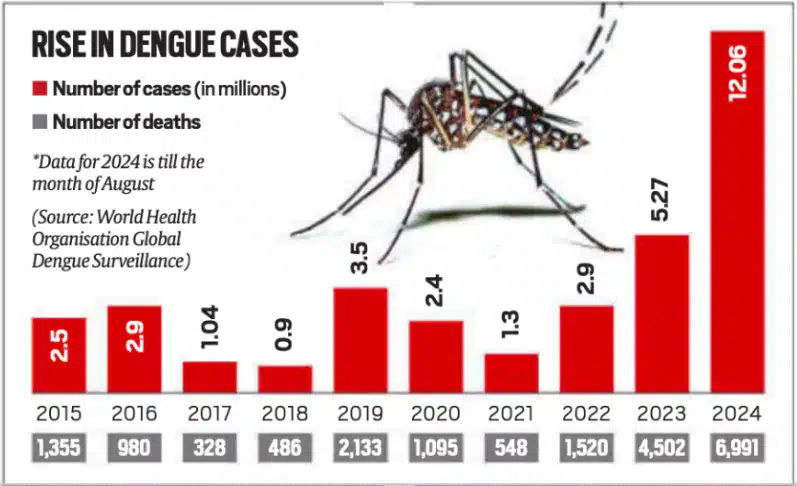
She’s one of 14.3 million people who contracted dengue in 2024—the highest number ever recorded and reported to WHO’s global dengue surveillance system. The virus killed 10,576 people that year across 112 countries.
And those numbers are rising faster than any other communicable disease on Earth.
What Dengue Actually Is
Dengue is a viral infection spread by mosquitoes—specifically Aedes aegypti and Aedes albopictus mosquitoes that bite during daytime, according to WHO’s comprehensive information on dengue.
The virus comes in four closely related types called serotypes. Infection with one serotype provides lifelong immunity against that specific type, but only partial and temporary protection against the other three. Here’s the terrifying part: evidence shows that sequential infections—getting dengue multiple times from different serotypes—significantly increases the risk of developing severe dengue.
Most people experience what doctors call “flu-like symptoms” that appear 4-10 days after an infected mosquito bite. Fever, severe headaches, pain behind the eyes, muscle and joint pain, nausea and vomiting, rash, and profound fatigue dominate the clinical picture.
For most, dengue is self-limiting. They feel absolutely terrible for a week or two, then recover completely.
But for some—no one can predict who—the disease progresses to severe dengue. Respiratory distress develops. Bleeding starts from nose and gums. Blood pressure drops rapidly, leading to shock. Internal organs begin failing. Without prompt medical intervention, death follows.
Dr. James Chen, who treats dengue patients in Singapore, described the unpredictability: “You can have two seemingly identical patients—same age, same health status, same viral load. One recovers in a week. The other crashes into severe dengue and ends up in intensive care. We still don’t fully understand why.”
Sound case management in hospitals has reduced dengue case-fatality rates to less than 1% in most affected countries. But that requires access to healthcare, trained medical staff, and adequate resources—luxuries many dengue-endemic regions lack.
The Staggering Scale of the Crisis
The numbers are jaw-dropping. Annual dengue incidence is estimated at 100 million symptomatic cases globally, with another 300 million asymptomatic infections that never get diagnosed or reported, according to WHO’s fact sheet on dengue.
The greatest burden falls on Asia, which accounts for 75% of cases, followed by Latin America and Africa.
But 2024 shattered all previous records. The 14,305,764 cases reported represented a staggering increase compared to previous years. WHO declared dengue a Grade 3 emergency in 2023 after outbreaks exploded in several countries simultaneously.
Consider this: dengue is increasing at a faster rate than any other communicable disease. Over the 24-year period from 2000 to 2024, incidence has skyrocketed.
What’s driving this explosion?
Climate change sits at the top of the list. Rising temperatures allow mosquitoes to expand their range northward and to higher elevations. Heat waves and changing precipitation patterns create ideal breeding conditions. Longer warm seasons mean longer transmission periods.
Unplanned urbanization concentrates susceptible populations in mosquito-friendly environments—crowded cities with inadequate water management, poor housing, and limited sanitation create perfect conditions for Aedes mosquitoes to thrive.
Lack of sustained vector control lets mosquito populations explode unchecked. Many countries abandoned systematic mosquito control programs decades ago. The consequences are now evident.
International travel and trade spread both mosquitoes and dengue viruses globally. A mosquito infected in Bangkok can end up in Buenos Aires via air cargo. A traveler infected in Manila can import the virus to Milan.
For more on climate impacts on infectious diseases, see our article on climate change and global health.
No Cure, Limited Prevention
Here’s the frustrating reality: no specific antiviral treatments exist for dengue.
When Maria Rodriguez arrived at the hospital with severe dengue, doctors couldn’t give her anything to kill the virus. They could only manage her symptoms—bring down fever with acetaminophen, replace fluids intravenously, monitor her closely, and hope her immune system would fight off the infection before organ failure occurred.
Aspirin and ibuprofen are strictly avoided in dengue patients because they increase bleeding risk—potentially catastrophic in a disease that can already cause hemorrhaging.
The only vaccine currently available is Q-denga (TAK-003), which WHO recommends for children aged 6-16 years in settings with high dengue transmission intensity. The vaccination course consists of two injections given three months apart.
But this vaccine has limitations. It’s not approved for all age groups. It’s not available everywhere. It doesn’t provide 100% protection. And it requires two doses, making widespread implementation challenging.
That leaves prevention focused on the mosquitoes themselves.
Fighting the Mosquito
The best way to prevent dengue is avoiding mosquito bites during daytime—unlike malaria mosquitoes that bite at night, Aedes mosquitoes are aggressive daytime biters.
WHO recommends several protective measures: wearing clothing that covers the body well (especially legs and feet), placing insect screens over doors and windows to keep mosquitoes out, applying insect repellents according to manufacturer instructions, sleeping under nets during daytime, and taking extra precautions if a family member is infected.
But individual protection alone won’t control dengue. Community-wide mosquito control is essential.
Aedes mosquitoes breed in standing water—as little as a bottle cap full of water can support larvae. Eliminating breeding sites requires cleaning surroundings and preventing water stagnation in and around homes. Flower pots, old tires, gutters, water storage containers, discarded containers—all become mosquito nurseries if not properly managed.
Dr. Raman Velayudhan, WHO’s dengue specialist, emphasized the challenge in a recent Science in 5 podcast: “Dengue mosquitoes have adapted brilliantly to urban environments. They breed in human habitats, bite during the day when people are active, and can complete their entire lifecycle in small containers around homes. Controlling them requires sustained community engagement and political commitment.”
Many countries have tried and failed to sustain effective vector control programs. Initial success gets undermined by funding cuts, staff reductions, political disinterest, and community fatigue with mosquito prevention measures.
The Diagnostic Challenge
Early and accurate diagnosis matters enormously for dengue management, yet diagnostic capacity remains inadequate in many endemic regions.
WHO recently established a Dengue Expert Review Panel for Diagnostics and published interim guidance on laboratory testing to improve diagnostic capabilities globally.
The challenge is that dengue symptoms mimic many other diseases—Zika, chikungunya, yellow fever, influenza. Clinical diagnosis alone often misses or misclassifies cases. Laboratory confirmation requires specific tests that many facilities don’t have.
Rapid diagnostic tests exist but vary widely in quality and accuracy. WHO’s new expert panel aims to evaluate and recommend reliable diagnostics, particularly for resource-limited settings where dengue burden is highest.
Recent Global Response
In July 2025, WHO released new clinical management guidelines for arboviral diseases covering dengue, chikungunya, Zika, and yellow fever—all spread by the same mosquito species.
These integrated guidelines recognize that in many regions, multiple arboviruses circulate simultaneously, making clinical management more complex.
WHO also published policy considerations for strengthening preparedness and response to arbovirus epidemics and pandemics, acknowledging that dengue and related diseases represent growing pandemic threats.
The WHO Academy now offers a self-learning course on clinical diagnosis and management of dengue, aiming to build healthcare worker capacity globally.
What Must Happen
The dengue crisis will worsen without urgent action across multiple fronts.
Countries must strengthen surveillance systems to detect outbreaks early and track transmission patterns through WHO’s global dengue surveillance dashboard.
Sustained vector control programs need political commitment and adequate funding—not just reactive spraying during outbreaks, but year-round integrated approaches combining breeding site elimination, larvicides, and community engagement.
Climate adaptation strategies must account for expanding dengue risk zones as mosquitoes colonize previously unaffected regions.
Vaccine development needs acceleration, with new candidates targeting broader age groups and providing stronger, longer-lasting protection.
Antiviral drug development requires investment—we desperately need specific treatments, not just symptom management.
Community engagement remains fundamental to success, as noted in WHO’s work on engaging communities to sustain dengue vector control.
For more articles on emerging infectious disease threats, visit ObserverVoice.com.
The Bottom Line
Dengue infected over 14 million people in 2024, killing more than 10,000. It’s spreading faster than any other communicable disease, driven by climate change, urbanization, and mosquito expansion.
No cure exists. Only one vaccine is available with limited application. Prevention relies on mosquito control—notoriously difficult to sustain.
The crisis will worsen before it improves unless countries recognize dengue as the serious public health emergency it represents and commit resources to comprehensive, sustained response.
Back to Maria Rodriguez: she survived severe dengue after five days in intensive care. Six months later, she still experiences fatigue and joint pain. She now sleeps under a mosquito net during afternoon naps, religiously empties standing water around her home, and tells everyone she knows that dengue is not just “a bad flu.”
“I nearly died from a mosquito bite,” she said. “A mosquito. That should terrify people more than it does.”
She’s right. It should.
Frequently Asked Questions (FAQs)
Dengue is a viral infection spread by Aedes aegypti and Aedes albopictus mosquitoes that bite during daytime. It’s caused by any one of four closely related dengue viruses (serotypes). The infection produces symptoms ranging from mild to severe, including fever, severe headaches, pain behind the eyes, muscle and joint pain, nausea, vomiting, rash, and fatigue appearing 4-10 days after an infected mosquito bite. In severe cases, patients can develop respiratory distress, bleeding, and life-threatening shock. Unlike malaria mosquitoes that bite at night, dengue mosquitoes are aggressive daytime biters that often live in and around homes. Learn more at WHO’s dengue information page.
Dengue is increasing faster than any other communicable disease globally. In 2024, WHO recorded the highest levels ever with 14,305,764 cases and 10,576 deaths reported from 112 countries. Annual dengue incidence is estimated at 100 million symptomatic cases with another 300 million asymptomatic infections. The greatest burden is in Asia (75%), followed by Latin America and Africa. WHO graded dengue as a Grade 3 emergency in 2023 after major outbreaks. Climate change, unplanned urbanization, lack of sustained vector control, and international travel are driving the explosion. Track current cases at WHO’s global dengue surveillance dashboard.
There is no specific antiviral treatment for dengue—only symptom management with acetaminophen for fever (aspirin and ibuprofen must be avoided as they increase bleeding risk). Only one vaccine is currently available: Q-denga (TAK-003), which WHO recommends for children aged 6-16 years in settings with high dengue transmission intensity. The vaccination course consists of two injections given three months apart. However, this vaccine has limitations—it’s not approved for all ages, not available everywhere, and doesn’t provide complete protection. Recovery from one serotype provides lifelong immunity against that serotype but only partial protection against the other three, and sequential infections increase severe dengue risk.
Prevention focuses on avoiding mosquito bites and eliminating breeding sites. WHO recommends wearing clothing that covers the body well, placing insect screens over doors and windows, applying insect repellents, and sleeping under nets during daytime. Since Aedes mosquitoes breed in standing water, communities must eliminate breeding sites by cleaning surroundings and preventing water stagnation in flower pots, old tires, gutters, water containers, and discarded items. Community-wide vector control requires sustained effort—initial success often fails due to funding cuts and waning commitment. See WHO’s frequently asked questions for detailed prevention strategies.
Multiple factors drive dengue expansion. Climate change allows mosquitoes to colonize previously unsuitable regions—rising temperatures enable survival at higher latitudes and elevations, while changing precipitation patterns create ideal breeding conditions. Unplanned urbanization concentrates susceptible populations in mosquito-friendly environments with inadequate water management. International travel and trade spread infected mosquitoes and viruses globally. Lack of sustained vector control lets mosquito populations explode unchecked. Heat waves and longer warm seasons extend transmission periods. WHO’s policy considerations for arbovirus preparedness address these challenges. Dengue is appearing in regions that never experienced it before, requiring global vigilanc
- WHO Dengue and Severe Dengue Information Hub
- WHO Fact Sheet on Dengue
- WHO Global Dengue Surveillance Dashboard
- WHO Clinical Management Guidelines for Arboviral Diseases
- WHO Laboratory Testing for Dengue Virus
- Dengue Information for Travelers
- Science in 5 Podcast: Dengue Fever
Disclaimer: This article is an adaptation of publicly available information from WHO’s Dengue and severe dengue health topic page (WHO, Geneva. Licence: CC BYNC-SA 3.0 IGO). WHO is not responsible for the
content or accuracy of this adaptation. This content is for informational and educational purposes
only and does not constitute medical advice. ObserverVoice.com is a news and information platform
— not a healthcare provider.
Observer Voice is the one stop site for National, International news, Sports, Editor’s Choice, Art/culture contents, Quotes and much more. We also cover historical contents. Historical contents includes World History, Indian History, and what happened today. The website also covers Entertainment across the India and World.

