

Cholera: Why a treatable disease still kills thousands when clean water would stop it
Cholera: The disease that kills in hours but has a 99% survival rate

The text message came at 3 AM.
Dr. Hassan, working with an aid organization in Yemen, watched five patients arrive within an hour. All with the same devastating symptoms—severe watery diarrhea, vomiting, rapid dehydration. By dawn, seven more had arrived. Then twelve more.
“Once you see your first cholera outbreak,” he told me later, “you never forget it. People arrive walking and can be dead within hours if you don’t act fast. But here’s the thing—almost everyone survives if you catch them in time.”
That’s the paradox of cholera. It’s terrifying, spreads rapidly, can kill with shocking speed. Yet it’s also one of the easiest diseases to treat and entirely preventable.
So why does it still kill up to 143,000 people every year?
The Numbers Behind the Crisis
Every year, somewhere between 1.3 and 4 million people contract cholera. That massive range itself tells you something—cholera hits hardest in places with weak health systems that can’t track cases properly.
Deaths range from 21,000 to 143,000 annually. The real number probably sits somewhere in that terrible uncertainty.
But here’s what we know for certain: cholera is what health experts call “an indicator of inequity and lack of social development.” Translation: cholera thrives where poverty exists, where clean water is scarce, where sanitation systems don’t work.
The disease doesn’t strike randomly. It targets communities failed by infrastructure, governments, and development.
What Actually Happens
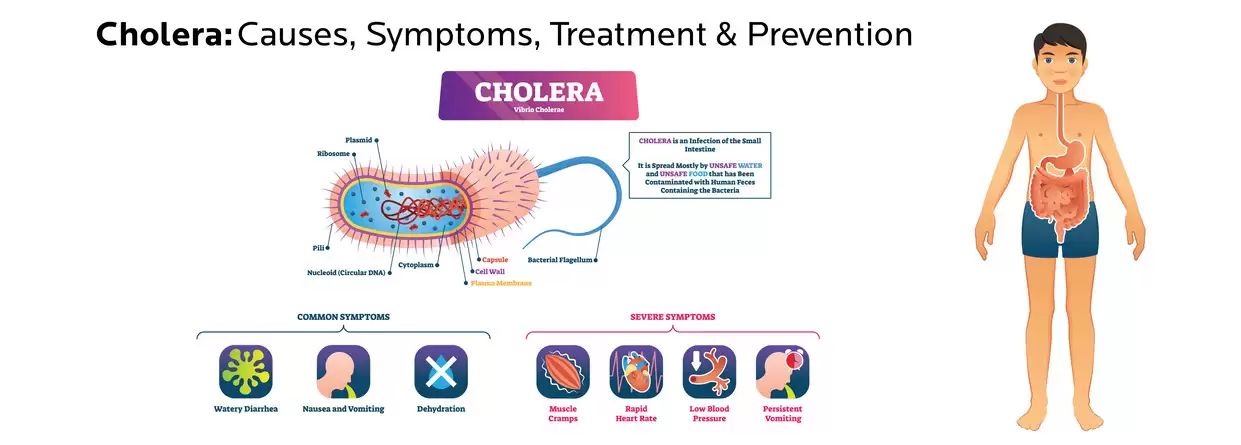
Cholera is caused by a bacterium called Vibrio cholerae. It lives in water contaminated with feces from infected people.
You consume contaminated water or food. The bacteria multiply in your intestines. Between 12 hours and 5 days later, symptoms hit.
For most people, nothing happens. That’s the sneaky part. Most infected individuals develop no symptoms whatsoever. But they shed bacteria in their feces for up to ten days, contaminating water sources and spreading disease to others.
For the unlucky ones who do get sick, cholera causes severe acute watery diarrhea. We’re not talking normal stomach upset. We’re talking catastrophic fluid loss—liters of liquid pouring out of the body.
Severe dehydration follows rapidly. Skin loses elasticity. Eyes sink. Blood pressure drops. Organs begin failing.
Without treatment, death can occur within hours. In severe cases, previously healthy people can go from first symptoms to death in less than a day.
With treatment, the survival rate exceeds 99%.
Let that gap sink in. The difference between 99% survival and rapid death depends entirely on whether you can access basic medical care.
The Treatment That Changed Everything
The beautiful simplicity of cholera treatment is that you don’t need fancy medicines.
The main treatment is rehydration—replacing the fluids and salts the body is losing. Oral rehydration solution (ORS)—a precise mixture of water, sugar, and salts—saves most lives.
Patients drink constantly, replacing what they’re losing. In severe cases, healthcare workers give intravenous fluids. Antibiotics can shorten the illness duration and reduce fluid requirements.
That’s essentially it. Rehydrate. Monitor. Support. Almost everyone survives.
Dr. Hassan described his treatment center in Yemen: “We had dozens of patients lying on cots with buckets beneath them, catching the diarrhea. IVs running constantly. It looked medieval, honestly. But nearly everyone walked out alive because we could give them fluids.”
The treatment is cheap, doesn’t require expensive equipment, and can be delivered even in basic facilities.
So why do people still die?
The Distance to Treatment
Distance kills.
In wealthy countries with universal healthcare, anyone experiencing cholera symptoms can reach a hospital quickly. Ambulances come. ERs are equipped. Treatment starts immediately.
In poor rural areas of developing countries, reaching healthcare can take hours or days. Some families live a full day’s walk from the nearest clinic. They have no vehicle, no phone to call for help, no money for transport.
By the time they arrive, severe dehydration has already done its damage. Organs are shutting down. The treatment window has narrowed or closed.
I heard about a mother in South Sudan who carried her daughter six hours to a clinic. The child died an hour before they arrived. The clinic had all the supplies needed to save her. They were just six hours too far away.
The Water Problem
Here’s the root cause: cholera spreads through contaminated water and food.
About one billion people worldwide lack access to basic water services. They drink from rivers, ponds, wells, or communal sources that may be contaminated. They have no choice.
Inadequate sanitation means human waste contaminates water sources. Open defecation, broken sewage systems, improper waste disposal—all create conditions for cholera to spread.
One infected person without access to proper toilets can contaminate water used by hundreds of others. In crowded settlements, refugee camps, slums, or areas with collapsed infrastructure, the disease spreads explosively.
The WHO identifies cholera as “often predictable and preventable.” We know exactly where cholera lurks. We know which communities lack clean water. We know when conditions create outbreak risk.
Yet outbreaks still surprise authorities, overwhelm health systems, and kill thousands.
The Vaccine That Helps But Isn’t Enough
Since 2013, the global cholera vaccine stockpile has distributed over 50 million doses of oral cholera vaccine (OCV).
The vaccine works. It’s safe. It provides protection for several years. Mass vaccination campaigns in high-risk areas have prevented countless outbreaks.
But—and this is crucial—vaccination is just one tool. It’s a bridge, not a solution.
The real solution is clean water, functioning sanitation, and good hygiene practices sustained for entire populations. Vaccines protect people while these permanent infrastructure improvements happen.
The problem is the infrastructure improvements often don’t happen. Countries in crisis, facing conflict, natural disasters, or extreme poverty can’t build water systems or sewage treatment plants.
So vaccines provide temporary protection in communities that should have permanent solutions.
The Invisible Carriers
Here’s what makes cholera particularly difficult to control: most infected people don’t know they’re infected.
You can have Vibrio cholerae multiplying in your intestines, shedding into your feces for ten days, contaminating water sources, spreading disease—and feel completely fine.
This means you can’t stop cholera simply by identifying and treating sick people. You have to address the water and sanitation systems everyone uses.
A single asymptomatic carrier using an open latrine near a water source can trigger an outbreak affecting thousands.
Why Cholera Outbreaks Are Growing
The recent trend is disturbing. Cholera has been killing more people for two consecutive years.
Climate change is expanding the areas where cholera can thrive. Rising temperatures allow the bacteria to survive in waters previously too cold. Floods contaminate clean water sources. Droughts force people to use questionable water supplies.
Conflict and displacement create perfect conditions for outbreaks. Refugee camps, overcrowded with inadequate sanitation and water systems, become cholera powder kegs. War destroys infrastructure that took decades to build.
Poverty persists. Despite global development efforts, massive populations still lack basic services.
The gap between what we know how to do and what actually happens continues widening.
What Needs to Happen
The solution is straightforward, if expensive and complex.
Provide clean water to every community. This means wells, water treatment systems, distribution networks, maintenance. It requires massive infrastructure investment.
Ensure proper sanitation for all. Build toilets, sewage systems, waste treatment facilities. Maintain them. Make them accessible to the poorest communities.
Promote hygiene education. Teach handwashing with soap. Explain how disease spreads. Make hygiene practices culturally appropriate and sustainable.
Use vaccination strategically in high-risk areas and during outbreaks. The vaccine buys time for permanent solutions.
Strengthen health systems to detect outbreaks early, respond rapidly, and treat cases effectively.
Develop multisectoral cholera control plans bringing together water, sanitation, health, education, and urban planning sectors.
None of this is mysterious. We know what works. We’ve eliminated cholera from wealthy countries using these exact approaches.
The question is political will and resource allocation.
The Progress That’s Possible
Some countries have made remarkable progress. Bangladesh, once devastated by cholera, has dramatically reduced deaths through improved water systems and rapid response capabilities.
Rwanda invested heavily in rural water infrastructure and sanitation. Cholera cases plummeted.
The global community has proven that rapid response to outbreaks saves lives. When detection is quick, treatment centers deploy fast, and vaccination campaigns reach communities, death tolls stay low.
But success requires sustained commitment. Infrastructure must be maintained. Systems must work during crises. The poorest communities must be prioritized, not forgotten.
Back to Dr. Hassan’s Text Message
That outbreak in Yemen eventually affected over 1,000 people in Dr. Hassan’s district. His team worked around the clock, running rehydration stations, distributing ORS, educating communities about safe water.
The death rate stayed under 1% because treatment reached people quickly.
“Cholera shows you exactly what healthcare inequality looks like,” Dr. Hassan said. “The same disease that’s been eliminated from rich countries still devastates poor ones. Not because we don’t know how to stop it. Because we choose not to invest in the infrastructure and systems that would.”
Cholera can ultimately be eliminated everywhere. We just have to actually do it.
For more information:
- WHO Cholera Fact Sheet
- Global Task Force on Cholera Control
- Cholera Outbreak Resources
- Water, Sanitation and Hygiene
Disclaimer: This article is an adaptation of publicly available information from WHO’s Cholera
health topic page (WHO, Geneva. Licence: CC BYNC-SA 3.0 IGO). WHO is not responsible for the
content or accuracy of this adaptation. This content is for informational and educational purposes
only and does not constitute medical advice. ObserverVoice.com is a news and information platform
— not a healthcare provider.
Observer Voice is the one stop site for National, International news, Sports, Editor’s Choice, Art/culture contents, Quotes and much more. We also cover historical contents. Historical contents includes World History, Indian History, and what happened today. The website also covers Entertainment across the India and World.

