

Osteoarthritis: Inflammation, Causes, and What Actually Helps

For decades, doctors described osteoarthritis as simple wear and tear — a mechanical breakdown of joints caused by years of use. The message was discouraging. Joints wore out like parts on an old machine, and there was little to do except manage the pain and wait for things to get worse. However, science has moved on significantly from this outdated view.
Osteoarthritis is now understood as a complex disease involving chronic low-grade inflammation, immune cell activity, and biological changes across the entire joint — not just the cartilage. The bone underneath the cartilage changes. The fluid-filled lining of the joint becomes inflamed. Nerves within the joint become sensitised. As a result, osteoarthritis is far more than mechanical wearing down — it is a dynamic disease process that responds to treatment in meaningful ways.
Osteoarthritis inflammation causes treatment helps is the central theme of this article. Understanding the real biology of osteoarthritis — what is actually happening inside affected joints — changes what patients and doctors can do about it. Furthermore, evidence-based treatments now exist that genuinely reduce pain, slow joint damage, and significantly improve quality of life. Consequently, the message is no longer simply to accept decline. It is to understand, act, and live better despite this condition.
Quick Answer
Osteoarthritis is a chronic joint disease involving cartilage breakdown, bone changes, and low-grade inflammation — not simply wear and tear. It causes pain, stiffness, and reduced joint function. The most effective treatments combine exercise, weight management, pain-relieving medications, and — when needed — injections or surgery to restore joint function and quality of life.
What Osteoarthritis Really Is
Beyond Wear and Tear
The traditional wear-and-tear model of osteoarthritis described the cartilage — the smooth, rubbery tissue covering the ends of bones inside joints — gradually wearing away with use. However, this model fails to explain why osteoarthritis affects some people heavily and others not at all. It fails to explain why inflammation plays such a prominent role. Furthermore, it fails to explain why the same person can have severe symptoms in one knee and almost none in the other.
Modern research shows that osteoarthritis involves a complex biological process. Cartilage cells — called chondrocytes — begin producing inflammatory chemicals called cytokines when stressed or damaged. These cytokines attract immune cells into the joint and activate the synovium — the membrane that lines the joint and produces lubricating fluid. The activated synovium produces more inflammatory chemicals and enzymes that accelerate cartilage breakdown. Moreover, the bone beneath the cartilage responds to altered loading by changing its structure — becoming thicker in some areas and developing outgrowths called osteophytes, or bone spurs.
The Whole Joint Is Involved
Osteoarthritis affects every structure within a joint simultaneously. Cartilage thins and develops cracks. The synovial membrane becomes inflamed — a process called synovitis — and produces excess joint fluid, causing swelling. The bone underneath changes density and structure. Ligaments and tendons around the joint stiffen. Furthermore, the nerves within and around the joint become sensitised, amplifying pain signals beyond what tissue damage alone would produce.
Consequently, osteoarthritis is not a disease of cartilage alone — it is a disease of the entire joint organ. This understanding explains why exercise, weight management, and medications targeting inflammation all produce meaningful benefit. For context on how inflammatory conditions affect multiple organ systems, see our article on lupus nephritis — when lupus attacks the kidneys.
Causes and Risk Factors
Age and Biology
Osteoarthritis inflammation causes treatment helps begins with understanding why certain people develop the condition. Age is the strongest risk factor. As people age, cartilage cells lose some of their ability to repair damage effectively. Furthermore, the water content and composition of cartilage changes — making it stiffer, less resilient, and more prone to breakdown under load.
However, age alone does not cause osteoarthritis. Many people reach their eighties with healthy joints. Therefore, biological changes associated with ageing create vulnerability — but other factors determine whether the disease actually develops.
Excess Weight and Joint Loading
Excess body weight is one of the most powerful modifiable risk factors for osteoarthritis — particularly of the knee and hip. Every extra kilogram of body weight places roughly four additional kilograms of force on the knee joint during walking. As a result, the cartilage in overweight people experiences far greater stress with every step. Moreover, fat tissue — called adipose tissue — is not metabolically inert. It actively produces inflammatory chemicals — particularly interleukin-6 and tumour necrosis factor — that drive joint inflammation systemically, not just locally.
Consequently, the link between obesity and osteoarthritis is both mechanical and inflammatory. This explains why osteoarthritis also affects the hands — a non-weight-bearing joint — in people with obesity, where pure mechanical loading cannot be the explanation. Therefore, weight loss is one of the most powerful interventions available for knee and hip osteoarthritis, producing benefits through both mechanical and anti-inflammatory pathways simultaneously.
Injury, Genetics, and Other Factors
Previous joint injury significantly increases osteoarthritis risk in the affected joint. Anterior cruciate ligament tears, meniscal injuries, and fractures involving joint surfaces all accelerate cartilage breakdown in the years and decades following the initial injury. Furthermore, occupations involving repeated knee bending, heavy lifting, or prolonged kneeling — such as farming, mining, and construction — carry elevated knee osteoarthritis risk.
Genetics contributes to osteoarthritis susceptibility — particularly for hand and knee osteoarthritis. Studies of twins show that genetic factors account for roughly 40 to 65% of osteoarthritis risk. Moreover, female sex is an independent risk factor — osteoarthritis is more common and more severe in women, particularly after menopause. Consequently, the combination of postmenopausal hormonal changes and the established bone density risks of that period links osteoarthritis risk closely to bone health. For more on how bone and joint health interrelate after menopause, see our article on osteoporosis — how bones lose density and what reverses it.
Symptoms of Osteoarthritis
Pain and Stiffness
Osteoarthritis inflammation causes treatment helps patients most when they recognise its symptoms early. Joint pain is the defining symptom. It typically worsens with activity and improves with rest — at least in the early stages. However, in more advanced disease, pain also occurs at rest and during the night. Furthermore, the character of pain in osteoarthritis is complex — it reflects both tissue damage within the joint and central sensitisation — a process in which the nervous system amplifies pain signals beyond their source.
Morning stiffness lasting up to 30 minutes is characteristic of osteoarthritis and helps distinguish it from inflammatory arthritis — such as rheumatoid arthritis — where morning stiffness typically lasts longer than 30 minutes. In addition, a brief period of stiffness after sitting called “gelling” — where joints feel stiff and painful after a period of inactivity — is a hallmark feature that many people with osteoarthritis recognise immediately.
Physical Changes and Functional Impact
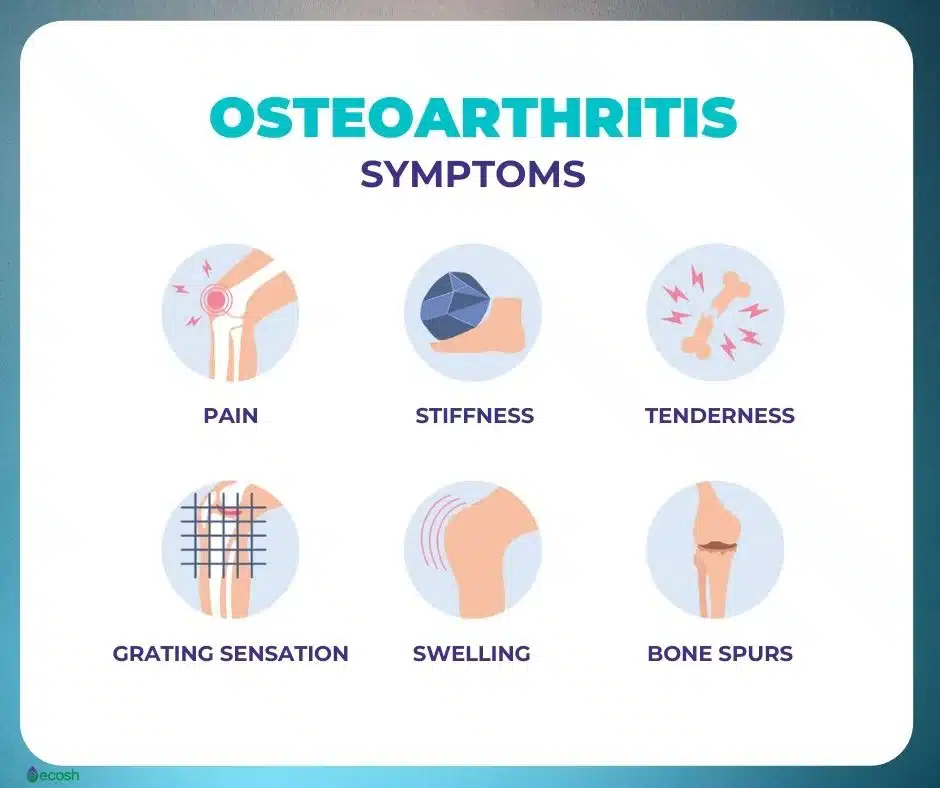
As osteoarthritis progresses, physical changes in affected joints become visible and palpable. Bony enlargements — the osteophytes formed at joint margins — produce a knobbly appearance, particularly noticeable in the finger joints. Swelling from excess joint fluid causes visible puffiness around the knee. A creaking or grating sensation — called crepitus — occurs as roughened joint surfaces move against each other.
Reduced range of movement develops as pain and joint changes limit the full arc of motion. Consequently, everyday activities — climbing stairs, getting up from a chair, opening jars, and walking distances — become progressively more difficult. In severe cases, functional limitation affects independence and significantly impairs quality of life. Moreover, chronic pain and reduced activity drive a cycle of muscle weakness, weight gain, and further joint loading that accelerates the disease if not actively interrupted.
How Doctors Diagnose Osteoarthritis
Clinical Assessment
Osteoarthritis is primarily a clinical diagnosis — meaning doctors base it mainly on the patient’s history and physical examination findings rather than on tests alone. A person’s age, symptom pattern, affected joints, and physical examination findings typically provide sufficient evidence for a confident diagnosis.
Doctors examine affected joints for tenderness, swelling, crepitus, reduced range of movement, and bony enlargement. The pattern of joint involvement provides diagnostic clues — osteoarthritis characteristically affects the knees, hips, hands — particularly the base of the thumb and the end finger joints — and the spine. In contrast, rheumatoid arthritis typically affects the knuckles and wrist joints symmetrically, which helps distinguish the two conditions clinically.
Imaging and Blood Tests
X-rays of affected joints confirm the diagnosis and assess severity. The classic X-ray findings of osteoarthritis include narrowing of the joint space — reflecting cartilage loss — osteophyte formation, hardening of the bone below the cartilage — called subchondral sclerosis — and cyst formation within the bone. Furthermore, MRI provides more detailed imaging of cartilage, synovium, and bone marrow changes and is particularly useful when the diagnosis is unclear or when surgical planning is needed.
Blood tests do not diagnose osteoarthritis directly. However, doctors often order them to exclude other causes of joint pain — particularly inflammatory arthritis conditions including rheumatoid arthritis and gout. Consequently, a normal inflammatory marker level — particularly CRP and ESR — in a person with typical joint findings supports osteoarthritis rather than an inflammatory arthritis diagnosis. For context on how kidney function tests fit into a broader joint disease assessment, see our article on chronic kidney disease — stages, symptoms, and how to slow the decline.
Treatment of Osteoarthritis
Exercise — The Single Most Important Treatment
Exercise is the most evidence-supported treatment for osteoarthritis. It produces benefits that no medication can fully replicate. It strengthens the muscles around affected joints — reducing the load transferred to the cartilage during movement. Furthermore, exercise reduces pain through the release of natural pain-modulating chemicals in the nervous system. It also improves joint lubrication through synovial fluid circulation and reduces systemic inflammation.
Aerobic exercise — including walking, cycling, and swimming — improves cardiovascular fitness and supports weight management. Resistance training — using weights or resistance bands — builds the muscle strength that protects joints most directly. Moreover, flexibility and balance exercises reduce fall risk and improve functional movement patterns. Consequently, a combination of all three exercise types produces the most comprehensive benefit.
Many people fear that exercise will accelerate joint damage. However, evidence consistently shows the opposite — regular moderate exercise is safe and beneficial for osteoarthritic joints. Therefore, the guidance from every major osteoarthritis guideline worldwide is clear: movement is medicine.
Weight Management
Losing excess body weight is one of the most powerful disease-modifying interventions available for knee and hip osteoarthritis. Clinical trials show that losing just 10% of body weight produces roughly 28% reduction in pain and significant improvement in physical function. Moreover, the combination of exercise and weight loss produces greater benefit than either intervention alone. Consequently, every kilogram of weight lost reduces knee joint load by four kilograms — a substantial cumulative reduction over thousands of steps per day.
Pain-Relieving Medications
When exercise and weight management alone provide insufficient pain relief, medications help manage symptoms and support continued activity. Paracetamol — used at the correct dose — provides modest pain relief with a good safety profile. However, it is less effective for osteoarthritis than previously believed and should not be considered a first-line solution in isolation.
Topical NSAIDs — anti-inflammatory drugs applied as a gel or cream directly to the affected joint — provide meaningful local pain relief with minimal systemic absorption. They are the preferred first pharmacological option for knee and hand osteoarthritis. Oral NSAIDs — including ibuprofen and naproxen — produce greater pain relief but carry gastrointestinal, cardiovascular, and kidney risks with prolonged use. Consequently, they should be used at the lowest effective dose for the shortest necessary period. For context on how NSAID use can affect kidney function, see our article on chronic kidney disease — stages, symptoms, and how to slow the decline.
Injections and Joint Procedures
Intra-articular corticosteroid injections — injections of anti-inflammatory steroid medication directly into the joint — provide significant short-term pain relief, typically lasting four to twelve weeks. They are particularly useful for managing flares of severe pain and for people who cannot tolerate oral medications. However, repeated injections may accelerate cartilage loss over time. Consequently, most guidelines recommend limiting them to three or four per year in any single joint.
Hyaluronic acid injections — placing a substance similar to natural joint fluid into the knee — aim to restore joint lubrication. Evidence for their effectiveness is mixed, but some patients experience meaningful pain reduction lasting three to six months. Furthermore, platelet-rich plasma injections — a newer technique using concentrated growth factors from the patient’s own blood — show promising results in early clinical trials, though evidence remains insufficient for routine recommendation at this stage.
Joint Replacement Surgery
Joint replacement surgery — replacing the damaged joint surfaces with metal and plastic components — is the most effective intervention for severe end-stage osteoarthritis that has not responded to conservative management. Total knee and total hip replacement consistently produce outstanding results — reducing pain dramatically, restoring function, and improving quality of life in the vast majority of patients.
Modern implants last 15 to 20 years in most patients. Moreover, surgery is not a last resort to be feared — it is a highly effective treatment option for people whose quality of life is severely compromised by joint disease. Consequently, the decision to pursue surgery should focus on individual functional limitations and goals rather than on age or disease severity alone.
Living Well With Osteoarthritis
Self-Management and Daily Strategies
Osteoarthritis is a long-term condition that responds enormously to active self-management. Pacing activities — balancing periods of activity with rest — reduces pain flares without encouraging inactivity. Using assistive devices — walking aids, jar openers, raised toilet seats — reduces joint stress during daily tasks. Furthermore, applying heat before exercise loosens stiff joints, and applying ice after activity reduces post-exercise inflammation and swelling.
Sleep disturbance from overnight joint pain is common in osteoarthritis and worsens pain perception the following day. Consequently, optimising sleep — through comfortable positioning, supportive pillows, and treating pain before bed — is an underappreciated component of comprehensive osteoarthritis management. For broader context on how chronic conditions affect multiple body systems in ageing adults, see our articles on overactive bladder — causes, treatments, and what is going on — and benign prostatic hyperplasia — the enlarged prostate explained.
Psychological Wellbeing
Chronic pain from osteoarthritis significantly increases the risk of depression and anxiety — particularly when pain limits activities that previously brought pleasure and social connection. Psychological support — including cognitive behavioural therapy for pain — produces meaningful improvements in pain coping, mood, and functional ability. Furthermore, patient education programmes that teach self-management skills significantly improve outcomes beyond medication and exercise alone. Consequently, addressing the psychological dimension of osteoarthritis is as important as managing its physical symptoms.
When to Seek Medical Help
See a doctor if joint pain persists for more than a few weeks, significantly limits daily activities, disrupts sleep, or fails to improve with paracetamol and gentle exercise. Furthermore, seek prompt medical attention if a joint becomes suddenly red, hot, severely swollen, and exquisitely tender — as this pattern may indicate gout or infectious arthritis rather than simple osteoarthritis flare.
Consequently, early specialist assessment — particularly from a rheumatologist or orthopaedic surgeon when symptoms are severe — ensures access to the full range of treatment options and prevents avoidable disability.
Frequently Asked Questions
1. Is osteoarthritis the same as rheumatoid arthritis?
No. Osteoarthritis and rheumatoid arthritis are different conditions with different causes. Osteoarthritis involves cartilage breakdown and low-grade joint inflammation driven by mechanical and metabolic factors. Rheumatoid arthritis is a systemic autoimmune disease in which the immune system attacks the joint lining across multiple joints simultaneously. Furthermore, rheumatoid arthritis typically causes prolonged morning stiffness, affects joints symmetrically, and shows elevated inflammatory markers in blood tests — features not typical of osteoarthritis. Consequently, accurate diagnosis is essential before treatment begins.
2. Can young people get osteoarthritis?
Yes. While osteoarthritis is more common in older adults, it can develop in younger people — particularly following significant joint injuries, in people with obesity, or in those with genetic predisposition. Furthermore, post-traumatic osteoarthritis — developing after ligament tears, fractures, or meniscal injuries — is a common cause of knee osteoarthritis in adults under 40. Consequently, joint injuries in young people deserve proper treatment and rehabilitation to minimise long-term osteoarthritis risk.
3. Does cold weather really make osteoarthritis worse?
Many people with osteoarthritis report worsening symptoms in cold and damp weather. While scientific evidence for this is not definitive, changes in barometric pressure — the pressure in the atmosphere — may affect joint fluid pressure and sensitised joint nerves in people with osteoarthritis. Furthermore, cold temperatures reduce activity levels, stiffen muscles and joints, and consequently worsen pain perception. Keeping warm, staying active, and maintaining indoor exercise routines during cold weather all help manage weather-related symptom fluctuations.
4. Are glucosamine and chondroitin supplements effective for osteoarthritis?
Evidence for glucosamine and chondroitin supplements is mixed. Some trials show modest benefit for knee pain — particularly the pharmaceutical-grade combination preparation studied in the GAIT trial. However, most regulatory agencies and rheumatology guidelines do not recommend them routinely because trial quality is variable and results are inconsistent. Furthermore, they are generally safe and well tolerated. Consequently, people who choose to try them should use them for three months and discontinue if no benefit is apparent.
5. When should a person consider joint replacement surgery for osteoarthritis?
Joint replacement surgery is appropriate when osteoarthritis pain significantly limits daily activities and quality of life, when non-surgical treatments have been adequately tried without sufficient relief, and when X-ray findings confirm severe joint damage consistent with the symptoms. Furthermore, age alone is not a reason to avoid surgery — older adults benefit from joint replacement as much as younger patients. Consequently, the decision should focus on individual functional limitations and goals rather than on age or arbitrary thresholds of disease severity.
References
- Rheumatoid Arthritis causes a wide variety of symptoms affecting joints and systemic health.
- Rheumatoid arthritis is a chronic autoimmune disease where the body’s immune system mistakenly attacks the synovial lining of joints, causing persistent inflammation and progressive joint damage.
- The good news is only a minority of people with hip pain will have something medically concerning or actually need surgery.
- Lateral knee pain disrupts the lives of millions of active people, especially when you have to run or cycle regularly.
- Calcium pyrophosphate deposition disease is a crystal-induced arthropathy characterised by the deposition of calcium pyrophosphate
Disclaimer
This article adapts publicly available information from WHO’s Osteoarthritis page. This content is for informational and educational purposes only and does not constitute medical advice. ObserverVoice.com is a news and information platform and not a healthcare provider.
Observer Voice is the one stop site for National, International news, Sports, Editor’s Choice, Art/culture contents, Quotes and much more. We also cover historical contents. Historical contents includes World History, Indian History, and what happened today. The website also covers Entertainment across the India and World.

