

India Maps Coastal Vulnerability Due to Climate Change

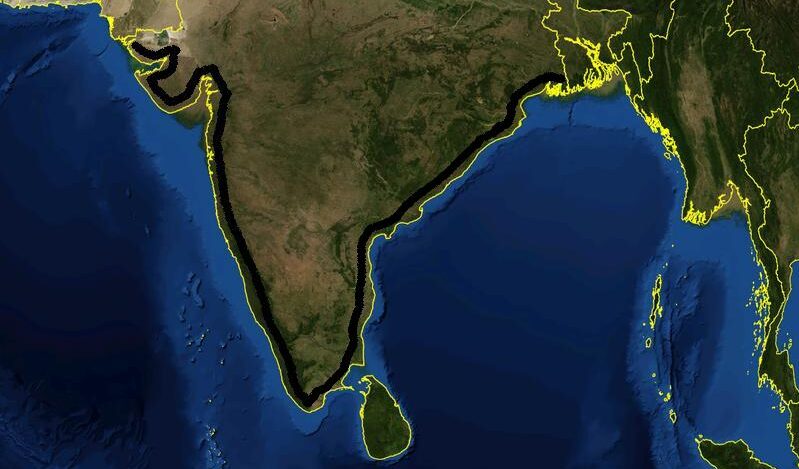
The Indian National Centre for Ocean Information Services (INCOIS) has undertaken a comprehensive mapping exercise known as Coastal Vulnerability Index (CVI) to understand how rising sea levels may impact the Indian coastline. By utilizing seven critical parameters, including shoreline change rates and coastal geomorphology, INCOIS has produced detailed maps that highlight potential vulnerabilities. An atlas featuring 156 maps of India’s coastline was first released in 2012, providing essential data for understanding coastal changes.
Further enhancing these efforts, studies focused on Multi Hazard Vulnerability Mapping have revealed areas at risk of coastal inundation on a more localized scale, utilizing data on extreme water levels and coastal erosion. The National Centre for Coastal Research (NCCR) has also been active, since 1990, in assessing sea erosion along India’s coastline and has published reports to aid governments in implementing shoreline protection measures effectively.
Coastal Erosion Insights
A significant report titled “National Assessment of Shoreline Changes along Indian Coast” was released in July 2018, marking a critical step in understanding coastal erosion patterns. The updated version of the atlas and associated reports was made public on March 25, 2022, revealing the alarming rates of erosion across various states. A summary of the data from 1990 to 2018 indicates that 33.6% of India’s coastal length is experiencing erosion, substantially affecting states like Kerala and Tamil Nadu.
Government Initiatives and Assistance
The Ministry of Jal Shakti is implementing flood management schemes, including those addressing coastal erosion, with state governments leading the execution using their resources. The central government assists states primarily through technical and advisory support. Over the years, the Ministry of Environment, Forest & Climate Change (MoEF&CC) has collaborated with the Survey of India to delineate a hazard line that outlines areas at risk due to climate change-induced shoreline shifts.
The Coastal Regulation Zone (CRZ) Notification, revised in 2019, aims to protect coastal regions while facilitating sustainable development. This notification establishes No Development Zones (NDZ) to safeguard against encroachment and erosion, emphasizing the importance of both engineering and natural solutions for coastal management.
Enhancing Coastal Resilience
To bolster structural measures against flooding, the government has continued its Flood Management and Border Areas Programme (FMBAP), which supports states in river management and anti-erosion efforts. Additionally, the Central Water Commission (CWC) provides flood forecasts to states, helping them prepare for potential inundation events.
In response to the increased risks associated with climate change, the government released the “Reference Manual on Climate Change Adaptation Guidelines for Coastal Protection” in March 2019, emphasizing both proactive and reactive strategies to mitigate risks. The guidelines call for integrating engineering methods with nature-based solutions for sustainable infrastructure.
Monitoring and Collaboration
To address the challenge of Glacial Lake Outburst Floods (GLOF), the National Disaster Management Authority (NDMA) has established protocols for monitoring and managing these risks. This includes regular satellite monitoring of glacial lakes and active collaboration among agencies to formulate effective disaster risk management plans.
The Central Water Commission, in partnership with MoES and NDMA, continues to develop early-warning systems to track the implications of climate change and enhance disaster preparedness across coastal and glacial regions in India.
Observer Voice is the one stop site for National, International news, Sports, Editor’s Choice, Art/culture contents, Quotes and much more. We also cover historical contents. Historical contents includes World History, Indian History, and what happened today. The website also covers Entertainment across the India and World.
Follow Us on Twitter, Instagram, Facebook, & LinkedIn

