

Why We Defend Systems That Actually Hurt Us

At Mumbai’s Cathedral School, there was a rule that seventeen-year-old Kavya and her classmates universally disliked: students were required to arrive at school by 7:00 AM sharp, thirty minutes before classes actually started, and sit silently in the assembly hall regardless of weather or circumstances. Missing the 7:00 AM deadline meant detention, even if you arrived before 7:30 AM when classes began. The rule caused daily stress—students woke at 5:30 AM to commute through heavy traffic, parents struggled with early morning schedules, and everyone spent thirty minutes sitting idle in the hall.
When a new principal arrived and asked students for feedback on school policies, most students initially stayed silent. When Kavya’s friend Rohan bravely raised his hand to suggest moving assembly to 7:30 AM to match class start time, the response from other students surprised him. Rather than supporting his reasonable suggestion, many classmates defended the existing rule:
“The 7:00 AM rule teaches us discipline and punctuality—it’s preparing us for real life,” said Priya.
“If we change it now, it wouldn’t be fair to all the students who followed it before us,” argued Arjun.
“Early arrival is a Cathedral tradition that makes us different from other schools,” insisted Meera.
“Students would become lazy if we made things easier. The strict rule builds character,” added Vikram.
Rohan was bewildered. “But we all complain about this rule every single morning! We’re exhausted from waking so early. We all agree it serves no real purpose. Why are you suddenly defending it now?”
The psychology teacher, who had been observing, later explained to Rohan: “You witnessed system justification—the psychological tendency to defend and rationalize existing systems, policies, and arrangements, even when those systems disadvantage you. Your classmates genuinely suffer from the 7:00 AM rule, yet when challenged, they found reasons to justify why this harmful rule is actually good, necessary, or fair. They did this because questioning the system feels threatening—it suggests that authorities might be wrong, that tradition might be unjust, that the way things are might not be the way things should be.”
She continued: “System justification makes people psychologically invested in defending status quo arrangements, even against their own interests. It’s comforting to believe that existing systems are fair, necessary, and legitimate—this makes the world feel predictable and just. Admitting that a system is unfair or unnecessary is psychologically uncomfortable because it suggests we’ve been complying with something unjust and that authorities we trust have maintained something harmful. So instead, we generate rationalizations for why the harmful system is actually beneficial. We defend the very arrangements that hurt us.”
This cognitive bias—defending existing systems and status quo even when they harm us—affects political views, economic policies, workplace practices, and any established arrangement. Understanding system justification reveals why social progress is difficult, why people vote against their economic interests, why workplace traditions persist despite being inefficient, and why disadvantaged groups sometimes defend the systems that disadvantage them.
What Is System Justification?
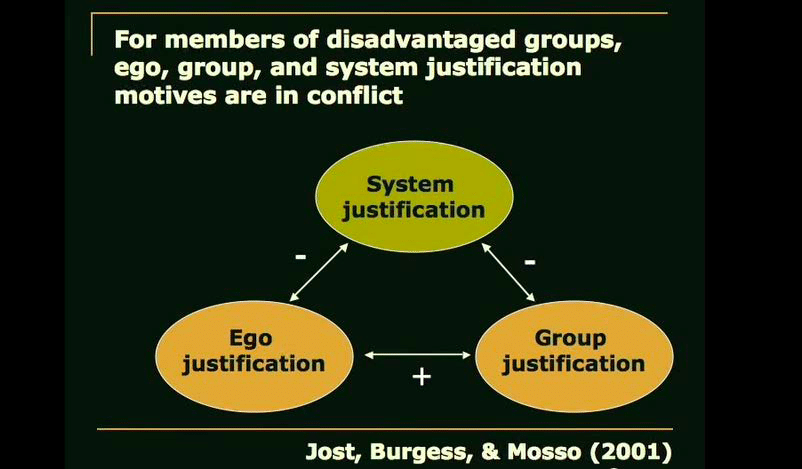
System justification is the psychological tendency to defend, rationalize, and bolster existing social, economic, and political systems, arrangements, and status quo, often even at the expense of personal and group interests. When confronted with evidence that a system is unfair, inefficient, or harmful, people don’t automatically demand change; instead, they often generate justifications for why the system is actually fair, necessary, or beneficial. This happens not only among people who benefit from existing arrangements (which would be self-interest) but also among those disadvantaged by them (which contradicts self-interest), revealing a psychological need to believe that existing systems are legitimate and justified.
The phenomenon was identified by social psychologist John Jost. Research at New York University demonstrated that people across socioeconomic classes, including those disadvantaged by existing economic systems, show tendency to view those systems as fair and legitimate. Poor people often defend economic inequality as necessary or deserved; women in highly unequal societies often defend gender hierarchies as natural and appropriate. This happens because system justification satisfies psychological needs for stability, predictability, and belief in a just world.
According to studies from Yale University, system justification operates through several mechanisms: reducing cognitive dissonance (accepting that you live in an unjust system is uncomfortable), satisfying existential needs (believing systems are legitimate reduces anxiety about social instability), and epistemic motives (wanting to understand and predict your environment, which is easier if you accept systems as they are). These needs make people rationalize existing arrangements rather than acknowledge their flaws.
Research from Harvard University demonstrates that system justification is particularly strong when: (1) the system feels unchangeable (making acceptance more psychologically necessary), (2) you depend on the system (making belief in its legitimacy comforting), (3) the system is threatened (triggering defensive justification), and (4) you lack power to change it (making acceptance preferable to frustration). These conditions make defending unjust systems psychologically attractive despite being objectively harmful.
The Parable of the Heavy Stones and the Village Path
A teaching tale tells of a village where the main path from homes to the well required carrying heavy stones. A tradition hundreds of years old dictated that each person walking to the well must carry a large stone and place it on a growing pile beside the path. The tradition began when the village’s founder, seeking to build a defensive wall, required stone collection. But the wall had been completed centuries ago, and the stone pile beside the path now served no purpose except to preserve tradition.
Carrying the heavy stones was burdensome—children struggled with the weight, elderly people suffered back pain, and pregnant women found the requirement dangerous. Everyone complained privately about how difficult and pointless the stone-carrying was. Yet the tradition continued generation after generation.
One day, a young woman named Anjali, returning from another village where no such tradition existed, asked at a village meeting: “Why do we carry stones? The wall was finished long ago. The pile beside the path serves no purpose. We’re all burdened by this tradition. Why don’t we stop?”
Instead of agreement, she faced resistance from the very people most burdened by the tradition:
An elderly man, whose back ached from decades of stone-carrying, said: “Carrying stones builds our children’s strength and character. It teaches discipline and respect for tradition.”
A mother, who worried about her pregnant daughter carrying stones, argued: “Our ancestors were wise to create this tradition. It connects us to our past and defines who we are as a village.”
A young man, who complained daily about the heavy stones, insisted: “If we stop now, it means all the stones we’ve carried were pointless. We can’t let previous generations’ efforts have been for nothing.”
Even the poorest villagers, who were most burdened because they made more trips to the well, defended the tradition: “This is how villages should be. The stone-carrying tradition separates proper villages from chaotic ones without rules and discipline.”
Anjali was stunned. “You’re defending a tradition that hurts you. You all acknowledge it serves no current purpose. Yet when I suggest ending it, you create reasons why this burden is actually beneficial. Can’t you see you’re rationalizing suffering?”
A wise elder who had been silent finally spoke: “Anjali is right. We’re doing what humans do when faced with unchangeable-seeming systems—we justify them to make our compliance feel chosen rather than forced. Admitting the stone-carrying tradition is pointless means admitting we’ve suffered unnecessarily, that our authorities maintained a harmful tradition, that the way things are is not the way things should be. These are uncomfortable truths. It’s psychologically easier to believe our suffering has purpose, that tradition is wise, that the system is just.”
He continued: “But this psychological comfort comes at the cost of perpetuating actual suffering. By justifying systems that hurt us, we prevent change that could help us. We defend the stones that burden our backs. True wisdom requires distinguishing between systems that genuinely serve us and systems we merely justify to avoid acknowledging we’ve been harmed. The first should be preserved; the second should be changed.”
Buddhist philosophy addresses system justification in teachings about not clinging to tradition merely because it’s traditional. The Buddha explicitly rejected defending practices simply because they were traditional or established, teaching instead that practices should be evaluated by whether they reduce suffering. System justification that preserves suffering-causing traditions represents the delusion of attachment to familiar forms rather than commitment to what actually benefits beings.
The Bhagavad Gita discusses this through Krishna’s teaching about not blindly following dharma (duty) as frozen tradition but understanding its purpose. Krishna teaches that duties and social arrangements exist to serve human welfare and spiritual growth, not as ends in themselves. When Arjuna questions whether traditional warrior duties still make sense in his circumstances, Krishna’s answer isn’t “defend tradition because it’s tradition” but rather examines the actual purposes and consequences. System justification that defends harmful traditions contradicts this teaching.
How We Rationalize Systems That Disadvantage Us
In economic inequality and poverty acceptance, system justification makes even poor and disadvantaged people defend economic systems that perpetuate their disadvantage. Research shows that poor people in highly unequal societies often view economic inequality as fair, necessary, or natural, agreeing with statements like “economic inequality reflects differences in talent and effort” or “the rich deserve their wealth” despite being personally disadvantaged by wealth concentration. This contradicts simple self-interest: why would disadvantaged people ideologically support systems that disadvantage them?
Studies from Stanford University found that lower-income individuals often show stronger system justification than higher-income individuals—they more strongly endorse beliefs that the economic system is fair, that hard work leads to success, and that inequality reflects merit. This happens because accepting that the system is unjust while being unable to change it creates painful cognitive dissonance. It’s psychologically easier to believe “the system is fair and I just haven’t succeeded yet” than “the system is rigged and I’m trapped in unfair disadvantage.”
In gender inequality and traditional gender roles, system justification makes women in patriarchal societies often defend gender hierarchies and restrictions as natural, necessary, or beneficial. Research shows that women in societies with strong gender inequality often agree more strongly than men that gender roles are biologically determined, that restrictions on women’s freedom are protective rather than limiting, and that existing gender arrangements are fair and legitimate. This appears paradoxical—why would disadvantaged group members justify their disadvantage?
Studies demonstrate that women facing unchangeable gender inequality reduce cognitive dissonance by endorsing beliefs that justify that inequality: “Men and women are naturally suited for different roles,” “Women are being protected, not restricted,” “Complementary spheres create harmony.” These beliefs make their restricted positions feel chosen and appropriate rather than imposed and unjust. System justification protects psychological well-being but perpetuates the very system causing disadvantage.
In political systems and democratic vs authoritarian support, system justification makes people living under authoritarian regimes often defend those regimes as necessary for stability, appropriate for their culture, or protective of traditional values. Research shows that citizens of authoritarian governments frequently express beliefs supporting authoritarian rule: “Strong leadership is necessary for order,” “Democracy would bring chaos,” “Our traditional way of governing suits our people.” These beliefs appear self-serving for the regime but contradict citizens’ interests in freedom.
Studies from University of California, Berkeley tracking political attitudes in authoritarian states found that even dissidents who privately oppose the regime often publicly and sometimes privately endorse system-justifying beliefs about why authoritarian rule is necessary or appropriate. Living under seemingly unchangeable political systems creates pressure to believe those systems are legitimate to reduce psychological distress from powerlessness.
In workplace policies and employee acceptance of unfavorable rules, system justification makes employees defend workplace policies that disadvantage them. Research shows that workers facing unpaid overtime, limited vacation, or other unfavorable conditions often generate justifications: “It shows commitment,” “It’s necessary for business success,” “It separates serious professionals from those just collecting paychecks.” These rationalizations happen even when employees privately resent the policies and when evidence shows the policies reduce worker wellbeing without improving business outcomes.
Studies demonstrate that employees with least power (lowest-paid, most easily replaceable) often show strongest system justification regarding workplace policies, endorsing beliefs about why demanding policies are beneficial or necessary. This happens because questioning policies feels futile when you lack power to change them, while accepting them as legitimate reduces the cognitive dissonance of complying with resented requirements.
In educational systems and student acceptance of problematic practices, system justification makes students defend educational practices that harm them. Research shows students in exam-focused systems with excessive testing, rote memorization, and high-stress competition often defend these practices as necessary for learning, character-building, or fair evaluation, even while experiencing stress, reduced interest in learning, and health problems. Students justify the systems they’re subjected to rather than acknowledging those systems’ harmful aspects.
Studies tracking student attitudes found that students most harmed by high-pressure educational systems (those with anxiety, reduced wellbeing, love of learning damaged) often most strongly endorse system-justifying beliefs: “The pressure builds resilience,” “Excessive testing ensures standards,” “Competition motivates us.” These beliefs protect against the cognitive dissonance of investing years in a system that might be harming them, but they also perpetuate harmful educational practices by generating grassroots support for the very policies that cause student suffering.
Questioning Systems Without Assuming All Traditions Are Wrong
The most important practice for countering system justification is distinguishing between defending systems because they’re genuinely beneficial versus defending them merely because they exist. When you find yourself defending a policy, tradition, or arrangement, ask: “Am I defending this because I’ve carefully evaluated it and concluded it’s truly beneficial? Or am I defending it because it exists and questioning it feels uncomfortable?” Often the latter—system justification makes us rationalize rather than evaluate.
Before defending status quo arrangements, honestly assess whether you benefit from them or whether they actually disadvantage you. System justification can make you defend systems against your own interests. If a policy or arrangement actually harms you but you’re defending it, examine whether you’re engaging in system justification rather than genuine evaluation. “This hurts me but it’s still good/necessary” is often system justification speaking.
Separate emotional investment in stability from rational evaluation of whether systems actually work. System justification partly reflects psychological need for predictability and order—change feels threatening even when current systems are harmful. Recognize this emotional component: you can acknowledge that change is uncertain and uncomfortable while still rationally concluding that a harmful system should change. Comfort with familiarity isn’t evidence that familiar arrangements are optimal.
Listen to critiques from those outside the system or newly entering it. System justification makes insiders defend existing arrangements while outsiders often see problems more clearly. When newcomers, visitors, or marginalized groups critique systems that seem normal to you, resist the impulse to immediately defend. Consider whether they’re seeing real problems that you’ve rationalized away through system justification.
Remember Kavya’s classmates who defended a 7:00 AM rule that exhausted everyone, and the villagers who defended carrying pointless heavy stones that burdened them all. Both illustrate how system justification makes us rationalize and defend arrangements that actually harm us, creating obstacles to beneficial change.
System justification can’t be eliminated because humans need some psychological acceptance of existing systems to function—constantly questioning everything creates exhausting cognitive burden. But recognizing system justification allows conscious evaluation: when you notice yourself defending systems that harm you or generating post-hoc rationalizations for why burdensome arrangements are actually beneficial, check whether you’re engaging in genuine evaluation or system justification. Many traditions and systems are valuable and worth defending, but defending them should come from honest assessment of their benefits, not from psychological need to believe whatever exists must be justified. Sometimes the courageous and rational response to a harmful system isn’t finding reasons to justify it but working to change it.
Frequently Asked Questions
Doesn’t defending existing systems show proper respect for tradition and social order?
Respecting valuable traditions is different from system justification’s automatic defense of all existing arrangements. System justification makes you defend even harmful or pointless systems simply because they exist. Proper respect for tradition involves evaluating which traditions are beneficial and worth preserving versus which are outdated or harmful and should change. Defending everything that exists isn’t wisdom—it’s uncritical acceptance that prevents beneficial change.
If I’m disadvantaged by a system, why would I psychologically defend it?
System justification happens because accepting that you live in an unjust or harmful system while feeling unable to change it creates painful cognitive dissonance. It’s psychologically more comfortable to believe “this system is fair and I’m working within it” than “this system is unfair and I’m trapped in injustice.” The psychological comfort comes at the cost of perpetuating your own disadvantage, but humans often choose immediate psychological relief over long-term strategic benefit.
Does questioning systems mean I should reject all traditions and existing arrangements?
No—it means evaluating systems thoughtfully rather than defending them automatically. Many existing arrangements are genuinely beneficial and worth preserving. System justification is problematic when it prevents recognizing and changing harmful arrangements, not when it leads to preserving good ones. The goal is conscious evaluation: keep what works, change what doesn’t, but don’t defend harmful things merely because they exist.
How can I tell if I’m genuinely evaluating a system versus engaging in system justification?
Check your reasoning: Are you identifying genuine benefits based on evidence? Or are you generating post-hoc rationalizations for why something that burdens you is “actually good for you”? Also check: would you accept these justifications if applied to a different system? If “it builds character” or “it’s traditional” or “it’s necessary for order” feels persuasive for your system but would feel like obvious rationalization for an unfamiliar system, you’re probably engaging in system justification.
Doesn’t system justification help maintain social stability by preventing constant questioning of authority?
System justification does reduce social conflict and maintain stability, but this comes at the cost of perpetuating unjust or harmful arrangements. Societies need some stability, but they also need capacity for reform and progress. Excessive system justification prevents beneficial change, keeping harmful systems in place longer than necessary. Healthy societies balance respect for functional traditions with willingness to change dysfunctional ones—not automatically defending everything that exists.
Observer Voice is the one stop site for National, International news, Sports, Editor’s Choice, Art/culture contents, Quotes and much more. We also cover historical contents. Historical contents includes World History, Indian History, and what happened today. The website also covers Entertainment across the India and World.

