

Why We Can’t Feel Others’ Pain Until It Happens to Us: Understanding the Empathy Gap
The Merchant Who Forgot His Hunger

There’s an old Panchatantra tale about a wealthy merchant named Vishwanath who never missed a meal in his life. One day, a beggar approached his shop asking for food, claiming he hadn’t eaten in two days. Vishwanath, sitting comfortably after a large lunch, couldn’t understand the urgency. “Why don’t you just wait until evening?” he asked dismissively. “Surely you can control yourself for a few more hours.”
Three months later, Vishwanath’s ships were lost at sea, and he found himself penniless and starving on the streets. When someone told him to “just wait” for the community kitchen to open in three hours, he broke down crying. For the first time, he understood what true hunger felt like. His well-fed self could never have imagined the desperation his hungry self now experienced.
This ancient story perfectly illustrates what psychologists call the empathy gap—our inability to understand or predict how different emotional states feel when we’re not experiencing them. It’s one of the most powerful blind spots in human thinking, affecting everything from our relationships to our decisions about health, money, and compassion.
What Is the Empathy Gap?
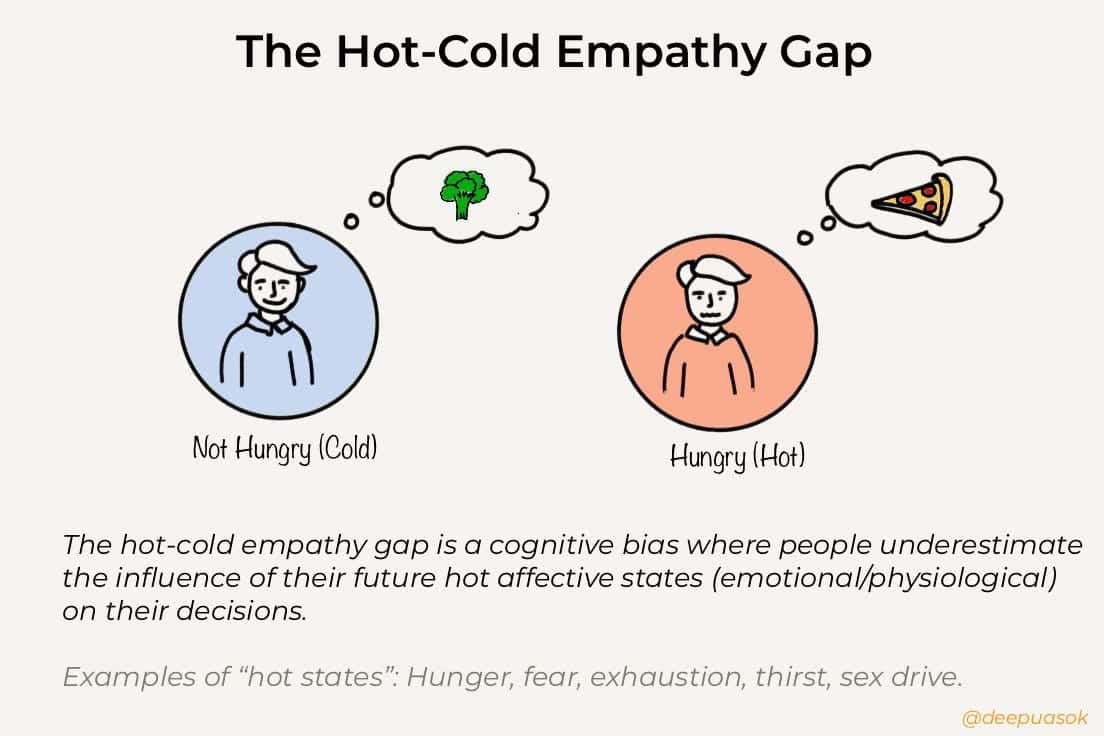
The empathy gap is our tendency to underestimate how much emotions and physical states affect behavior and decision-making, both in ourselves and in others. When we’re calm, we can’t truly imagine how we’d act when angry. When we’re full, we can’t understand the desperation of hunger. When we’re healthy, we underestimate how much pain changes everything.
Research from Carnegie Mellon University shows that this gap exists in two forms. The hot-cold empathy gap happens when we’re in a calm state and can’t predict our behavior in an emotional state. The cold-hot empathy gap occurs when we’re emotional and can’t remember what it’s like to be calm. Both versions cause serious problems in our lives.
According to studies published by researchers at Harvard University, the empathy gap affects medical decisions, financial choices, relationship conflicts, and even criminal justice. Judges give harsher sentences before lunch when they’re hungry and irritable compared to after meals when they’re satisfied and calm. The same crime receives different punishments based on the judge’s physical state, not the severity of the offense.
The Hungry Shopper and the Full Planner
Imagine Priya planning her weekly grocery shopping on a Sunday afternoon after a heavy lunch. She carefully makes a list of healthy foods, fresh vegetables, fruits, and whole grains. She’s determined to eat better this week. But when Thursday evening arrives and she’s exhausted and starving after work, she drives past the grocery store and heads straight to the fast-food restaurant. Her hungry self makes completely different choices than her full self planned.
This is the empathy gap in action. Research from Stanford University demonstrates that people consistently underestimate how much their current state affects future decisions. Students studying for exams while well-rested believe they’ll maintain the same focus when sleep-deprived. They’re almost always wrong. Workers who plan their workday in the morning calm can’t predict how they’ll react to afternoon stress and fatigue.
The gap works in reverse too. When Rajesh is furious at his colleague for missing a deadline, he can’t remember ever being understanding or patient. His angry brain tells him he’s always known this colleague was unreliable. But when his anger cools the next day, he suddenly recalls the many times this same colleague helped him and met important deadlines. His emotional state literally changed what memories his brain could access.
Ancient Wisdom About Walking in Another’s Shoes
Long before modern psychology discovered the empathy gap, ancient wisdom traditions warned about this human tendency. The Native American proverb says, “Don’t judge a man until you’ve walked a mile in his moccasins.” This wasn’t just about being kind—it recognized the fundamental truth that we cannot understand another person’s experience without sharing their circumstances.
In the Buddhist tradition, there’s a story about a wealthy man who refused to give water to a thirsty traveler, saying, “I’m not thirsty, so water isn’t that important.” Later, when crossing a desert, the wealthy man offered his last gold coin for a single cup of water. The merchant who sold it to him said, “Now you understand that value changes with need.” This tale teaches that our current state blinds us to other states of being.
The Bhagavad Gita addresses this human limitation when Krishna tells Arjuna that the wise person is one who remains steady in both pleasure and pain, understanding that these states are temporary and don’t reflect ultimate reality. The text recognizes that most people swing between emotional states and lose perspective with each swing—a perfect description of the empathy gap.
How the Empathy Gap Damages Our Lives
In relationships, the empathy gap creates devastating misunderstandings. When Meena’s husband comes home exhausted and irritable, snapping at small things, she takes it personally because she’s currently calm and energized. She can’t access the memory of her own exhaustion-fueled irritability from last week. Similarly, when she’s overwhelmed and emotional, his logical advice feels dismissive because his calm brain can’t connect with her stressed state. Research from Yale University shows that couples who understand the empathy gap report higher relationship satisfaction and fewer conflicts.
In healthcare decisions, the gap causes serious problems. Patients feeling fine after surgery often stop taking pain medication too soon, unable to remember how intense the pain was or predict its return. Cancer patients in remission sometimes refuse preventive treatments because they can’t connect emotionally with their sick self’s suffering. Studies show that people make very different medical choices depending on whether they’re currently in pain or pain-free.
Financial decisions suffer dramatically from empathy gaps. Someone who just received a salary bonus feels wealthy and spends freely, unable to predict the anxiety they’ll feel when bills arrive and the money is gone. Conversely, someone in financial stress might refuse a reasonable investment opportunity because their anxious brain can’t imagine future stability. The same person makes opposite choices in different emotional states.
The criminal justice system struggles with empathy gaps constantly. Victims testifying while traumatized want maximum punishment, but months later, when healed, they often express regret about their harsh statements. Criminals released from prison after years of suffering swear they’ll never return, genuinely believing it—but once free and comfortable, many forget that suffering and reoffend. Their current state blinds them to their past pain and future temptation.
Bridging the Gap With Awareness and Practice
Understanding the empathy gap doesn’t eliminate it, but awareness provides powerful tools. When making important decisions, we can deliberately pause and ask, “How would I feel about this choice if I were angry, tired, hungry, or stressed?” Writing down our reasoning helps because we can review it later when our emotional state changes.
Creating rules during calm moments helps navigate emotional storms. Athletes and performers know this well—they practice responses to pressure situations repeatedly so that when emotions run high, trained habits take over. A tennis player who decides in advance how to respond to bad calls doesn’t have to make that decision while furious during a match.
In relationships, naming the empathy gap transforms conflicts. Instead of saying, “You’re being unreasonable,” try saying, “I know you’re stressed right now, and I can’t fully understand how that feels, but I’m here to help.” This acknowledgment that we can’t perfectly understand another’s state creates space for compassion rather than judgment.
For healthcare, keeping pain diaries or symptom journals helps bridge the gap between sick days and well days. When feeling fine, reading your own words from difficult days reminds you why you need medication or treatment. The written record becomes a bridge across the empathy gap.
The wisest approach comes from combining ancient wisdom with modern understanding. Practice remembering that your current state is temporary. When calm, prepare for challenges. When emotional, remember you won’t always feel this way. When judging others, recall times you’ve been in similar states. The empathy gap can’t be eliminated, but it can be narrowed through mindful awareness and deliberate practice.
Frequently Asked Questions
Does everyone experience the empathy gap equally?
No, research shows significant individual differences. People with higher emotional intelligence tend to show smaller empathy gaps because they’re better at recognizing and naming emotional states. However, everyone experiences this bias to some degree, regardless of intelligence or education. Interestingly, people who’ve experienced extreme emotional or physical states, like chronic pain or trauma, sometimes develop better ability to recall those states, though this isn’t universal.
Can the empathy gap be completely eliminated?
Unfortunately, no. It’s built into how our brains process emotional and physical states. However, it can be significantly reduced through awareness, practice, and specific techniques like keeping journals, making rules during calm moments, and deliberately recalling past emotional experiences. Meditation and mindfulness practices also help by increasing awareness of changing internal states.
How does the empathy gap affect parenting?
The empathy gap significantly impacts parenting decisions. Parents who’ve never experienced their child’s current developmental stage often struggle to understand its challenges. A parent of a calm toddler can’t imagine how they’ll handle the terrible twos until they arrive. Similarly, parents forget their own childhood struggles and judge their teenagers harshly for normal developmental behaviors. Understanding this gap helps parents approach challenges with more patience and realistic expectations.
Is the empathy gap related to lack of compassion?
Not necessarily. Even deeply compassionate people experience empathy gaps—it’s a cognitive limitation, not a character flaw. However, people who are aware of the empathy gap and actively work to bridge it do show more effective compassion because they recognize their understanding is limited and seek additional information rather than making assumptions based on their current state.
How can teachers use understanding of empathy gaps in classrooms?
Teachers who understand empathy gaps make better educational decisions. They recognize that students experiencing stress, hunger, or emotional turmoil can’t learn the same way as calm, well-fed students. They avoid making major disciplinary decisions when angry and don’t expect students to understand consequences when emotionally activated. This knowledge leads to more effective classroom management and more compassionate, realistic educational approaches that account for students’ varying physical and emotional states.
Observer Voice is the one stop site for National, International news, Sports, Editor’s Choice, Art/culture contents, Quotes and much more. We also cover historical contents. Historical contents includes World History, Indian History, and what happened today. The website also covers Entertainment across the India and World.

