

Why Two People Can Watch the Same Event and See Completely Different Things

After the final whistle of the Delhi versus Mumbai school football championship, something strange happened. Both teams’ supporters were absolutely certain their team had been cheated by unfair refereeing. Delhi fans were furious: “The referee was clearly biased toward Mumbai! He ignored three obvious fouls against our players and gave Mumbai every close call. We were robbed!”
Mumbai supporters were equally outraged: “That referee favored Delhi the entire game! He gave them a penalty that wasn’t deserved and ignored Mumbai players being pushed and held. The match was stolen from us!”
Sixteen-year-old Priya, a neutral spectator with no loyalty to either team, watched the same match and saw something different from both groups. “The referee was pretty fair,” she told friends from both teams. “He made a few questionable calls both ways, but nothing terrible. Each team got away with some fouls and got called for others. It was a normally-refereed close game.”
Her friends from both teams were stunned. “How could you not see the bias?” Delhi fans demanded. “How did you miss all those bad calls against Mumbai?” Mumbai fans asked simultaneously. All three—Delhi supporters, Mumbai supporters, and neutral Priya—had watched the identical game, yet they’d seen dramatically different events.
Their psychology teacher later explained what happened: “You all experienced selective perception—the tendency for your expectations, loyalties, and beliefs to shape what you perceive. Delhi fans expected to see bias against Delhi, so they noticed every call against Delhi and barely registered calls against Mumbai. Mumbai fans did the opposite. Priya, with no expectations or loyalties, saw the game more objectively. You didn’t see different games—you saw the same game through different perceptual filters created by your expectations and loyalties.”
This phenomenon explains why eyewitnesses give contradictory testimony, why people with different political views see the same speech completely differently, and why confirmation bias is so powerful. Understanding selective perception reveals how much our minds construct what we perceive rather than passively receiving objective reality.
What Is Selective Perception?
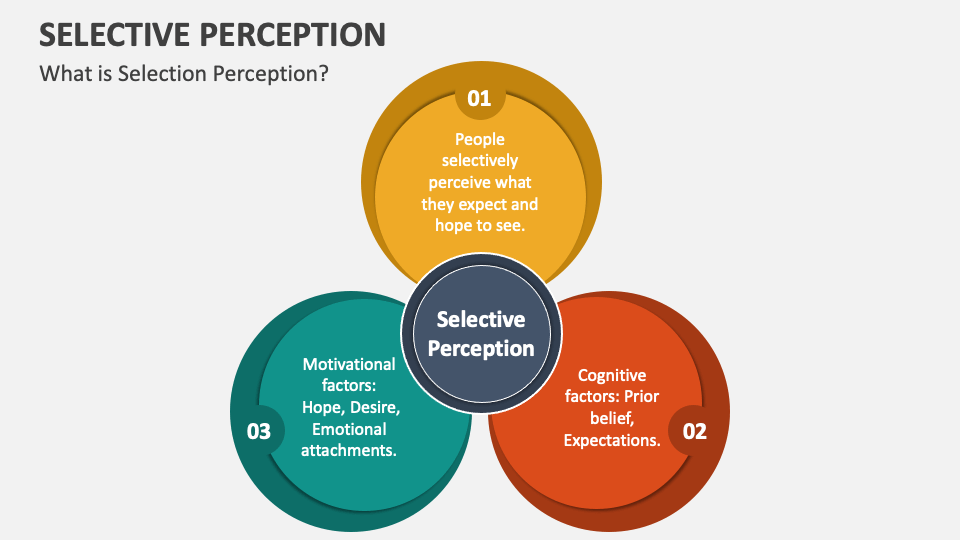
Selective perception is the cognitive bias where our expectations, beliefs, values, and existing mental frameworks shape what we notice, how we interpret ambiguous information, and what we remember. We don’t passively observe reality and form conclusions—we actively filter reality through our existing beliefs, seeing what we expect to see, interpreting ambiguous situations to match our expectations, and remembering information that confirms what we already believe while forgetting information that contradicts it.
The phenomenon was systematically studied in classic research by psychologists Albert Hastorf and Hadley Cantril. In a famous study at Princeton University, researchers asked Princeton and Dartmouth students to watch a film of a particularly rough Princeton-Dartmouth football game and count rules violations. Princeton students “saw” Dartmouth commit more than twice as many violations as Princeton. Dartmouth students saw approximately equal violations or even more Princeton violations. Same film, dramatically different perceptions based on which team the viewer supported.
According to research from Stanford University, selective perception operates through several mechanisms. There’s selective attention—we notice information consistent with our expectations more readily than inconsistent information. There’s selective interpretation—we interpret ambiguous information to fit our existing beliefs. And there’s selective memory—we remember confirming information better than contradicting information. These three processes work together to create and maintain distorted perceptions that feel completely objective.
Studies from Yale University demonstrate that selective perception is largely unconscious. People aren’t deliberately ignoring contradicting information or lying about what they saw—they genuinely perceive events differently based on their expectations. The perceptual filtering happens before conscious awareness, meaning people experience their biased perceptions as objective reality, not as interpretations or opinions.
The Parable of the Four Merchants Viewing One Diamond
A teaching story tells of four merchants inspecting the same diamond to determine its value. The first merchant, who specialized in colored gems and preferred sapphires and emeralds, examined the diamond critically. “This diamond is acceptable but not exceptional,” he concluded. “It’s colorless—boring compared to vibrant colored stones. It’s merely adequate.”
The second merchant, who specialized in diamonds and treasured clarity, examined the same stone enthusiastically. “This is a magnificent diamond!” he declared. “The clarity is exceptional—nearly flawless. The colorless quality is precisely what makes it valuable. This is an excellent stone.”
The third merchant, deeply in debt and desperate to find cheap inventory, examined the stone hopefully. “I see several flaws that reduce its value,” he noted, focusing on tiny inclusions. “This would be an affordable acquisition—I could purchase it at a lower price due to these imperfections.”
The fourth merchant, wealthy and seeking only the finest gems for his collection, examined the same stone and saw perfection. “This diamond is flawless!” he exclaimed. “Those tiny marks you mention are insignificant. This is exactly the quality I seek and worth a premium price.”
A wise gem master watching these four evaluations pointed out: “You examined one diamond and saw four different stones. Each of you saw what your expectations, needs, and beliefs led you to see. The colored-gem specialist saw dullness where the diamond specialist saw perfection. The desperate merchant saw flaws justifying low price; the wealthy collector saw flawlessness justifying high price. The diamond hasn’t changed—your perceptions changed based on what you expected, needed, and believed. This is why two honest merchants can disagree completely about value—they’re not seeing the same stone, even while looking at the identical diamond.”
Buddhist philosophy extensively addresses selective perception in teachings about right view and the constructed nature of reality. The Buddha taught that we don’t perceive reality as it is—we perceive reality filtered through our expectations, attachments, aversions, and ignorance. The teaching of maya (illusion) includes the illusion that our perceptions are objective when actually they’re heavily constructed by our minds. Developing right view requires recognizing how perception is shaped by expectation and learning to see more clearly.
The Bhagavad Gita discusses selective perception through Krishna’s teaching about how the gunas (qualities of nature) color perception. Krishna teaches that people dominated by different gunas perceive the same reality differently—what appears as desirable to one appears undesirable to another, not because reality changed but because their perceptual frameworks differ. Wisdom requires recognizing that your perception is shaped by your conditioning, expectations, and qualities of mind.
How Selective Perception Shapes What We See
In eyewitness testimony and legal proceedings, selective perception explains why honest witnesses give contradictory accounts of the same event. Research shows that witnesses who expect to see violence perceive ambiguous situations as violent, while witnesses with different expectations see the same situations as non-violent. Race, age, appearance, and context all shape perception through expectation-based filtering that witnesses experience as objective observation.
Studies from University of Virginia using mock crime scenarios found that witnesses’ descriptions of suspects’ behavior varied dramatically based on the witnesses’ expectations about criminal behavior, with identical actions perceived as suspicious or innocent depending on the witness’s prior beliefs. Selective perception creates “honest” but wildly inaccurate eyewitness testimony that contributes to wrongful convictions.
In political perception and media consumption, selective perception explains why people with different political views watching the same speech or debate come away with opposite conclusions. Conservative viewers perceive liberal politicians as dishonest, extreme, and incorrect. Liberal viewers perceive the same politicians as honest, reasonable, and correct. Each group genuinely believes their perception is objective reality, not recognizing how their political expectations filter their perception.
Research from Duke University shows that identical political speeches are rated completely differently by viewers of different political affiliations. What conservatives hear as “reasonable common sense,” liberals hear as “dangerous extremism,” and vice versa. The speech doesn’t change—expectations about the speaker shape perception of what was said.
In workplace evaluation and performance reviews, selective perception makes managers who expect an employee to perform well perceive their performance as good, while managers with negative expectations perceive the same performance as poor. Ambiguous behaviors get interpreted through expectation-based filters—arriving on time is “conscientious” for expected-good employees but “just doing the minimum” for expected-poor employees.
Studies demonstrate that employees’ performance ratings correlate more strongly with their supervisors’ expectations than with objective performance metrics. Two employees with identical productivity receive different ratings based on whether their supervisor expected them to do well or poorly. The supervisor genuinely believes they’re rating objectively, not recognizing selective perception is operating.
In relationships and interpersonal perception, selective perception makes people in happy relationships interpret their partner’s behaviors positively (“she’s quiet because she’s thoughtful”) while people in troubled relationships interpret identical behaviors negatively (“she’s quiet because she’s angry at me”). The behavior doesn’t change—relationship expectations shape perception.
Research shows that couples therapy often involves helping partners recognize their selective perception—how negative expectations make them interpret neutral or positive behaviors as negative, creating self-fulfilling prophecies where expectations of relationship problems create perceived evidence of problems that may not actually exist.
In consumer behavior and product perception, selective perception makes identical products seem different based on branding and expectations. Wine experts rate the same wine higher when told it’s expensive than when told it’s cheap. Coffee tastes better from a well-known brand cup than from a generic cup, even when it’s the same coffee. The product is identical; expectations shape perception of quality.
Studies from MIT using blind versus non-blind taste tests consistently find that brand expectations shape perception of taste, quality, and satisfaction more than the actual product does. What people “taste” is heavily influenced by what they expect to taste based on brand, price, and packaging information.
Seeing Past Your Expectations
The most important practice for countering selective perception is recognizing that your perception is NOT objective reality but rather reality filtered through your expectations, beliefs, and biases. When you perceive something, acknowledge: “This is what I’m seeing given my expectations and beliefs” rather than “This is what’s objectively happening.” This epistemic humility—recognizing limits of your perception—is the foundation of seeing more clearly.
Actively seek disconfirming information and alternative perspectives. Selective perception makes you naturally notice confirming information. Deliberately looking for contradicting information counterbalances this bias. If you think someone is dishonest, actively look for evidence of honesty. If you think a policy is bad, actively look for positive aspects. This conscious search for disconfirming evidence partially overcomes selective attention.
Examine your expectations before observing events where perception matters. If you’re about to watch a political debate, acknowledge your political expectations. If you’re evaluating an employee, acknowledge your expectations about that employee. Making expectations explicit helps you recognize when they might be distorting perception, creating opportunity to consciously adjust for bias.
Get feedback from people with different expectations and compare perceptions. If you and someone with opposite expectations perceive the same event completely differently, that’s evidence selective perception is operating in both of you. The truth likely lies somewhere between your perspectives, not at either extreme. Comparing perceptions reveals the role expectations play.
Use objective metrics and recordings when possible. If you’re evaluating employee performance, use productivity metrics rather than impressions. If you’re assessing referee fairness, count calls objectively rather than relying on perceived bias. Objective data helps overcome perception-based filters, though even objective data interpretation can be affected by expectations.
Practice mindfulness and present-moment awareness. Buddhist meditation practices specifically train seeing things as they are rather than through expectation-based filters. Regular practice increases awareness of when expectations are shaping perception, creating opportunities to see more clearly beyond automatic filtering.
Remember the football match where Delhi fans, Mumbai fans, and neutral Priya saw three different games despite watching the identical match. Remember the four merchants seeing four different diamonds despite examining the same stone. Both illustrate how expectations and beliefs shape perception so powerfully that people with different expectations genuinely experience different realities while observing identical situations.
Selective perception doesn’t mean you’re dishonest or deliberately biased. It means you’re human—your brain constructs perception from raw sensory data plus expectations, beliefs, and prior knowledge. This construction happens automatically, unconsciously, before you’re aware of perceiving anything. You experience the end result as “objective reality” when actually it’s “reality as filtered through your expectations.”
Breaking selective perception requires recognizing this filtering, acknowledging that what you perceive is interpretation not pure observation, seeking alternative perspectives, and using objective metrics where possible. Even with these practices, you’ll never perceive purely objectively—but you can perceive less biased, more aware of when expectations are shaping what you see, and more humble about whether what you perceive matches what’s actually there.
Frequently Asked Questions
If everyone has selective perception, is there such a thing as objective reality?
Yes—objective reality exists independent of perception, but individual perception of it is always filtered through expectations and beliefs. Multiple people with different expectations will perceive the same reality differently, but systematic observation, measurement, and comparison of multiple perspectives can approach closer to objective truth than any single subjective perception. Science works by acknowledging selective perception and using methods—controlled experiments, blind studies, peer review—to minimize its effects.
Can I train myself to overcome selective perception completely?
Not completely—some expectation-based filtering is built into how human perception works and happens unconsciously. However, you can significantly reduce selective perception through practices like mindfulness meditation, actively seeking disconfirming evidence, examining your expectations explicitly, and comparing your perceptions with others. Awareness is the key—you can’t eliminate the bias but can become aware of when it’s operating and consciously adjust for it.
Why did selective perception evolve if it distorts reality?
Because expectation-based perception processing is faster and more efficient than analyzing everything from scratch. Using expectations to guide perception allows quick decision-making in situations where speed matters more than perfect accuracy. For our ancestors, assuming rustling bushes were predators (expectation-guided perception) kept them alive better than carefully analyzing each rustle to determine actual cause. Modern contexts where accuracy matters more than speed expose the downsides of this evolutionary adaptation.
How can I tell if I’m experiencing selective perception or if I’m genuinely seeing something others miss?
Compare your perception with people who have different expectations from yours. If you see something and people with opposite expectations see the opposite, selective perception is likely operating in both of you. If you see something and even people with opposite expectations acknowledge it (though perhaps interpreting it differently), you may be genuinely perceiving something real. Also examine whether you’re noticing confirming evidence more than disconfirming evidence—that’s a signature of selective perception.
Does selective perception explain all disagreement, or do people sometimes just have different values and priorities?
Selective perception explains disagreement about what happened or what evidence shows—factual disputes about perception of reality. But people can accurately perceive the same facts and still disagree due to different values, priorities, and goals—normative disputes about what should be done. For example, people might agree that a policy will increase taxes and improve services (shared perception) but disagree about whether that tradeoff is worthwhile (different values). Both selective perception and value differences contribute to disagreement, often simultaneously.
Observer Voice is the one stop site for National, International news, Sports, Editor’s Choice, Art/culture contents, Quotes and much more. We also cover historical contents. Historical contents includes World History, Indian History, and what happened today. The website also covers Entertainment across the India and World.

