

Why Beginners Think They’re Experts: The Dunning-Kruger Effect Explained
Dunning-Kruger effect explained

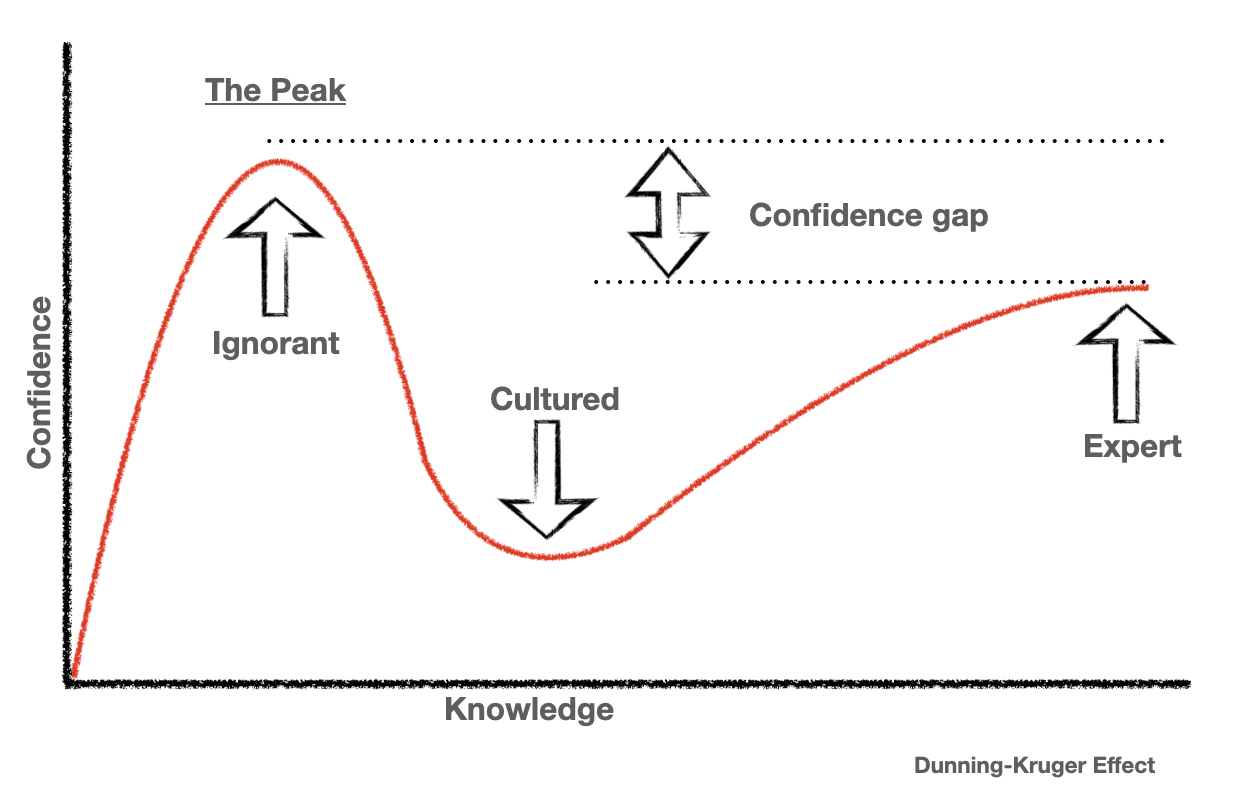
Have you ever met someone who just learned to drive and suddenly thinks they could win Formula 1? Or watched a cooking show and believed you could become a master chef overnight? If yes, you’ve witnessed the Dunning-Kruger effect in action—a fascinating quirk of human psychology that affects us all.
Imagine this: Raj, a tenth-grader, watches three YouTube videos about playing guitar. The next day, he confidently tells his music teacher that he’s ready to perform at the school’s annual function. Meanwhile, his teacher, who has been playing for twenty years, humbly says she’s “still learning.” This puzzling contradiction is exactly what psychologists David Dunning and Justin Kruger discovered in their groundbreaking 1999 research at Cornell University.
The Dunning-Kruger effect reveals a strange truth about human nature: people who know the least often feel the most confident, while true experts frequently doubt themselves. It’s like climbing a mountain of knowledge—beginners at the bottom think they can see everything, but experts at the top realize how much more mountain lies beyond the clouds.
The Bank Robber Who Inspired a Scientific Discovery
The story behind this discovery is almost comical. In 1995, a man named McArthur Wheeler robbed two banks in Pittsburgh in broad daylight without wearing a mask. When police arrested him that evening, he was shocked. “But I wore the juice!” he protested.
Wheeler had rubbed lemon juice on his face, believing it would make him invisible to security cameras—like invisible ink. He was so confident in his absurd plan that he didn’t even bother to hide his identity. This bizarre incident caught the attention of Dunning and Kruger, who wondered: could incompetence prevent people from recognizing their own incompetence?
Their subsequent experiments, published in the Journal of Personality and Social Psychology, confirmed this phenomenon. Students who performed poorly on tests of logic, grammar, and humor consistently overestimated their performance, sometimes by as much as 50%. According to research from the American Psychological Association, this cognitive bias affects people across cultures and domains.
Why Smart People Often Feel Like Frauds
On the flip side, the Dunning-Kruger effect reveals something equally important: experts often underestimate themselves. Dr. Priya Sharma, a mathematics professor, once confessed, “Even after publishing twelve research papers, I sometimes feel like a student who got lucky.”
This happens because experts know how vast their field truly is. They’ve climbed high enough on the mountain to see the endless peaks beyond. As the ancient Chinese philosopher Confucius wisely said, “Real knowledge is to know the extent of one’s ignorance.”
Studies from Stanford University show that high-achieving students and professionals frequently experience “impostor syndrome”—feeling like frauds despite clear evidence of their competence. This is the Dunning-Kruger effect’s shadow side, where knowledge breeds humility instead of confidence.
The Four Stages of Learning
Ancient folklore offers a beautiful framework for understanding this effect. There’s an old story about a martial arts student who approached a master:
“How long will it take to learn this art?” the student asked.
“Ten years,” replied the master.
“What if I practice twice as hard?”
“Then twenty years,” said the master.
“Why longer if I work harder?” asked the confused student.
“Because when you rush,” the master explained, “one eye watches your progress, leaving only one eye for the journey itself.”
Modern psychologists describe learning in four stages:
- Unconscious incompetence (You don’t know what you don’t know)
- Conscious incompetence (You realize how much you don’t know)—this is the valley of despair
- Conscious competence (You know, but it requires effort)
- Unconscious competence (Mastery becomes natural)
The Dunning-Kruger effect strikes hardest in stage one, where confidence peaks despite minimal knowledge. According to research from Harvard Medical School, this explains why medical students in their first year sometimes question experienced doctors’ diagnoses—they’ve learned enough to feel dangerous but not enough to recognize complexity.
How to Overcome the Dunning-Kruger Effect
The good news? Awareness is the first step toward wisdom. Here are practical strategies based on psychological research:
Seek feedback actively. Don’t just ask, “How did I do?” Ask specific questions: “What could I improve? What did I miss?” Studies from MIT’s Department of Brain and Cognitive Sciences show that structured feedback helps calibrate self-assessment.
Embrace the beginner’s mind. The Japanese concept of shoshin teaches us to maintain an attitude of openness, even when studying something familiar. When you think you know everything about a topic, that’s precisely when you should study it again.
Test yourself objectively. Create measurable benchmarks. If you think you’re good at mathematics, attempt progressively harder problems. Reality has a way of humbling us, and that humility is the doorway to genuine improvement.
Learn from multiple sources. One teacher, one book, or one video creates a narrow perspective. As the African proverb goes, “If you want to go fast, go alone. If you want to go far, go together.” Diverse sources reveal blind spots.
Why This Matters in the Real World
Understanding the Dunning-Kruger effect isn’t just academic—it’s practical wisdom for navigating modern life. In the age of social media, where everyone seems to be an expert on everything after reading a single article, recognizing this bias becomes crucial.
Whether you’re choosing a career, learning a new skill, or simply trying to become a better person, remember: confidence without competence is dangerous, but competence with humility is powerful. The truly wise person knows that learning never ends—there’s always another mountain beyond the clouds.
As you continue your educational journey, carry this wisdom: be confident enough to try new things, but humble enough to know you have much to learn. That balance—between courage and humility—is where real growth happens.
Frequently Asked Questions
Q1: Can the Dunning-Kruger effect be measured scientifically?
Yes. Psychologists measure it by comparing people’s self-assessments with their actual test performance. The gap between perceived and real ability reveals the effect’s strength.
Q2: Does everyone experience the Dunning-Kruger effect?
To some degree, yes. It’s a natural part of learning. However, people who actively seek feedback and remain open to criticism experience it less intensely.
Q3: How is the Dunning-Kruger effect different from simple overconfidence?
The Dunning-Kruger effect is specific: it occurs because incompetence prevents people from recognizing their incompetence. Regular overconfidence might happen despite knowing your limitations.
Q4: Can experts completely avoid underestimating themselves?
It’s challenging because true expertise reveals complexity. However, experts can recognize their relative skill level by comparing themselves to peers rather than the entire knowledge domain.
Q5: How long does it take to move from beginner overconfidence to informed confidence?
It varies by field, but research suggests that after approximately 20-40 hours of deliberate practice, people enter the “valley of despair” where they realize their limitations—the first step toward genuine competence
Observer Voice is the one stop site for National, International news, Sports, Editor’s Choice, Art/culture contents, Quotes and much more. We also cover historical contents. Historical contents includes World History, Indian History, and what happened today. The website also covers Entertainment across the India and World.

