

Congenital Syphilis Cases Surge Globally: WHO Data Reveals Preventable Tragedy Affecting 660,000 Newborns Annually

Key Facts: WHO and Syphilis
- WHO estimates 7.1 million new syphilis infections occur globally each year among adults aged 15-49
- Approximately 660,000 newborns are infected with congenital syphilis annually, resulting in over 200,000 stillbirths and neonatal deaths
- Mother-to-child transmission rates reach 70-100% in untreated pregnant women with early syphilis, according to WHO surveillance
- A single dose of benzathine penicillin during pregnancy prevents congenital syphilis in 98% of cases, yet only 35% of pregnant women in low-income countries receive syphilis testing
- WHO reports syphilis cases increased 74% globally between 2020 and 2022, reversing decades of decline in many regions
In November 2023, WHO issued an urgent call to action after new surveillance data revealed that congenital syphilis cases had reached a 20-year high in multiple regions, with the Americas reporting a 900% increase since 2016. This preventable tragedy—babies born with infections that a $0.50 antibiotic could have stopped—reflects catastrophic failures in antenatal care systems. The resurgence comes despite WHO’s 2007 launch of a global initiative to eliminate mother-to-child transmission of syphilis, a goal that seemed within reach just a decade ago. How did the world backslide so dramatically on a disease we’ve known how to prevent for 80 years? This article examines WHO’s latest data on syphilis transmission, the biological mechanisms behind congenital infections, and why health initiatives targeting this ancient disease continue falling short in 2024.
What Is Syphilis? — WHO’s Definition
According to WHO, syphilis is a sexually transmitted infection caused by the bacterium Treponema pallidum, characterized by distinct clinical stages and the ability to remain dormant in the body for years before causing severe complications. The organization classifies syphilis into primary, secondary, latent, and tertiary stages, each with specific manifestations. Primary syphilis appears as a painless ulcer (chancre) at the infection site, typically 3 weeks after exposure. Secondary syphilis develops weeks to months later, presenting with rash, mucous membrane lesions, and systemic symptoms. Latent syphilis—the hidden stage—shows no symptoms but remains infectious during early latency. Tertiary syphilis, occurring years after initial infection in untreated cases, can damage the heart, brain, and other organs.
WHO’s clinical definition emphasizes syphilis as “the great imitator” because its symptoms mimic numerous other conditions, making diagnosis challenging without laboratory testing. Congenital syphilis occurs when Treponema pallidum crosses the placenta from infected mother to fetus, potentially causing miscarriage, stillbirth, premature birth, low birth weight, or severe newborn infections affecting bones, liver, kidneys, and brain. The tragedy is that unlike many infections, syphilis is entirely preventable and curable with widely available antibiotics—yet it persists as a major global health threat.
Global Burden — WHO Prevalence Data
WHO’s 2023 global estimates documented 7.1 million new syphilis cases among adults aged 15-49, representing a sharp reversal of previous declining trends. The prevalence varies dramatically by region and population. Sub-Saharan Africa carries the highest burden with an estimated 2.9 million cases, followed by the Western Pacific region with 1.7 million. Women of reproductive age account for 3.7 million infections globally—a critical figure since each represents a potential congenital syphilis case if pregnancy occurs.
The congenital syphilis data is where numbers become a humanitarian crisis. WHO reports approximately 660,000 babies are born with syphilis infections annually, resulting in over 200,000 stillbirths and neonatal deaths. That’s more than 550 preventable deaths every single day. In the Americas, CDC surveillance data shows congenital syphilis cases increased from 334 in 2012 to 3,700 in 2022 in the United States alone—a tenfold rise. European surveillance networks report similar trends, with cases doubling in several countries since 2019.
At-risk populations include men who have sex with men (MSM), who account for a disproportionate share of cases in high-income countries, sex workers, people living with HIV, prisoners, and mobile populations with limited healthcare access. WHO identifies pregnant women in low-resource settings as critically vulnerable: antenatal care coverage data shows that while 86% of pregnant women globally attend at least one antenatal visit, only 62% receive the recommended four visits where syphilis screening would typically occur. In countries with the highest syphilis burdens, screening rates drop below 40%. This mirrors broader patterns seen in preventable stillbirths that claim 1.9 million lives annually, where system failures compound biological risks.
Causes, Transmission & Risk Factors
WHO reports that syphilis spreads almost exclusively through direct contact with syphilitic sores during vaginal, anal, or oral sex. The bacterium Treponema pallidum is a spirochete—a corkscrew-shaped organism that penetrates mucous membranes or microscopic breaks in skin with remarkable efficiency. Once inside the body, it disseminates through the bloodstream within hours, establishing infections in multiple organ systems before the immune system mounts an effective response. The primary chancre that appears at the entry point contains millions of organisms, making it highly infectious, yet it’s painless and often goes unnoticed, particularly when located internally.
Mother-to-child transmission follows a different pathway. WHO’s transmission studies show Treponema pallidum crosses the placental barrier after approximately 9-10 weeks of gestation, though transmission can occur at any stage of pregnancy. Transmission rates correlate directly with maternal disease stage: untreated primary or secondary syphilis carries 70-100% transmission risk, early latent syphilis 40%, and late latent syphilis 10%. The bacterium causes severe fetal damage including hepatosplenomegaly, skeletal abnormalities, and neurological impairment.
Risk factors extend beyond individual behaviors to structural determinants. WHO identifies poverty, lack of education, gender inequality, stigma around sexual health, and weak health systems as primary drivers. Research published in The Lancet Infectious Diseases demonstrates that syphilis clusters geographically in areas with limited healthcare infrastructure, high population mobility, and concurrent HIV epidemics. Drug use, particularly methamphetamine, correlates with increased syphilis transmission in multiple studies. Incarceration disrupts treatment continuity. These factors create what WHO terms “syndemic conditions”—overlapping epidemics that amplify each other’s impact, similar to dynamics affecting the broader STI epidemic affecting 1 million people daily worldwide.
Signs, Symptoms & Health Impacts
WHO identifies syphilis through its characteristic staging, though individual presentations vary widely. Primary syphilis manifests as a single chancre (occasionally multiple) appearing 10-90 days post-infection, typically around 21 days. The ulcer is firm, round, and painless—characteristics that distinguish it from other genital ulcers. It appears at the infection site: genitals, anus, rectum, or mouth. Without treatment, it heals spontaneously within 3-6 weeks, often leading people to assume the infection has resolved. It hasn’t.
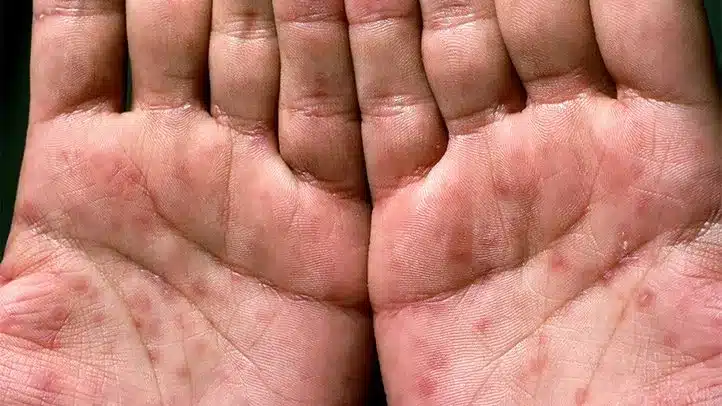
Secondary syphilis emerges weeks to months later as the bacteria spread systemically. WHO reports manifestations include skin rash (particularly on palms and soles), mucous patches in the mouth or genitals, condylomata lata (wart-like lesions), lymphadenopathy, fever, fatigue, sore throat, patchy hair loss, and weight loss. The rash doesn’t itch—a key distinguishing feature. These symptoms also resolve without treatment, ushering in latent syphilis where no symptoms appear but the infection persists. Early latent (first year) remains infectious during sexual contact; late latent (beyond one year) is generally not sexually transmissible but can still pass to a fetus during pregnancy.
Tertiary syphilis, developing in 15-30% of untreated cases years or decades later, causes devastating complications. WHO documents neurosyphilis (affecting brain and spinal cord, causing dementia, paralysis, sensory deficits, and stroke), cardiovascular syphilis (damaging aorta and heart valves), and gummatous syphilis (destructive soft tissue lesions). Ocular syphilis can cause blindness and has shown concerning increases in recent years—CDC data reported over 200 cases annually in the United States since 2020, up from fewer than 10 cases in 2014.
Congenital syphilis presents differently. WHO identifies early congenital syphilis (first 2 years of life) through hepatosplenomegaly, skeletal abnormalities visible on X-ray, rash, anemia, thrombocytopenia, and rhinitis (“snuffles”). Late congenital syphilis manifests as Hutchinson’s teeth (notched incisors), mulberry molars, saddle nose deformity, saber shins, and eighth nerve deafness. Many infected newborns appear healthy at birth but develop complications weeks later—a pattern that underscores the importance of systematic testing rather than symptom-based diagnosis.
Treatment & Health Response
WHO reports that benzathine penicillin G remains the gold-standard treatment for all syphilis stages—a medication that’s been used since the 1940s and costs less than $2 per dose in most markets. For primary, secondary, and early latent syphilis, WHO treatment guidelines recommend a single intramuscular injection of 2.4 million units benzathine penicillin G. Late latent, latent of unknown duration, and tertiary syphilis require three doses administered weekly. Neurosyphilis demands intravenous aqueous crystalline penicillin G for 10-14 days. For penicillin-allergic patients, WHO’s STI treatment guidelines recommend doxycycline, though it’s contraindicated in pregnancy.
Treatment effectiveness is remarkable when administered properly: cure rates exceed 95% for early syphilis. The Jarisch-Herxheimer reaction—fever, chills, and muscle aches occurring within 24 hours of treatment—affects 10-35% of patients but resolves without specific intervention. For pregnant women, treatment before the third trimester prevents congenital syphilis in 98% of cases. Even treatment in the third trimester reduces transmission substantially.
Access gaps create the real crisis. WHO documents severe benzathine penicillin shortages affecting 95 countries between 2014-2019, driven by manufacturing consolidation and low profit margins. Many healthcare facilities, particularly in rural areas, lack refrigeration to store penicillin properly. Global health supply chain analyses reveal that stockouts force providers to substitute less effective medications or delay treatment. The situation mirrors challenges with scabies treatment access affecting 200 million cases worldwide, where essential medicines remain unavailable in settings that need them most.
Regional differences are stark. High-income countries generally maintain adequate penicillin supplies and laboratory capacity for syphilis diagnosis, though marginalized populations face barriers including stigma, cost, and geographic access. Low-income countries struggle with all aspects: limited laboratory infrastructure means many facilities can’t perform treponemal tests, stockouts interrupt treatment continuity, and weak antenatal care systems fail to identify infected pregnant women. WHO reports that in sub-Saharan Africa, where congenital syphilis burden is highest, only 35% of pregnant women receive syphilis testing during antenatal care. What happens to the other 65%? Their infections go undetected, their babies suffer preventable consequences.
Prevention & WHO Strategies
WHO’s prevention framework centers on the “ABCs” adapted for syphilis: testing (knowing your status), treatment (curing infections before transmission), and barrier methods (condoms reducing transmission risk by approximately 95% when used consistently). But population-level prevention requires systematic approaches beyond individual behaviors. The organization’s global health sector strategies target syphilis elimination through universal screening, particularly for pregnant women.
Antenatal screening represents the most cost-effective intervention. WHO recommends syphilis testing at the first antenatal visit, ideally in the first trimester, with repeat testing in the third trimester for high-prevalence settings or high-risk women. Rapid point-of-care tests, requiring only a finger prick and providing results in 15-20 minutes, have transformed screening feasibility in resource-limited settings. These tests cost $0.50-$2.00 and enable same-visit treatment—critical since many women attend only one antenatal visit. WHO’s dual HIV/syphilis rapid test addresses both infections simultaneously, improving efficiency.
Partner notification and treatment breaks transmission chains. When someone tests positive for syphilis, WHO guidelines recommend tracing and treating sexual partners from the past 3 months (for primary syphilis), 6 months (for secondary), or 1 year (for early latent). This epidemiologic treatment—treating partners before their test results return—prevents reinfection and onward transmission. The challenge is that partner notification relies on patient disclosure, which stigma and fear of violence often prevent.
Condom promotion remains fundamental despite implementation challenges. WHO reports consistent condom use reduces syphilis transmission by approximately 95%, yet global condom use rates remain low, particularly among populations most affected by syphilis. Structural interventions matter: WHO’s sex work guidance recommends decriminalizing sex work, enabling workers to negotiate condom use and access healthcare without fear of arrest. Countries implementing these policies show improved STI control outcomes.
Vaccination would revolutionize syphilis prevention, but none exists. Unlike bacterial infections where vaccines target surface antigens, Treponema pallidum’s complex immune evasion mechanisms have thwarted vaccine development for decades. Research continues, but WHO doesn’t anticipate a licensed syphilis vaccine within the next decade. Prevention therefore depends on strengthening the unglamorous fundamentals: testing, treatment, and health system capacity.
WHO’s Global Efforts
WHO launched the “Global Strategy for the Prevention and Control of Sexually Transmitted Infections 2006-2015” and subsequently the “Global Health Sector Strategy on Sexually Transmitted Infections 2016-2021,” both identifying syphilis elimination as a priority. The organization’s Initiative for the Global Elimination of Congenital Syphilis, launched in 2007, established targets for countries to achieve: antenatal care coverage ≥95%, syphilis testing for ≥95% of pregnant women, and treatment for ≥95% of seropositive pregnant women. By 2023, WHO’s progress assessment showed only 17 countries had achieved elimination validation—far short of the global goal.
The World Health Assembly adopted resolution WHA69.22 in May 2016, urging member states to strengthen STI prevention and control. This resolution set ambitious 90% reduction targets for syphilis incidence by 2030. Current trends move in the opposite direction. WHO’s July 2023 data release revealed that instead of declining 90%, syphilis cases increased 74% between 2020 and 2022 across reporting countries. Director-General Tedros called the resurgence “a preventable public health failure” during a September 2023 press briefing.
Recent initiatives show renewed urgency. WHO partnered with UNICEF and UNFPA in March 2024 to launch an accelerated congenital syphilis elimination campaign focusing on 25 high-burden countries. The campaign commits to procuring 50 million rapid syphilis tests annually, training 100,000 healthcare workers in point-of-care testing, and addressing benzathine penicillin supply chain bottlenecks. Manufacturing agreements secured commitments from generic manufacturers to triple production capacity by 2025.
WHO also addresses syphilis within broader sexual health frameworks, recognizing that infection control requires confronting stigma, discrimination, and structural barriers. The organization’s technical guidance increasingly emphasizes integrated service delivery—offering syphilis screening alongside HIV testing, family planning, and other reproductive health services rather than as standalone interventions.
What’s the editorial reality? WHO’s technical guidance is excellent; implementation remains catastrophic. The gap between what WHO recommends (test all pregnant women, treat all positive cases) and what happens (only 35% of pregnant women in high-burden countries get tested) represents policy failure at scale. The tragedy of babies infected with syphilis through entirely preventable transmission isn’t a mystery requiring complex solutions—it’s a failure of political will to fund and staff antenatal care systems. WHO can’t force governments to prioritize maternal health; it can only document the consequences when they don’t. Those consequences currently include 200,000 dead babies annually who didn’t need to die.
FAQ
According to WHO, syphilis spreads through direct contact with syphilitic sores during vaginal, anal, or oral sex. The bacteria Treponema pallidum enters through mucous membranes or microscopic skin breaks. Pregnant women can transmit syphilis to their fetus through the placenta at any stage of pregnancy, with transmission rates reaching 70-100% in untreated early syphilis.
WHO reports that syphilis is completely curable with penicillin antibiotics at any stage. A single dose of benzathine penicillin G cures primary, secondary, and early latent syphilis in over 95% of cases. Late-stage syphilis requires three weekly doses. However, treatment doesn’t reverse organ damage already caused by tertiary syphilis, making early detection and treatment critical.
WHO identifies untreated maternal syphilis as causing approximately 660,000 congenital infections annually, resulting in over 200,000 stillbirths and neonatal deaths. Surviving infected newborns may develop hepatosplenomegaly, skeletal abnormalities, neurological damage, and long-term disabilities including deafness and developmental delays. Treatment before the third trimester prevents congenital syphilis in 98% of cases.
According to WHO, primary syphilis symptoms (painless chancre) typically appear 21 days after infection, though the range is 10-90 days. Secondary syphilis develops weeks to months later with rash and systemic symptoms. Latent syphilis shows no symptoms but remains infectious during the first year. Tertiary syphilis complications emerge years or decades after initial infection in 15-30% of untreated cases.
WHO attributes rising syphilis rates to multiple factors: weakened sexual health services during COVID-19 disruptions, benzathine penicillin shortages affecting 95 countries, reduced condom use particularly among young people and MSM populations, increased use of dating apps facilitating anonymous sexual encounters, and persistent stigma preventing people from seeking testing. Surveillance improvements may also contribute to reported increases in some regions.
Sources
- World Health Organization. “Syphilis.” WHO Health Topics. https://www.who.int/health-topics/syphilis
- World Health Organization. “Sexually Transmitted Infections (STIs).” Fact Sheet, July 2023. https://www.who.int/news-room/fact-sheets/detail/sexually-transmitted-infections-(stis)
- World Health Organization. “WHO Guidelines for the Treatment of Treponema pallidum (Syphilis).” 2016. https://www.who.int/publications/i/item/9789241549806
- Centers for Disease Control and Prevention. “Syphilis – CDC Detailed Fact Sheet.” https://www.cdc.gov/std/syphilis/stdfact-syphilis-detailed.htm
DISCLAIMER
This article adapts publicly available information from WHO’s Syphilis page. This content is for informational and educational purposes only and does not constitute medical advice. ObserverVoice.com is a news and information platform—not a healthcare provider. For questions about inclusive healthcare access and awareness initiatives, consult local health authorities. Historical perspectives on global disease control efforts can be explored through world history resources.
Observer Voice is the one stop site for National, International news, Sports, Editor’s Choice, Art/culture contents, Quotes and much more. We also cover historical contents. Historical contents includes World History, Indian History, and what happened today. The website also covers Entertainment across the India and World.

