

Why We Keep Using Old Passwords and Never Switch Banks: The Status Quo Trap

For fifty years, Delhi Public School had followed the same daily schedule: school started at 7:30 AM, with eight 40-minute periods and a 30-minute lunch break. This schedule had been designed when the school was founded in the 1970s and had never been reconsidered.
In 2023, a new principal arrived with research showing that adolescents’ circadian rhythms make early morning learning difficult, that longer class periods allow deeper learning, and that current schedule created rushed, stressful days. She proposed a new schedule: school starting at 8:30 AM, with six 60-minute periods and a 45-minute lunch break. Students would be more alert, learn more deeply, and feel less rushed.
The proposal was backed by sleep research from medical schools, educational research from top universities, and pilot data from schools that had made similar changes with excellent results. Every objective measure suggested the new schedule would be superior.
Yet the reaction was overwhelmingly negative. Teachers complained: “We’ve always started at 7:30—changing feels wrong.” Parents worried: “This schedule worked for us; why change what isn’t broken?” Alumni protested: “The current schedule is part of school tradition.” The arguments weren’t about evidence—they were emotional attachments to the existing schedule simply because it was familiar and current.
Seventeen-year-old Priya, studying behavioral economics, recognized what was happening. “Everyone’s experiencing status quo bias,” she explained to her psychology teacher. “They prefer keeping the current schedule not because it’s better—the evidence shows it’s worse—but simply because it’s what exists now. Humans have a powerful bias toward maintaining the status quo, resisting change even when change would be beneficial. The current schedule feels safe and comfortable because it’s familiar; the new schedule feels risky and uncomfortable because it’s different, regardless of objective merits.”
This bias—preferring things to remain as they are—affects everything from personal habits to organizational policies to societal structures. Understanding it reveals why change is so difficult even when change is clearly beneficial.
What Is Status Quo Bias?
Status quo bias is the preference for the current state of affairs, where the current baseline is taken as a reference point, and any change from that baseline is perceived as a loss. People prefer things to stay the same, resist change, and require much stronger evidence for changing than for maintaining the status quo, even when change would objectively improve outcomes.
The phenomenon was identified by behavioral economists William Samuelson and Richard Zeckhauser. Research at Harvard University using decision experiments found that people systematically prefer options designated as “current situation” over alternatives, even when alternatives are objectively superior and the “status quo” designation is randomly assigned. Simply labeling something as the status quo makes people prefer it.
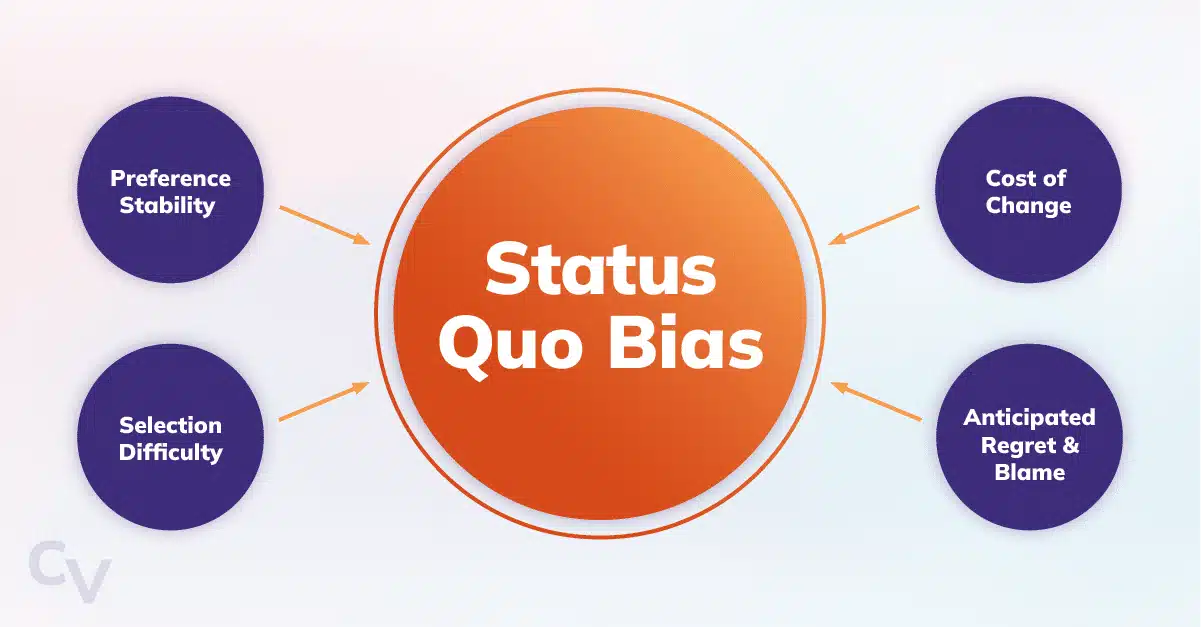
According to studies from Princeton University, status quo bias operates through several mechanisms: loss aversion (changes are framed as losses from current state), cognitive effort (changing requires thinking and action while maintaining status quo requires nothing), regret avoidance (if change goes wrong you regret it, but maintaining status quo that goes wrong feels less regrettable), and psychological ownership (current state feels “yours” in a way alternatives don’t).
Research from Duke University demonstrates that status quo bias intensifies with number of options (more alternatives make status quo even more attractive), decision complexity (harder decisions increase status quo preference), and time in current state (longer you’ve been in status quo, stronger the bias toward maintaining it). These factors combine to create powerful resistance to change even when change is clearly beneficial.
The Farmer Who Refused the Plow
An ancient teaching story tells of a farmer who cultivated his land using a simple wooden stick to break soil—the tool his ancestors had used for generations. A visiting metalsmith offered him a metal plow that would break soil more effectively, allowing him to cultivate more land with less effort.
The farmer examined the plow skeptically. “My stick has served me well,” he said. “Why should I change to this unfamiliar tool?” The metalsmith explained the plow’s advantages, demonstrated its effectiveness, and offered to let the farmer try it at no cost. Still the farmer hesitated.
“What if the plow breaks?” he worried. “What if I can’t learn to use it properly? What if there’s some problem with it I haven’t anticipated? My stick is reliable. I know exactly what it can do.” The metalsmith pointed out that the plow was stronger than the stick, that he would teach the farmer to use it, and that thousands of other farmers had successfully adopted plows without problems.
But the farmer ultimately refused. “I’ll stick with what I know,” he decided. He continued using his inferior tool, cultivating less land with more effort than neighbors who adopted the plow, purely because changing felt uncomfortable and risky while maintaining his current method felt safe and familiar.
A wise elder observing this pattern explained: “The farmer prefers his current inferior method not because he’s stupid or because the plow’s advantages aren’t real. He prefers it because it’s what he knows. The current method is his reference point, and any change from it feels like a loss of familiar ground even though it’s actually a gain of effectiveness. This is human nature—we cling to current states even when better alternatives are available, because the familiar feels safer than the unknown, regardless of objective evidence about which is actually better.”
Buddhist philosophy addresses status quo bias in teachings about impermanence and attachment. The Buddha taught that all things change constantly, yet humans persistently cling to current states as if they were permanent and secure. Status quo bias represents attachment to transient current conditions and resistance to inevitable change. The teaching emphasizes accepting impermanence and developing flexibility rather than rigidly clinging to familiar current states.
The Bhagavad Gita discusses this through Krishna’s teaching about action and the necessity of change. Krishna teaches that dharma sometimes requires departing from familiar comfortable paths to pursue right action. Status quo bias makes people prefer familiar wrong paths over unfamiliar right paths. Krishna’s teaching that Arjuna must fight despite his preference to maintain the status quo (not fighting) illustrates that wisdom sometimes requires embracing necessary change despite bias toward maintaining current comfortable states.
How Status Quo Bias Keeps Us Stuck
In personal finance and banking, status quo bias explains why people rarely switch banks, credit cards, or investment providers even when competitors offer clearly superior terms. Research shows that even when people acknowledge their current provider is inferior and changing would be financially beneficial, most never switch because maintaining the familiar current arrangement feels easier and less risky than changing to something new.
Studies from MIT tracking consumer behavior found that people require new options to be substantially superior—not just marginally better—before they’ll switch from status quo. The “switching threshold” varies but typically requires the new option to be 20-40% better than current option to overcome status quo bias. This creates market inefficiency where inferior providers retain customers simply because customers resist change.
In healthcare and medical treatment, status quo bias makes patients resist changing medications or treatments even when doctors recommend superior alternatives. Patients stay on medications that aren’t working well rather than trying new ones, resist changing healthcare providers even when current ones are unsatisfactory, and maintain unhealthy lifestyle patterns despite knowledge they should change.
Research demonstrates that default options in healthcare systems—whatever treatment patients are already receiving—have enormous sticking power. Doctors must actively overcome status quo bias to get patients to try better treatments, and many patients simply refuse beneficial changes because current treatment, however inadequate, is familiar while new treatment is unknown.
In technology adoption and software use, status quo bias explains why people continue using outdated software, inefficient workflows, and obsolete tools long after superior alternatives emerge. People say “this is how we’ve always done it” and resist learning new systems even when new systems would save time and effort after brief learning period.
Studies show that organizations often maintain inefficient legacy systems for decades past their useful life, despite ongoing costs far exceeding costs of switching to modern alternatives, simply because status quo bias makes “keep using what we have” the default preference requiring no justification while “switch to something better” requires extensive justification and faces resistance at every step.
In relationships and living situations, status quo bias keeps people in mediocre or even unsatisfactory relationships, jobs, and living arrangements. The current situation, however imperfect, is familiar and known. Alternatives, however potentially better, are uncertain and require effort to pursue. Status quo bias tips the scale toward staying in dissatisfying situations rather than pursuing potentially better alternatives.
Research demonstrates that people require very high levels of dissatisfaction before overcoming status quo bias in major life domains. Moderate dissatisfaction isn’t enough—the pain of current situation must become severe before people overcome bias toward maintaining it. This keeps people stuck in suboptimal situations longer than rational evaluation would suggest.
In organizational and policy reform, status quo bias creates enormous resistance to beneficial changes. Organizations maintain ineffective policies “because that’s how we’ve always done it.” Societies maintain inefficient laws and systems decades or centuries past their usefulness because reforming them requires overcoming collective status quo bias where millions of people resist change simply because change feels uncomfortable regardless of benefits.
Studies show that policy reforms, even those with clear benefits and broad expert support, face systematic resistance from status quo bias that must be overcome through extensive persuasion, pilot demonstrations, and sometimes waiting for generational turnover where people without attachment to old system are more open to new one.
Embracing Beneficial Change
The most important practice for overcoming status quo bias is actively questioning whether you prefer current state because it’s objectively best or simply because it’s current and familiar. When you resist change, ask: “If I were making this choice from scratch without any current situation, would I choose what I have now, or would I choose the alternative?” If you’d choose differently from scratch, status quo bias is likely operating.
Conduct periodic zero-based reviews of decisions and situations. In business, zero-based budgeting means justifying every expense from scratch rather than just continuing previous budget with minor adjustments. Apply this principle to your life: periodically evaluate your bank, job, living situation, relationships, habits, and tools as if choosing from scratch, without weight given to “this is what I currently have.” This overcomes status quo bias’s automatic preference for current state.
Frame changes as gains rather than losses. Status quo bias operates partly through loss framing—change feels like losing the current state. Reframing as gaining something better rather than losing something familiar reduces the bias. Instead of “I’m giving up my current comfortable schedule,” think “I’m gaining a better, healthier schedule that will improve my life.”
Start with small low-risk changes to build change capacity. Status quo bias is strongest for major life-changing decisions. Building comfort with change through small switches (trying new restaurant, new route, new technique) reduces bias for larger decisions by demonstrating that change often works well and familiar isn’t always better.
Seek outside perspectives on your status quo decisions. Friends, mentors, or advisors without attachment to your current state can more objectively evaluate whether maintaining it makes sense. They don’t experience your status quo bias and can point out when you’re clinging to inferior current states purely from bias rather than rational choice.
Set specific criteria that would trigger change, decided in advance. “I’ll switch banks if I find one offering X% better interest rates.” “I’ll change jobs if I find one with Y salary increase and Z better conditions.” Pre-committing to change criteria prevents status quo bias from raising the bar after you find alternatives meeting original criteria.
Remember Priya’s school that resisted a better schedule purely because the current one was familiar, and the farmer who refused the superior plow because his current stick was what he knew. Both illustrate how status quo bias makes people cling to inferior current states simply because they’re current, familiar, and comfortable, resisting beneficial change purely because it’s different from what exists now.
Status quo bias isn’t stupidity or excessive caution—it’s a predictable psychological preference for maintaining familiar current states that helped ancestors avoid unnecessary risks but often prevents modern humans from pursuing beneficial changes. The bias makes “do nothing” or “keep things as they are” the default requiring no justification while “change to something better” requires extensive justification and faces emotional resistance regardless of objective evidence. Breaking the bias requires recognizing when you’re preferring the familiar over the better, actively questioning whether current states are truly optimal or just comfortable, and building capacity to embrace beneficial change despite psychological pull toward maintaining comfortable familiar inadequate status quo. Sometimes the best decision is maintaining what works. But when the best decision is changing, status quo bias is what prevents you from making it.
Frequently Asked Questions
How is status quo bias different from being cautious or conservative in decision-making?
Healthy caution means carefully evaluating changes and requiring good evidence they’ll improve outcomes before adopting them—appropriate risk management. Status quo bias means preferring current state regardless of evidence, requiring alternatives to be dramatically superior before considering them, and experiencing emotional resistance to change independent of rational risk assessment. Caution is evidence-focused; status quo bias is familiarity-focused.
Why did status quo bias evolve if it often prevents beneficial changes?
In ancestral environments with high uncertainty and genuine danger from the unknown, avoiding change and sticking with proven methods that kept ancestors alive was adaptive. “If it ain’t broke, don’t fix it” was good heuristic when changes often were actually worse and testing them was costly or dangerous. Modern environments have less genuinely dangerous change and more beneficial innovations, exposing the downside of a bias that was more adaptive ancestrally.
Can status quo bias ever be beneficial in modern contexts?
Sometimes yes—it prevents chasing every new trend, maintains valuable traditions worth preserving, and provides stability in situations where constant change would be chaotic. However, the bias is typically too strong relative to modern environments where many changes are beneficial and innovation is rapid. The bias preventing some bad changes doesn’t compensate for the much larger number of beneficial changes it prevents.
Are some people more prone to status quo bias than others?
Yes—research shows individual differences. People high in openness to experience and low in need for closure show weaker status quo bias. Older people show stronger bias (longer time in status quo increases attachment). People in unstable situations sometimes show less bias (constantly changing status quo reduces attachment). However, everyone shows substantial status quo bias, with individual differences being matters of degree.
How can organizations reduce status quo bias in decision-making?
Several techniques: (1) Require periodic zero-based reviews where current policies must be justified rather than assumed, (2) Assign someone devil’s advocate role to argue against maintaining status quo, (3) Use A/B testing or pilot programs that directly compare current and alternative approaches with objective metrics, (4) Bring in outside consultants without attachment to current systems, (5) Create cultures that explicitly reward and celebrate beneficial changes rather than punishing any departure from established practices. These reduce but don’t eliminate organizational status quo bias.
Observer Voice is the one stop site for National, International news, Sports, Editor’s Choice, Art/culture contents, Quotes and much more. We also cover historical contents. Historical contents includes World History, Indian History, and what happened today. The website also covers Entertainment across the India and World.

