

Why Your Old Bicycle Suddenly Feels Priceless: The Strange Psychology of Ownership
The Potter's Magic Clay

In a small village in Rajasthan, there lived a potter named Gopal who made beautiful clay pots. One day, a traveler offered to buy a simple water pot from his collection for fifty rupees. Gopal refused, saying, “This pot is worth at least two hundred rupees.” The traveler was confused because just that morning, he’d seen Gopal buy identical clay and materials for barely twenty rupees at the market.
“But you just bought the clay for twenty rupees,” the traveler protested. “How is the pot now worth two hundred?” Gopal smiled and said, “Ah, but this pot is mine now. I’ve shaped it with my hands, fired it in my kiln, and given it a place in my shop. It’s no longer just clay—it’s my creation.”
The traveler shook his head and left. The next week, he returned with an identical pot made by another potter and offered it to Gopal for fifty rupees. “Would you buy this pot?” he asked. Gopal laughed and said, “Why would I pay fifty rupees for something I can make for twenty?”
This folk wisdom captures what psychologists call the endowment effect—our tendency to value things more highly simply because we own them. It’s one of the most powerful and puzzling biases in human psychology, affecting everything from garage sales to international trade negotiations.
What Is the Endowment Effect?
The endowment effect is our irrational tendency to demand much more money to give up something we own than we would be willing to pay to acquire the same thing. If you own a cricket bat, you might refuse to sell it for less than three thousand rupees. But if you didn’t own it and saw an identical bat in a shop, you might think one thousand five hundred rupees is too expensive.
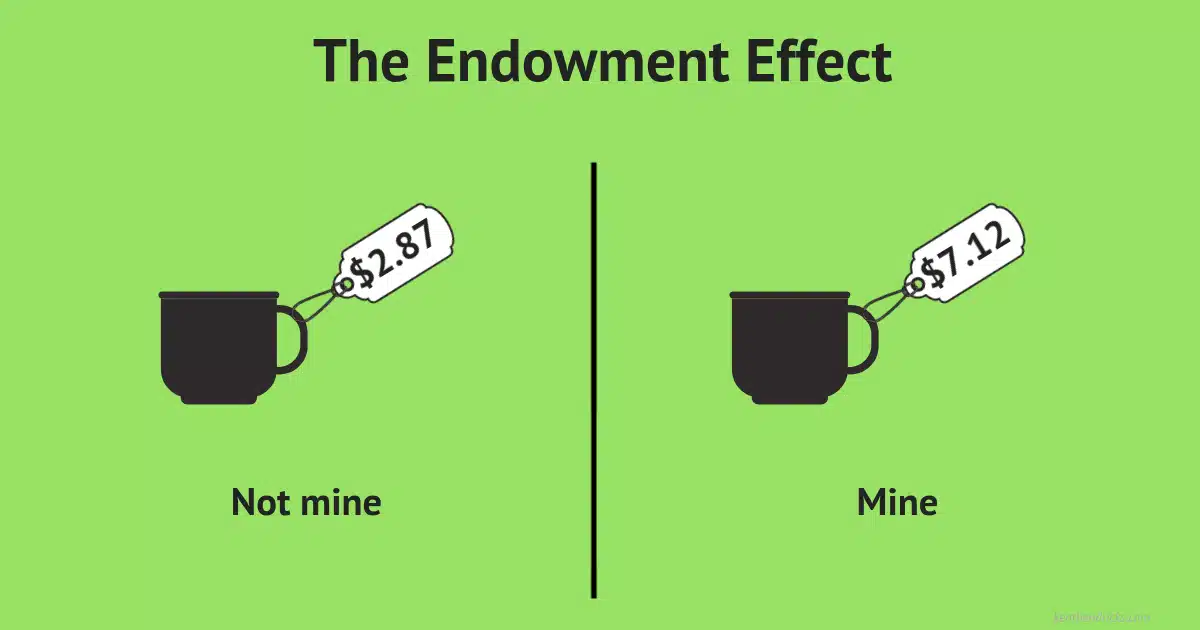
This phenomenon was discovered by economist Richard Thaler, who won the Nobel Prize for his work on behavioral economics. In a famous experiment at Cornell University, researchers gave half the students coffee mugs and asked them to set selling prices. They asked the other half how much they’d pay to buy identical mugs. The results were shocking—mug owners wanted an average of seven dollars to sell, while non-owners offered only three dollars to buy. Ownership instantly doubled the perceived value.
Research from Duke University shows this effect happens within seconds of taking possession. The moment you touch something and consider it “yours,” your brain starts valuing it more highly. This isn’t rational—the mug doesn’t change, your circumstances don’t change, but your perception transforms completely.
The Basketball Ticket Experiment That Changed Economics
Duke University has a famous basketball team, and tickets to their games are extremely hard to get. Students enter a lottery, and winners can buy tickets. In a groundbreaking study, researchers contacted both lottery winners and losers just hours after the results were announced.
They asked winners, “How much money would it take for you to sell your ticket?” The average answer was around two thousand four hundred dollars. Then they asked losers, “How much would you pay to buy a ticket?” The average answer was around one hundred seventy dollars. The same ticket, the same game, the same students from the same university—but winners valued tickets fourteen times higher than buyers simply because they owned them for a few hours.
According to research published by Stanford University, this irrational attachment to owned objects causes enormous economic inefficiencies. People hold onto stocks they should sell, refuse reasonable offers for houses they should move from, and keep jobs they should quit—all because ownership creates emotional attachment that clouds judgment.
Ancient Wisdom About Letting Go
Ancient philosophies understood this human tendency long before modern economics studied it. Buddhist teachings emphasize non-attachment precisely because they recognized how ownership creates suffering. The story of the monk and the heavy stone illustrates this perfectly.
Two monks were traveling when they encountered a beautiful, rare gemstone on the path. The younger monk picked it up, admiring its beauty. “This could feed a village for a year,” he said. The older monk replied, “Then why are you still holding it?” The younger monk couldn’t answer. He’d held the stone for only moments, but already he felt it was his. Putting it down felt like losing something valuable, even though he’d never had it before picking it up.
In the Mahabharata, there’s a conversation where Yudhishthira asks a wise sage why people cling to possessions that bring them no joy. The sage replies that humans confuse ownership with identity—we believe our possessions define who we are, so giving them up feels like losing part of ourselves. This ancient insight matches modern psychological research perfectly.
The Sufi poet Rumi wrote, “You think you own things, but really they own you.” He recognized that our attachments to possessions create mental prisons. The more we have, the more we fear losing, and the more we overvalue what we possess simply to justify holding onto it.
How the Endowment Effect Controls Our Daily Lives
Walk through any Indian household during spring cleaning, and you’ll see the endowment effect in action. Mothers hold onto old sarees they haven’t worn in twenty years, insisting each one is special and irreplaceable. Fathers keep broken electronics in storage, convinced they’ll be useful someday. Children refuse to donate toys they haven’t touched in years because “those are mine.”
In real estate, the endowment effect causes massive market distortions. Homeowners consistently overvalue their properties compared to market prices. Research from Yale University shows that sellers typically list homes for fifteen to twenty percent above fair market value, genuinely believing their house is worth more than identical neighboring houses. They remember every improvement, every happy memory, every rupee invested—none of which actually increases market value, but all of which increase their personal valuation.
The effect devastates negotiation and trade. In business deals, both parties overvalue what they have and undervalue what the other offers. A company might refuse to sell a division for ten crore rupees while simultaneously refusing to buy a competitor’s identical division for eight crore rupees. Each side’s ownership bias creates a gap that prevents mutually beneficial trades.
Online marketplaces like OLX and Facebook Marketplace overflow with items priced far above reasonable value because sellers can’t overcome their endowment effect. Someone lists a used laptop for fifteen thousand rupees that they’d never pay ten thousand rupees to buy. When it doesn’t sell for months, they blame “cheap buyers” rather than recognizing their own bias.
In personal relationships, the endowment effect manifests as jealousy and possessiveness. People who wouldn’t date someone new become intensely attached once that person becomes “mine.” The relationship status changes perception entirely. This explains why breakups hurt so much—we’re not just losing a person, we’re losing someone we’ve come to overvalue through ownership.
Breaking Free From Ownership Bias
Understanding the endowment effect provides practical strategies for better decision-making. When selling something, ask yourself honestly, “Would I buy this item today at the price I’m asking?” This question forces you to switch perspectives from owner to buyer, often revealing that your asking price is unrealistic.
Before making major financial decisions, imagine you don’t own the asset in question. If you owned shares in a struggling company, would you buy them today? If no, you should probably sell. If you owned a house in a declining neighborhood, would you buy it today? If no, consider moving. This mental trick helps overcome ownership bias.
The “replacement test” works well for physical possessions. Before keeping something during decluttering, ask, “If this item were destroyed, would I replace it?” If the answer is no, you’re keeping it because of ownership bias, not actual value. This insight helps many people finally donate or discard items they haven’t used in years.
Professional investors and traders develop systematic rules to combat the endowment effect. They decide selling prices before buying assets, committing to exit strategies when their judgment isn’t clouded by ownership. They track “opportunity cost”—what else they could do with the money tied up in current holdings. These techniques help override emotional attachment with rational analysis.
Perhaps the deepest wisdom comes from practicing gratitude while holding possessions lightly. Enjoy what you have while you have it, but remember that all ownership is temporary. The potter’s clay returns to earth eventually, the mug breaks, the ticket’s game ends, and the house becomes someone else’s home. By recognizing that ownership is temporary and often arbitrary, we can make clearer decisions about when to hold and when to let go.
The endowment effect will never completely disappear—it’s hardwired into human psychology. But awareness transforms it from an invisible force controlling our choices into a recognized bias we can account for and adjust. When you catch yourself overvaluing something simply because it’s yours, smile at this very human tendency, remember Gopal the potter, and ask yourself what the object is truly worth beyond your sense of ownership.
Frequently Asked Questions
Does the endowment effect apply to all types of possessions?
Not equally. Research shows the effect is strongest for items with personal or emotional significance, like gifts, heirlooms, or things we’ve created ourselves. It’s weaker for purely functional or commodity items like paper clips or generic food products. However, even these show some endowment effect under certain conditions. Interestingly, the effect is also stronger for physical objects we can touch than for digital goods or financial assets.
Can companies exploit the endowment effect in marketing?
Absolutely, and they do constantly. Free trial periods work by triggering the endowment effect—once you’ve used a product for thirty days, it feels like “yours,” and canceling feels like a loss rather than avoiding a purchase. Similarly, “try before you buy” programs and money-back guarantees exploit this bias. Once you take something home and integrate it into your life, returning it becomes psychologically much harder than simply not buying it in the first place.
Is the endowment effect the same across different cultures?
Research suggests some cultural variation, though the effect appears universal. Studies show it’s somewhat weaker in cultures that emphasize collective ownership and sharing, like some East Asian and indigenous communities, compared to highly individualistic Western cultures. However, even in collectivist cultures, the effect still exists—it just manifests differently. Indian joint family systems, for example, may reduce individual endowment effects while creating collective family attachment to properties and heirlooms.
How does the endowment effect relate to sentimental value?
They’re related but different concepts. Sentimental value is a rational reason to value something more highly—your grandmother’s ring genuinely is more valuable to you than an identical ring because of its history and meaning. The endowment effect, however, is irrational overvaluation based solely on ownership, independent of any special history or meaning. They often work together, making it especially hard to let go of inherited possessions that trigger both sentimental attachment and ownership bias.
Can children be taught to recognize and overcome the endowment effect?
Yes, research suggests early education helps. Teaching children to regularly donate toys they don’t use, practicing gift-giving, and discussing the difference between “mine” and “important to me” all help develop healthy relationships with possessions. Role-playing exercises where children experience both sides of trades help them recognize how perspective changes valuation. However, the endowment effect has deep evolutionary roots related to resource scarcity, so it never disappears completely—awareness and management are more realistic goals than elimination.
Observer Voice is the one stop site for National, International news, Sports, Editor’s Choice, Art/culture contents, Quotes and much more. We also cover historical contents. Historical contents includes World History, Indian History, and what happened today. The website also covers Entertainment across the India and World.

