

Why Your Old Decisions Always Seem Brilliant: The Choice-Supportive Bias

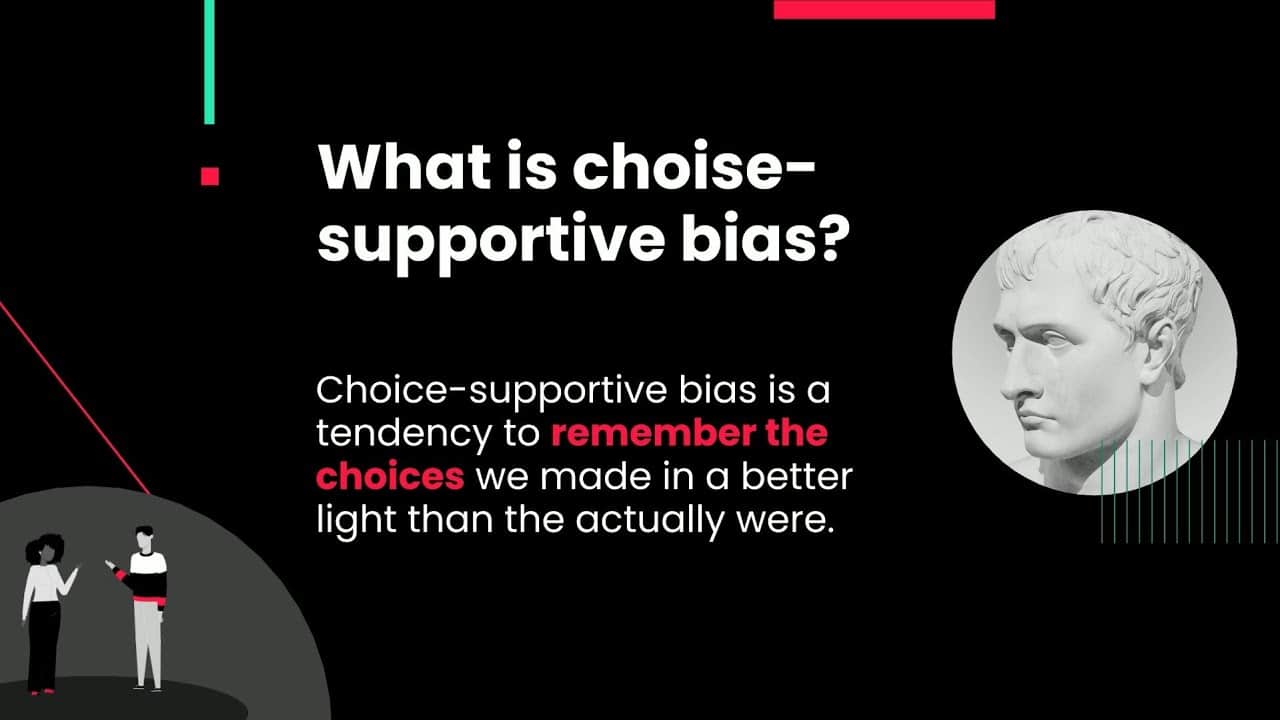
Remember that smartphone you bought two years ago? At the time, maybe you agonized over the decision, comparing specs and prices, worried you might be making a mistake. But now, looking back, you probably remember that choice as obviously correct—the best option available, perfectly suited to your needs. You might even have forgotten the doubts you had or the appealing features of the models you rejected. This is choice-supportive bias, and it’s quietly rewriting your personal history every single day. This psychological phenomenon causes us to remember our past decisions as better, wiser, and more justified than they actually were at the time. Our minds don’t just make choices and move on; they actively reconstruct memories of those choices to make ourselves look smarter, more rational, and less conflicted than we really were.
Choice-supportive bias serves a psychological function: it protects our self-esteem and reduces cognitive dissonance. Admitting that you made a poor choice, wasted money, or chose wrongly feels bad. Your brain protects you from this discomfort by subtly editing your memories. It amplifies the positive features of what you chose while downplaying or forgetting the negatives. Simultaneously, it minimizes the good features of rejected options while emphasizing their flaws. The result is a memory that makes your choice seem obvious and excellent in retrospect, even if you were genuinely uncertain at the time. Research from Northwestern University’s psychology department demonstrates that this bias operates automatically and unconsciously. People don’t deliberately lie about their past decisions; they genuinely remember them as better than they were.
There’s an Akbar-Birbal tale that captures this phenomenon perfectly. Akbar chose a particular horse from the royal stables for an important journey, despite his advisors recommending a different horse. The journey proved difficult, and the chosen horse performed adequately but not exceptionally. Months later, Akbar recounted the story, praising his “brilliant choice” of horse and claiming he’d always known it was the best. Birbal gently reminded him that at the time, he’d been uncertain and had only chosen that horse because it was standing nearest to him. Akbar, confronted with the truth, insisted his memory was correct—he’d definitely recognized the horse’s superior qualities immediately. Birbal smiled, recognizing that the emperor’s mind had rewritten history to protect his pride. The lesson: we are all emperors of our own memories, revising the past to make ourselves appear wiser than we were.
How Your Brain Rewrites Personal History
Choice-supportive bias works through selective memory enhancement and suppression. After making a choice, your brain begins a subtle editing process. Features of your chosen option that support your decision become more prominent in memory, easier to recall, and seem more important than they did originally. Meanwhile, drawbacks of your choice fade, become harder to remember, or get mentally minimized as “not that bad” or “worth it for the benefits.” The unchosen alternatives undergo the opposite transformation. Their appealing features become less memorable, while their flaws grow in your recollection. This memory editing isn’t intentional dishonesty; it happens automatically as your brain consolidates experiences into long-term memory.
Studies from Yale University’s memory and cognition lab tracked people’s evaluations of choices over time. Immediately after making decisions, participants rated their chosen and rejected options fairly accurately, acknowledging both pros and cons of each. Weeks later, when asked to recall these evaluations, participants consistently remembered their chosen options as better and the rejected options as worse than they’d originally rated them. The distortion happened during memory consolidation and retrieval, not at the moment of choice. Interestingly, the bias strengthened when the original decision had been difficult or uncertain. The harder the choice, the more our brains need to justify it retrospectively, and the more aggressively memory gets edited to support that justification.
Think about Rahul, who chose to study engineering despite being passionate about literature. The decision was agonizing. He made lists of pros and cons, lost sleep, and felt genuinely torn. Five years later, he describes that choice as “obvious” and “the only rational option,” completely forgetting the intense doubt he experienced. When his younger cousin faces a similar decision and mentions considering literature, Rahul confidently advises, “Engineering is clearly the practical choice. I never regretted it for a moment.” But that’s not true. He regretted it intensely during his first two years, struggled with courses, and often wondered what if. His brain has simply edited those memories to reduce cognitive dissonance and maintain a positive self-image as someone who makes good decisions. This memory revision serves him psychologically but makes his advice less valuable to his cousin, who needs to hear about real trade-offs, not sanitized retrospective certainty.
The Hidden Costs of Remembering Ourselves as Always Right
Choice-supportive bias might protect our egos, but it comes with significant costs. First, it prevents us from learning from mistakes. If you can’t accurately remember why you made a poor decision, you can’t identify patterns and avoid repeating errors. Your edited memory shows you making a reasonable choice that simply faced bad luck or unforeseen circumstances, when the truth might be that you ignored warning signs or made predictable errors in judgment. This self-deception blocks improvement. Second, the bias makes us overconfident in our decision-making abilities. If you remember most of your past choices as good ones, you’ll trust your judgment too much in future decisions, underestimating the possibility of error.
The bias also damages our ability to give good advice. When you remember your choices as obviously correct, you can’t empathize with others facing similar dilemmas. You tell them “the answer is clear” when it isn’t, because your memory has made your own difficult choice seem easy in retrospect. This misleads people who need realistic guidance about tough trade-offs. According to research on decision-making and advice-giving, people who are most confident about their past decisions often give the worst advice because their memory distortions prevent them from acknowledging genuine complexity and uncertainty.
Relationships suffer too. In conflicts, both partners often remember their own behavior as more reasonable and the other’s behavior as more problematic than was actually the case. Choice-supportive bias reinforces these one-sided memories. You remember your decision to work late as a necessary sacrifice for the family, forgetting that you also wanted to avoid a difficult conversation. Your partner remembers their decision to confront you as brave honesty, forgetting they were also venting anger. Each person’s memory supports their own position, making resolution harder. Neither is deliberately lying; both genuinely remember events in self-serving ways that feel absolutely true.
Consider Meera and Arjun’s vacation decision. They debated between mountains and beach. Meera pushed for mountains, and they went. The trip was mixed—beautiful views but cold, rainy weather. A year later, they’re planning another trip. Meera remembers the mountain vacation as wonderful and obviously the right choice, her preference fully vindicated. Arjun remembers it less favorably but doesn’t directly contradict her. When planning the new trip, Meera’s confidence that “mountains worked so well last time” influences the decision, even though the truth was more complicated. Her choice-supportive bias, if unchecked, could lead to another choice that doesn’t actually reflect lessons from experience.
Breaking Free: Strategies for Honest Memory
Overcoming choice-supportive bias requires deliberate effort and external aids. The most effective strategy is keeping decision journals. Before making important choices, write down your reasoning, doubts, and honest evaluation of all options. Include your uncertainties, the appealing features of rejected alternatives, and the drawbacks of what you’re leaning toward. Later, when your memory tries to rewrite history, you have an objective record. Reading your past entries can be humbling—you’ll discover you were far more uncertain than you now remember, and the rejected options were more attractive than current memory suggests.
Seek out contrary perspectives. Ask people who disagreed with your decision to remind you of their reasoning. Don’t dismiss their objections as wrong simply because you chose differently. Those alternative viewpoints help reconstruct a more balanced picture of the original decision context. Practice active recall of your original doubts before letting yourself celebrate a decision’s outcome. When something works out, resist the temptation to immediately think “I knew it all along.” Force yourself to remember “Actually, I was quite worried about X and Y at the time.”
Distinguish between outcome and decision quality. A good decision can have a bad outcome due to bad luck. A bad decision can have a good outcome due to good luck. Choice-supportive bias conflates these, remembering good outcomes as validating good decisions and bad outcomes as just bad luck. Train yourself to evaluate decisions based on the information and reasoning available at the time, not on how things turned out afterward. This is hard because outcomes are vivid and memorable while reasoning processes fade, but it’s essential for accurate self-assessment.
Build in regular decision reviews. For important choices—career moves, major purchases, relationship decisions—schedule time a few months later to honestly evaluate how the choice is working out. Don’t just ask “Am I happy with this?” but “If I were making this decision again with what I know now, what would I do differently?” This practice combats the bias by forcing ongoing honest assessment rather than allowing memory to gradually beautify the past. Research from Stanford’s decision science lab shows that people who regularly review decisions this way make better future choices and show reduced choice-supportive bias over time.
Finally, cultivate intellectual humility. Accept that you’ve made poor decisions in the past, you’re making poor decisions in the present, and you’ll make poor decisions in the future. This isn’t pessimism; it’s realism. Everyone makes mistakes. The question is whether you can admit them, learn from them, and improve. Choice-supportive bias thrives on the need to see yourself as consistently smart and right. If you can tolerate seeing yourself as inconsistently smart—sometimes wise, sometimes foolish, always learning—the bias loses its psychological necessity.
There’s a Tenali Raman story where a merchant boasted about his “brilliant” business decisions and how he’d “always known” which investments would succeed. Tenali asked him to review his account books from previous years. The books revealed numerous failed ventures the merchant had completely forgotten, plus evidence that his “brilliant” successful choices had been highly uncertain at the time, with several advisors recommending against them. The merchant, confronted with written evidence, had to acknowledge that his memory had been far kinder to him than reality warranted. Tenali’s lesson: written records protect against the mind’s natural tendency to rewrite failure as success and uncertainty as confidence.
Frequently Asked Questions
Q1: Is choice-supportive bias the same as confirmation bias? They’re related but different. Confirmation bias is seeking information that supports existing beliefs. Choice-supportive bias is remembering past choices as better than they were. Confirmation bias affects how you gather information before and after decisions. Choice-supportive bias affects how you remember decisions after making them.
Q2: Does this bias mean we should doubt all our positive memories of past decisions? Not necessarily. Some decisions genuinely were good and remain good in accurate memory. The point is that memory of decisions is systematically biased in a self-flattering direction. Healthy skepticism about your own certainty, especially when remembering difficult past choices as obvious or easy, helps correct for the bias.
Q3: Can choice-supportive bias ever be helpful? Psychologically, yes—it protects self-esteem and reduces regret, which can be mentally healthy. But it comes at the cost of accurate self-knowledge and learning from experience. Whether this trade-off is worthwhile depends on context. For maintaining general life satisfaction, some choice-supportive bias might be adaptive. For improving decision-making skills, it’s an obstacle.
Q4: Do people with depression show less choice-supportive bias? Research suggests yes. People with depression often show more accurate self-assessment and memory, including remembering their decisions more realistically. This is sometimes called “depressive realism.” However, this doesn’t mean depression is good—it means that mental health sometimes involves benign self-deception, while depression involves painful accuracy.
Q5: How can I tell if I’m experiencing choice-supportive bias about a specific decision? Ask yourself: Can I remember genuine drawbacks of my choice and genuine benefits of rejected alternatives? If your memory makes your choice seem flawless and alternatives seem terrible, bias is probably operating. Another test: Do I remember the decision as easier and more obvious than it felt at the time? If yes, your memory has likely been edited.
Observer Voice is the one stop site for National, International news, Sports, Editor’s Choice, Art/culture contents, Quotes and much more. We also cover historical contents. Historical contents includes World History, Indian History, and what happened today. The website also covers Entertainment across the India and World.

