

Why Children Think Trees Get Sad: Understanding Human-Centered Thinking

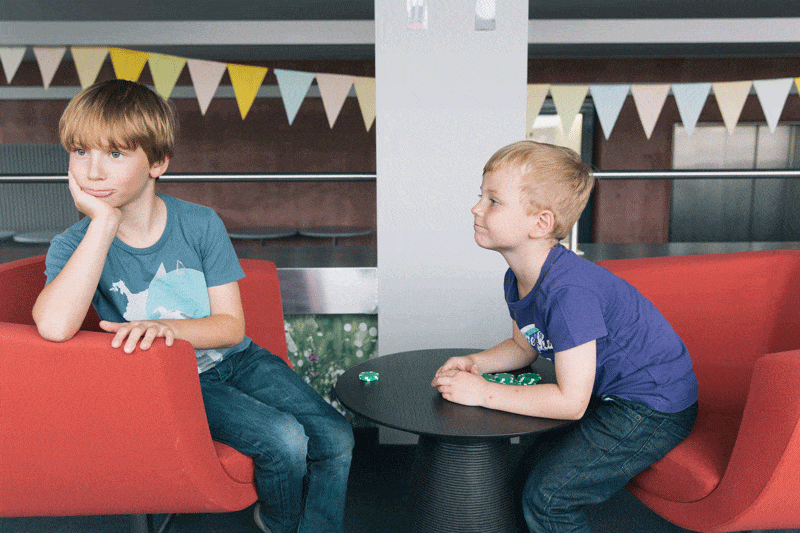
“Does the moon feel lonely at night?” asked five-year-old Riya, looking up at the sky.
Her mother smiled. “The moon is not a person, beta. It doesn’t have feelings.”
“But it’s all alone up there!” Riya insisted.
If you’ve ever heard a child ask whether plants feel pain, or whether clouds get tired of flying, you’ve witnessed anthropocentric thinking in action. It’s one of the most fascinating quirks of how young minds understand the natural world—and it reveals something profound about how all humans think.
Anthropocentric thinking is the tendency to apply one’s own experience of being human to other biological systems Wikipedia. In simpler terms: kids (and sometimes adults!) use themselves as the reference point for understanding everything in nature.
The Great Experiment: Do Bees Have Hearts Like We Do?
Researchers at Northwestern University conducted experiments with children as young as 3 years old to understand how they reason about biology PubMed Central. They introduced children to made-up body parts (like “andro” or “omentum”) and told them that humans have this part. Then they asked: “Do you think bees/dogs/rabbits also have this inside them?”
The results were eye-opening. Five-year-old children consistently adopted an anthropocentric stance, privileging humans over nonhuman animals as an inductive base PNAS. If humans had it, they reasoned, then animals similar to humans (like dogs) probably had it too. But insects or worms? Not so much.
Interestingly, 3-year-olds showed no hint of anthropocentrism, suggesting it’s not an initial step in conceptual development but an acquired perspective that emerges between ages 3 and 5 in urban children PubMed Central.
The Story of the Compassionate Tree
There’s a beautiful Jataka tale about a tree that supposedly wept when its branches were cut. The story teaches compassion, but it also reveals something about human psychology: we’ve been projecting human emotions onto nature for thousands of years.
In India, we speak of “Mother Earth” and worship trees during festivals. We say rivers are “angry” when they flood and mountains “stand proud.” These aren’t just poetic expressions—they reflect a deep-rooted tendency to see the natural world through human eyes.
Japanese children as young as six have been found to use their knowledge of humans to make guesses about how relatively unfamiliar organisms like rabbits, grasshoppers, or tulips would react in novel situations PubMed Central.
The Two Sides of Human-Centered Thinking
Anthropocentric thinking works in two opposite ways, and both can lead to misunderstandings:
Over-attribution: Giving human qualities to non-human things
Children might think:
- “Plants turn toward the sun because they want sunlight” (attributing desire)
- “Trees must be sad when their leaves fall” (attributing emotions)
- “Insects probably get scared when we chase them” (attributing fear)
Under-attribution: Denying basic biological similarities
Because insects look so different from humans, children might think:
- “Insects don’t need food” (but they do!)
- “Fish don’t have hearts” (but they do!)
- “Worms don’t reproduce” (but they definitely do!)
Research found that prior to age 10, children showed a regular decline in attributing biologically necessary properties to organisms that corresponded to their phylogenetic distance from humans PubMed Central. The further an animal looked from humans, the less likely kids thought it shared basic life processes with us.
Why Do Children Think This Way?
Anthropocentric thinking isn’t stupidity—it’s actually a clever mental shortcut.
Imagine you’re a child encountering a rabbit for the first time. You’ve never learned rabbit biology. But you know humans:
- Humans eat food → Maybe rabbits eat food too?
- Humans need water → Maybe rabbits need water too?
- Humans have hearts → Maybe rabbits have hearts too?
This reasoning by analogy is usually helpful! The problem is when it leads to incorrect conclusions, like assuming that because humans don’t like being in the dark, plants must also prefer sunlight out of emotional preference rather than biological necessity.
Reasoning by analogy is an attractive thinking strategy, and it can be tempting to apply one’s own experience to other biological systems Wikipedia.
Culture and Experience Shape How We Think
Here’s where it gets really interesting: anthropocentric thinking isn’t universal or inevitable.
Studies involving children from indigenous peoples of the Americas have found little use of anthropocentric thinking PubMed Central. Children from the Wichí people in South America, for example, think about organisms in terms of ecological relationships and taxonomic similarities rather than comparing everything to humans.
Similarly, research found that children who raised goldfish tended to reason about frogs by analogy to goldfish, whereas children with no experience with goldfish did so by analogy to humans PubMed Central.
What does this tell us? The more direct experience children have with diverse living things, the less they rely on “humans as the default template” for understanding biology.
From Childhood Thinking to Classroom Misconceptions
The fascinating part? This childhood thinking pattern doesn’t always disappear with age.
Even college students studying biology sometimes fall back on anthropocentric thinking when faced with unfamiliar concepts. They might think:
- “Extinction is bad because death is bad” (but programmed cell death is essential to life!)
- “Predators are evil because they kill” (but ecosystems need predators!)
- “Humans are separate from the animal kingdom” (we’re not—we’re primates!)
These misconceptions all share a common root: viewing nature through exclusively human values and experiences.
The Wisdom in Ecological Thinking
The Upanishads teach “Vasudhaiva Kutumbakam”—the whole world is one family. But not in the sense that everything is like humans. Rather, in the sense that all life is interconnected, each species playing its unique role.
The Buddha observed nature deeply and taught about interdependence—how everything arises in relationship to everything else, not in terms of human categories.
These ancient teachings point toward ecological thinking: understanding organisms in terms of their relationships with each other and their environment, not just in terms of their similarity to humans.
How to Think More Ecologically
For students:
Observe real organisms: Spend time watching insects, birds, plants. Notice how they behave differently from humans.
Learn taxonomies: Understanding that insects are arthropods, not “things sort of like tiny humans,” helps break anthropocentric patterns.
Ask ecological questions: Instead of “What would I do?”, ask “What does this organism need to survive in its environment?”
Recognize differences: It’s okay that a jellyfish doesn’t have a brain like ours—it has a nerve net that works perfectly for a jellyfish!
Question your assumptions: When you think “plants want sunlight,” pause and rephrase: “Plants need sunlight for photosynthesis.”
The Beauty of Biodiversity
The natural world is far stranger and more wonderful than if everything were just variations on the human theme. Octopuses have three hearts and blue blood. Some bacteria can survive in boiling water. Trees communicate through underground fungal networks.
Understanding that these organisms operate on entirely different principles than humans doesn’t make them less remarkable—it makes them more amazing!
The next time you catch yourself thinking “Would a fish be sad if…?”, remember: you’re experiencing a perfectly natural human tendency. But now you know to go one step further and ask: “What does a fish actually need and feel based on fish biology, not human emotions?”
That’s when the real learning begins.
Frequently Asked Questions
Q1: Is anthropocentric thinking wrong or bad?
Not necessarily! It’s a useful mental shortcut, especially when we’re right (animals do need food like we do). The problem is only when it leads to incorrect biological assumptions or prevents us from understanding organisms on their own terms.
Q2: Do only children think anthropocentrically?
No. Adults do it too, especially when encountering unfamiliar organisms or biological concepts. However, people with more diverse experiences with nature (farmers, indigenous communities, biologists) tend to do it less.
Q3: How can teachers help students move beyond anthropocentric thinking?
By providing hands-on experiences with diverse organisms, teaching about evolutionary relationships, emphasizing ecological connections, and explicitly pointing out when students are reasoning by analogy to humans instead of using actual biological knowledge.
Q4: Does anthropocentric thinking affect environmental attitudes?
Yes! If people see humans as separate from nature rather than part of it, they may care less about environmental conservation. Conversely, anthropomorphizing nature (seeing animals as having human feelings) can increase empathy and conservation behavior.
Q5: Is it okay to teach children through anthropomorphic stories?
In moderation, yes. Stories about friendly trees or brave little toasters can teach values and engage imagination. The key is to eventually also teach biological accuracy alongside the stories, so children learn to distinguish fantasy from science.
Observer Voice is the one stop site for National, International news, Sports, Editor’s Choice, Art/culture contents, Quotes and much more. We also cover historical contents. Historical contents includes World History, Indian History, and what happened today. The website also covers Entertainment across the India and World.

