

PCOS (Polycystic Ovary Syndrome): Hormones, Insulin, and Why It’s More Than a Fertility Issue

Millions of women around the world are living with a condition that affects far more than their ovaries. It disrupts hormones, interferes with how the body processes sugar, affects the skin, the hair, the weight, the mood, and the heart — and yet, for most of the women who have it, the diagnosis takes years to arrive. Polycystic Ovary Syndrome, or PCOS, is one of the most common hormonal disorders affecting women today, and one of the most misunderstood. It is not just a reproductive condition. It is a whole-body syndrome that deserves far greater attention than it currently receives.
What Is PCOS?
Polycystic Ovary Syndrome is a common hormonal disorder in which higher than normal androgen levels lead to irregular menstrual periods, abnormal ovulation, infertility, excess facial or body hair, and acne in women. PCOS affects an estimated 10 to 13% of reproductive-aged women. It is estimated that up to 70% of women with PCOS worldwide do not know they have the condition. PCOS is the most common cause of anovulation among women globally and a leading cause of infertility. PubMed
Anovulation simply means the ovaries are not releasing eggs regularly. This disrupts the menstrual cycle and makes it harder to conceive. But infertility is only one chapter in a much larger story.
PCOS is a common endocrine disorder affecting approximately 10% of middle-aged women worldwide. Alarmingly, approximately 70% of affected individuals remain undiagnosed, preventing timely intervention and management. This enormous diagnostic gap means that countless women are living with symptoms they do not understand, or receiving treatment only for individual symptoms — such as acne or weight gain — without ever identifying the root cause. ESMO Open
What Causes PCOS?
The exact cause of PCOS is not fully understood, but scientists know it involves a combination of genetic and environmental factors. The cause of PCOS is unknown, but women with a family history of PCOS or type 2 diabetes are at higher risk. PCOS runs in families but can cause a range of different symptoms and affect women in different ways. PubMed
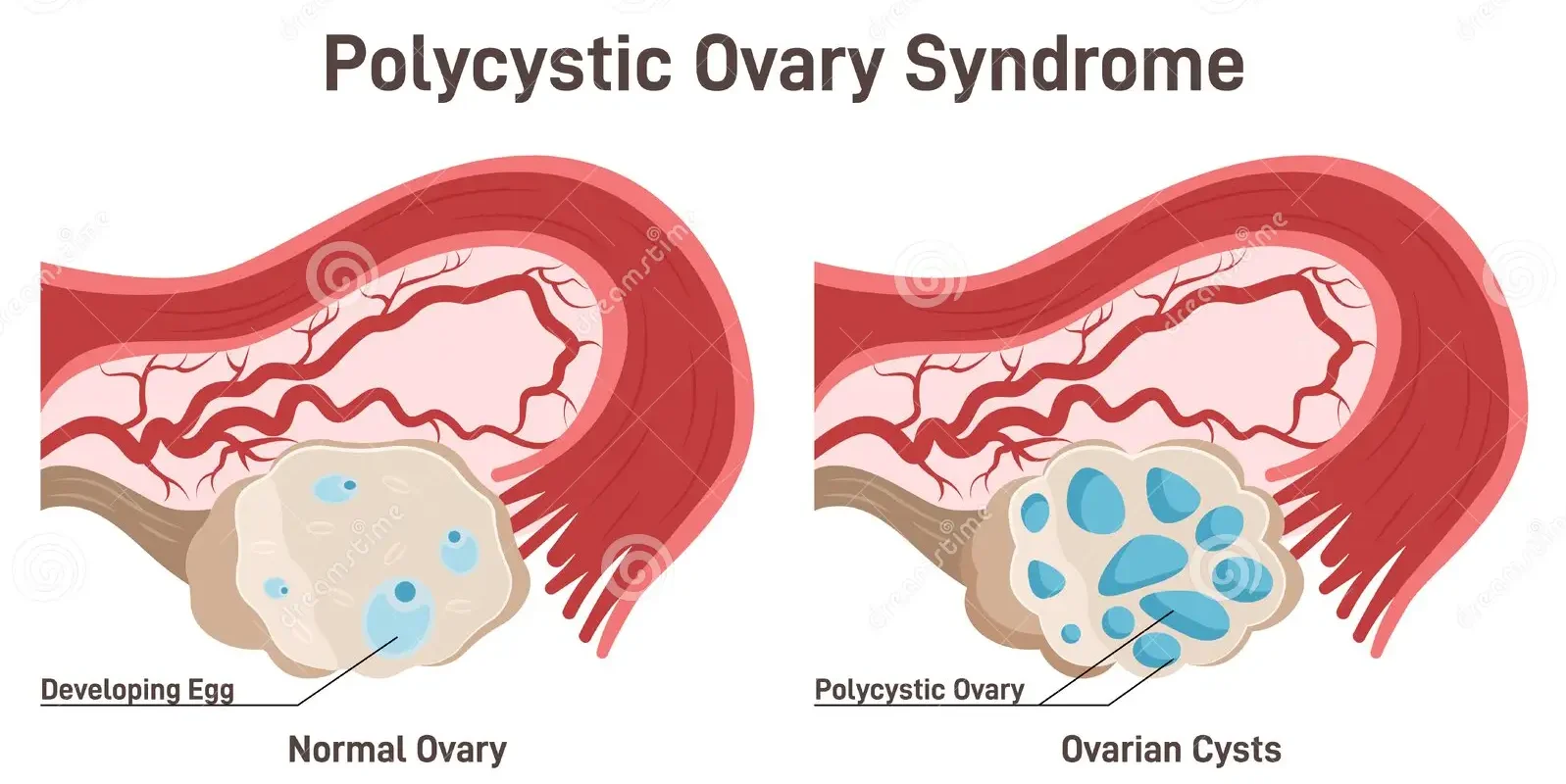
At the heart of the condition is a hormonal imbalance. The ovaries produce too much androgen — a group of hormones often called “male hormones,” though women produce them too. Elevated androgens interfere with the development and release of eggs, leading to the irregular cycles that characterise the condition. Small fluid-filled sacs called follicles can accumulate in the ovaries because eggs fail to mature and release — this is where the word “polycystic” comes from, though not every woman with PCOS will have these cysts.
The Insulin Connection
One of the most important — and least discussed — aspects of PCOS is its deep connection to insulin. Insulin resistance has been highly associated with PCOS. Around 33 to 66% of patients with PCOS have an abnormal degree of insulin resistance. NCBI
Insulin is the hormone that helps cells absorb sugar from the blood to use as energy. When cells become resistant to insulin, the pancreas compensates by producing more of it. This excess insulin then signals the ovaries to produce more androgens, which worsens the hormonal imbalance and creates a damaging cycle. Insulin resistance contributes to metabolic features but also to reproductive features through augmenting androgen production and increasing free androgens by reducing sex hormone binding globulin. Springer
The link between PCOS and insulin resistance is complex and often bidirectional — insulin resistance worsens the hormonal dysfunction, and PCOS itself increases the risk of developing impaired glucose tolerance and type 2 diabetes. This is why PCOS is no longer considered simply a gynaecological condition. It is increasingly recognised as a metabolic disorder. Guideline Central
Symptoms That Go Beyond Irregular Periods
Many people associate PCOS primarily with irregular periods and difficulty getting pregnant. While these are real and significant symptoms, the full picture is considerably broader. Women with PCOS may experience irregular or infrequent menstrual periods, pain including pain with heavy menstrual bleeding, abnormal ovulation, changes in hair — either excessive facial or body hair or female-pattern baldness — oilier skin, acne, and cysts in the ovaries. PubMed
Weight gain, particularly around the abdomen, is also common. Although obesity, particularly central adiposity, often coexists with PCOS and is associated with a higher risk of insulin resistance, metabolic syndrome, and type 2 diabetes, lean individuals with PCOS with a normal body weight also have an increased risk of insulin resistance and cardiometabolic disease. This is a crucial point — PCOS is not only a condition of overweight women, and dismissing symptoms in lean women because of their weight is a common reason for delayed diagnosis. nih
Long-Term Health Risks
PCOS is a lifelong condition. PCOS is a chronic metabolic condition that persists beyond the reproductive years. Women with PCOS are at higher risk for a variety of longer-term health problems that affect physical and emotional wellbeing, including insulin resistance, type 2 diabetes mellitus, and obesity. PubMed
The cardiovascular risks are equally concerning. With increasing evidence for the risk of myocardial infarction and stroke even in the reproductive years, PCOS is now considered a cardiovascular disease risk-enhancing factor. Cardiovascular risk factors in PCOS are well documented and include insulin resistance, hypertension, hypertensive disorders in pregnancy, dyslipidaemia, gestational and early-onset diabetes, and metabolic syndrome. Compared with the general population, these risk factors often manifest at an earlier age in women with PCOS. StatPearlsOxford Academic
There is also an elevated risk of endometrial cancer due to long periods without ovulation, which causes the uterine lining to thicken abnormally without the regular shedding of a menstrual period. Obstructive sleep apnoea — a condition where breathing repeatedly stops during sleep — is more common in women with PCOS even at normal body weight.
Mental Health: The Hidden Burden
The psychological impact of PCOS is significant and frequently overlooked. A 2021 study found that 40% of women with PCOS have depression and 16.6% have mood disorders, indicating that at least 56.6% of women with the condition have mental health problems. The psychological effects for women of reproductive age are substantial and can lead to psychosocial distress due to fertility problems, low confidence as a result of hirsutism, and managing the side effects of medications. PubMed Central
Anxiety, disordered eating, and body image concerns are also significantly elevated in women with PCOS. Yet mental health assessment is rarely a standard part of PCOS diagnosis or follow-up. Addressing the psychological dimension of this condition is just as important as managing hormones and blood sugar.
How Is PCOS Diagnosed?
Diagnosis of PCOS requires adherence to the Rotterdam criteria, which include oligovulation or anovulation, hyperandrogenism, and polycystic ovarian morphology. At least two of these three features must be present for diagnosis. ESMO Open
A doctor will typically conduct a physical examination, blood tests to measure hormone and glucose levels, and a pelvic ultrasound. Women who are newly diagnosed with PCOS are recommended to have additional blood testing to evaluate for underlying insulin resistance and to assess their overall cardiometabolic health. Endocrine Society guidelines recommend using an oral glucose tolerance test to screen for impaired glucose tolerance and type 2 diabetes, with rescreening conducted every 3 to 4 years. PubMedNCBI
For more information on PCOS and women’s health globally, visit the World Health Organization and ObserverVoice.com.
How Is PCOS Managed?
There is no cure for PCOS, but its symptoms and long-term risks can be effectively managed. Given the role of insulin resistance, multidisciplinary lifestyle improvement aimed at normalising insulin resistance, improving androgen status, and aiding weight management is recognised as a crucial initial treatment strategy. Modest weight loss of 5 to 10% of initial body weight has been demonstrated to improve many of the features of PCOS. Management should focus on support, education, addressing psychological factors, and strongly emphasising a healthy lifestyle with targeted medical therapy as required. Springer
Medications play an important supporting role. Combined oral contraceptives help regulate the menstrual cycle and reduce androgen-related symptoms such as acne and excess hair. Metformin — a drug originally developed for type 2 diabetes — is widely used to improve insulin sensitivity in women with PCOS. For women trying to conceive, ovulation-stimulating medications such as letrozole are used. Pharmacological interventions such as combined oral contraceptives, metformin, and clomiphene assume pivotal roles in regulating menstrual cycles and mitigating hyperandrogenism symptoms. Personalised approaches tailored to individual responses are essential for optimising outcomes. Research And Markets
Frequently Asked Questions
Q1. Does every woman with PCOS have cysts on her ovaries? No. Despite the name, not all women with PCOS actually have visible cysts on ultrasound. The diagnosis is based on a combination of symptoms — irregular periods, elevated androgens, and ovarian appearance — and having all three is not required. Many women are diagnosed without cysts being present.
Q2. Can thin or lean women have PCOS? Yes. PCOS affects women of all body types. While excess weight worsens insulin resistance and hormonal imbalance, lean women with PCOS also face elevated risks of insulin resistance and cardiovascular disease. Body weight alone cannot rule out the condition.
Q3. Does PCOS go away after menopause? Not entirely. While some reproductive symptoms resolve after menopause, PCOS is a lifelong metabolic condition. The elevated risks of type 2 diabetes, cardiovascular disease, and metabolic syndrome persist into and beyond the menopausal years, making continued monitoring important.
Q4. Can PCOS be prevented? There is no known way to prevent PCOS since it has a strong genetic component. However, maintaining a healthy weight, staying physically active, and managing blood sugar levels can significantly reduce the severity of symptoms and lower the risk of long-term complications.
Q5. Is PCOS the same as having polycystic ovaries? No. Polycystic ovarian morphology — where the ovaries contain many small follicles — can occur in women without PCOS. To be diagnosed with PCOS, a woman must meet specific clinical criteria involving hormonal imbalance and ovulatory dysfunction, not just an ultrasound finding.
References
- World Health Organization — Polycystic Ovary Syndrome Fact Sheet
- StatPearls / NIH — Polycystic Ovarian Syndrome
- PMC / NIH — Polycystic Ovary Syndrome: A Complex Condition Across the Lifespan
- PMC / NIH — Polycystic Ovary Syndrome Revisited: Novel Insights and Updates
- Journal of the American Heart Association — Cardiovascular Disease in Polycystic Ovary Syndrome
- Cleveland Clinic Journal of Medicine — PCOS: An Update on Diagnosis and Management
Disclaimer
This article adapts publicly available information from WHO’s Polycystic Ovary Syndrome page and other publicly available sources on PCOS, hormonal disorders, and women’s metabolic health. This content is for informational and educational purposes only and does not constitute medical advice. Diagnosis and management of PCOS should always be guided by a qualified gynaecologist, endocrinologist, or healthcare professional. ObserverVoice.com is a news and information platform — not a healthcare provider.
Observer Voice is the one stop site for National, International news, Sports, Editor’s Choice, Art/culture contents, Quotes and much more. We also cover historical contents. Historical contents includes World History, Indian History, and what happened today. The website also covers Entertainment across the India and World.

