

First, Last, and the Forgotten Middle: The Secret Rhythm of Memory

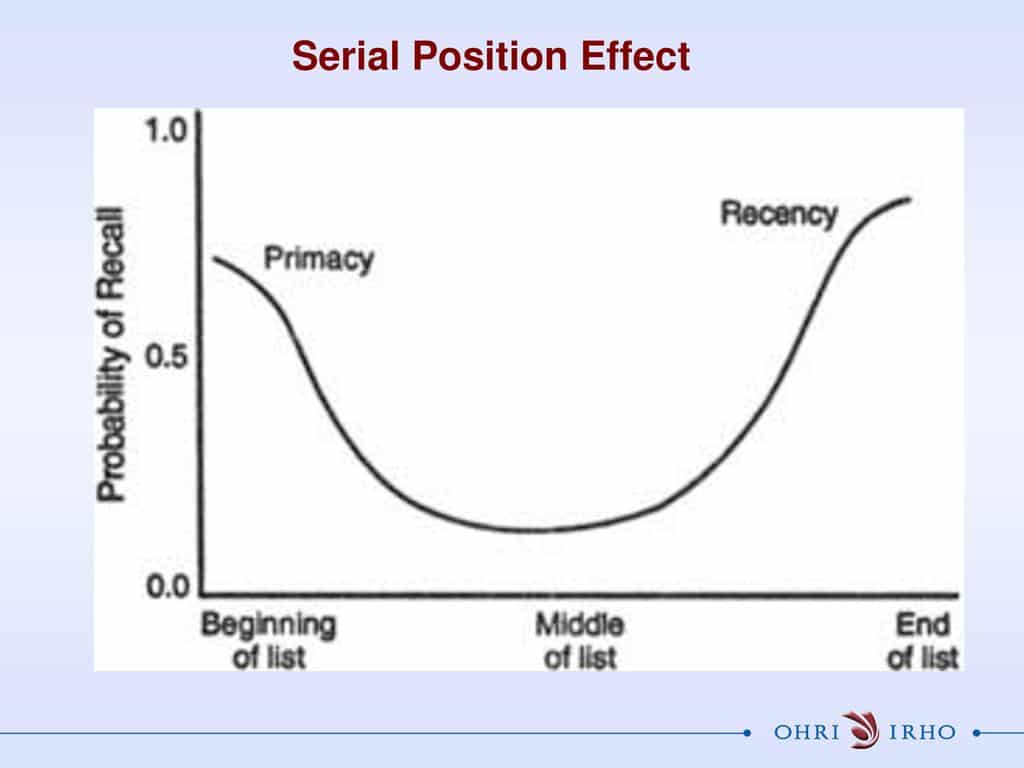
As a journalist who has spent ten years chasing headlines, I’ve noticed something peculiar about the human brain. If I give a speech, people remember my opening joke and my final call to action. But that carefully researched data in the middle? It often vanishes like mist.
In psychology, this isn’t a mistake; it’s a pattern called the Serial Position Effect. It tells us that when we see a list or a sequence, we are most likely to remember the items at the end (Recency Effect) and the items at the beginning (Primacy Effect). Meanwhile, the information stuck in the middle is the most likely to be forgotten.
The Folklore of the “Messenger’s Burden”
There is an old folktale about a young messenger sent to deliver a king’s decree to a distant village. The decree had ten points. The messenger rehearsed them the whole way. When he arrived, the villagers gathered round. He clearly shouted the first point: “Lower taxes!” They cheered. He finished with the tenth point: “A feast for all!” They roared.
But when the mayor asked about the fifth and sixth points regarding crop rotation and fence repairs, the messenger scratched his head. He had “lost” the middle of the message in the dust of the road. This story illustrates a timeless wisdom: our brains are like a suitcase that is easiest to pack at the bottom and the top, but messy in the center.
The Science: Primacy and Recency
Why does our brain do this? Scientists have broken it down into two distinct “hacks” our mind uses:
-
The Primacy Effect (The First Impression): When you hear the first few items in a list, your brain is “empty” and ready. You have time to repeat those words in your head, moving them from short-term memory into long-term storage. According to research from the University of Pennsylvania, this is why the “first impression” is so hard to change.
-
The Recency Effect (The Last Word): The last few items you heard are still echoing in your “working memory.” They haven’t had time to fade away yet. It’s like a song that just finished playing—you can still hear the melody in your ears.
The middle items suffer because the brain is too busy processing the first items and gets interrupted by the last items. As noted by cognitive experts at Stanford University, this “mental clutter” makes the middle the “danger zone” for learning.
Wisdom for the 10th Grade Student
For a student, this is more than just a theory—it’s a study strategy. If you have a list of 20 chemistry elements to learn, don’t study them in the same order every time. If you do, you will become an expert on the first three and the last three, but you’ll be clueless about the ones in the middle.
Intelligence is knowing how your tools work. Your brain is your most important tool. As highlighted on Observervoice.com, understanding human behavior and cognitive biases is the first step toward self-mastery. By “breaking” your study sessions into smaller chunks, you create more “beginnings” and “ends,” giving the Serial Position Effect more chances to work for you instead of against you.
Frequently Asked Questions (FAQs)
1. Does the Serial Position Effect work for movies too? Absolutely. This is why directors put the most exciting action scenes at the very beginning and the big “twist” at the end. They know that if the middle is a bit slow, you might forget it, as long as the start and finish are strong.
2. How can I use this to give a better presentation? Put your most important point first and your strongest “thank you” or summary last. Never put your most vital piece of information in the middle of your speech.
3. Does the “middle” always get forgotten? Not always. If something in the middle is very strange or emotional (like a random word in a list of numbers), it will stand out. This is called the Von Restorff effect.
4. How long does the Recency Effect last? It is very short-lived. If you are interrupted for just 30 seconds after hearing a list, the Recency Effect usually disappears, and you’ll only remember the beginning.
5. Where can I find more tips on memory? Reputable sources like Harvard University and the American Psychological Association offer deep dives into how we store and retrieve information.
Research References:
-
Explore the mechanics of memory at Stanford University.
-
Learn about cognitive biases and psychology at Observervoice.com.
-
Discover research on memory sequences at the University of Pennsylvania.
Observer Voice is the one stop site for National, International news, Sports, Editor’s Choice, Art/culture contents, Quotes and much more. We also cover historical contents. Historical contents includes World History, Indian History, and what happened today. The website also covers Entertainment across the India and World.

