

Why We Fear Plane Crashes More Than Car Accidents: Understanding the Availability Heuristic

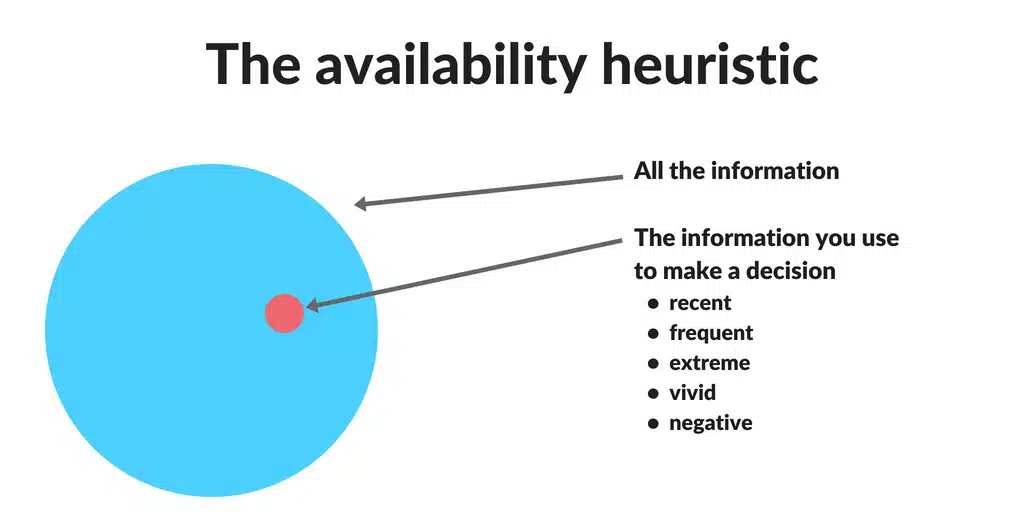
Have you ever refused to swim in the ocean after watching a shark attack documentary? Or felt nervous about flying after hearing news about a plane crash? Welcome to your brain playing tricks on you through something psychologists call the “availability heuristic.”
This mental shortcut makes us believe that dramatic, memorable events happen more often than they actually do. Like an overenthusiastic news reporter in your mind, your brain gives front-page coverage to sensational stories while burying everyday facts in the back pages.
The Mental Shortcut That Fools Us All
Imagine Rajesh, a college student from Mumbai, who watched a news report about a rare train accident. The next morning, despite having traveled by train hundreds of times safely, he insisted on taking a bus instead—even though road accidents in India claim far more lives than train accidents each year.
This is the availability heuristic at work. Our minds judge how likely something is based on how easily we can remember examples of it happening. The problem? Our memories aren’t fair judges. They favor the dramatic, the recent, and the emotional over the common and mundane.
According to research from Stanford University’s Department of Psychology, this bias happens because our brains evolved to make quick decisions with limited information. In ancient times, remembering that one villager who got attacked by a tiger was more useful for survival than calculating actual tiger attack statistics.
Why Plane Crashes Scare Us More Than Daily Commutes
Here’s a startling fact: you’re statistically safer in an airplane than in a car. The National Safety Council reports that your odds of dying in a car crash are 1 in 107, while your odds of dying in a plane crash are 1 in 205,552.
Yet many people fear flying more than driving. Why?
When a plane crashes, it makes international headlines for days. News channels show the wreckage repeatedly. Social media explodes with photos and theories. The images burn into our memories. Meanwhile, the 3,700 people who die in car accidents globally every day rarely make the news beyond local reports.
There’s an old Panchatantra tale about a merchant who refused to sail after hearing about one shipwreck, even though thousands of ships crossed the seas safely every day. His competitor, who understood that one dramatic story doesn’t reflect reality, sailed regularly and became wealthy. The moral? Vivid stories can blind us to actual probabilities.
The Three Ingredients That Make Memories “Available”
Research from the University of Michigan’s cognitive psychology department identifies three factors that make certain memories more “available” to us:
Recency: Events that happened recently feel more likely to happen again. If you heard about a house fire last week, you might overestimate fire risks compared to someone who hasn’t heard such news in months.
Emotional intensity: Emotionally charged events—whether frightening, surprising, or disturbing—stick in memory like superglue. A single scary encounter with a dog can make someone overestimate how dangerous all dogs are for years.
Unusualness: Rare, dramatic events capture our attention more than common occurrences. Nobody remembers the 99 times they crossed the street safely, but everyone remembers that one time they almost got hit by a motorcycle.
How This Bias Shapes Our Everyday Decisions
The availability heuristic influences decisions far beyond transportation choices. During exam season, students often panic after hearing about one friend’s difficult test, assuming all upcoming exams will be equally challenging. Parents might restrict children’s outdoor play after news of a single kidnapping case, despite UNICEF data showing that children face greater health risks from sedentary lifestyles.
In the business world, investors frequently make poor choices based on recent market crashes they remember vividly, while ignoring decades of steady growth data. According to behavioral economics research, this bias costs investors billions annually in missed opportunities.
Consider the story of village elder Kamala from Tamil Nadu folklore. When villagers panicked about a wolf sighting, demanding all livestock be kept indoors permanently, Kamala asked them to count: how many actual attacks had occurred versus peaceful nights? The answer—one attack in fifteen years—helped restore perspective. She taught that wisdom lies not in ignoring danger, but in measuring it accurately.
Breaking Free From the Availability Trap
Recognizing this bias is your first defense against it. When you catch yourself thinking “this happens all the time” based on a few memorable examples, pause and ask: “How often does this actually occur?”
Seek out statistical data rather than relying on memory alone. If you’re worried about crime in your neighborhood after hearing about one incident, check actual crime statistics from police reports. The numbers often tell a very different story than our anxious minds do.
Diversify your information sources. If you only consume news that highlights dramatic negative events, your sense of reality will be skewed. Balance sensational stories with data-driven reporting and long-term trend analysis.
Finally, practice what psychologists call “base rate thinking”—considering the overall frequency of events rather than just memorable instances. Before deciding something is common or dangerous, ask yourself: “Out of how many total cases?”
Frequently Asked Questions
Q1: Is the availability heuristic always harmful? Not necessarily. This mental shortcut evolved because it often serves us well. If you vividly remember getting food poisoning from a restaurant, avoiding it isn’t irrational—it’s practical. The problem arises when this heuristic overrides statistical reality in important decisions.
Q2: How can I tell if I’m using the availability heuristic versus making a rational judgment? Ask yourself: “Am I basing this judgment on one or two memorable examples, or on comprehensive data?” If vivid recent memories are driving your decision more than actual statistics, you’re likely in availability heuristic territory.
Q3: Does this bias affect some people more than others? Yes. Research suggests that people who consume more sensational news media tend to show stronger availability bias. Additionally, those who have personally experienced rare traumatic events may reasonably weight those experiences heavily, though this can sometimes lead to disproportionate fear responses.
Q4: Can the availability heuristic work in positive ways? Absolutely. If you vividly remember examples of people achieving difficult goals, you might feel more confident attempting similar challenges yourself. Inspiration often works through the availability heuristic—one powerful story can make success feel more possible.
Q5: How do marketers and politicians exploit this bias? They repeatedly show dramatic examples and emotional stories to make specific outcomes feel more likely than they are. Political campaigns often feature individual crime victims to make crime feel more prevalent than statistics suggest. Advertisers use testimonials to make product success seem more common than failure rates indicate.
Observer Voice is the one stop site for National, International news, Sports, Editor’s Choice, Art/culture contents, Quotes and much more. We also cover historical contents. Historical contents includes World History, Indian History, and what happened today. The website also covers Entertainment across the India and World.

