

The First Number Trap: How Your Brain Gets Stuck on Anchors

Imagine walking into a shop to buy a watch. The first one you see has a price tag of ₹10,000. It’s too expensive, so you keep looking. Then you spot another watch for ₹5,000. Suddenly, ₹5,000 seems like a great deal! You buy it, feeling proud of yourself.
But wait—would you have still thought ₹5,000 was reasonable if the first watch you saw cost ₹2,000 instead? Probably not. That’s the anchoring bias at work, and it’s one of the most powerful tricks your mind plays on you every single day.
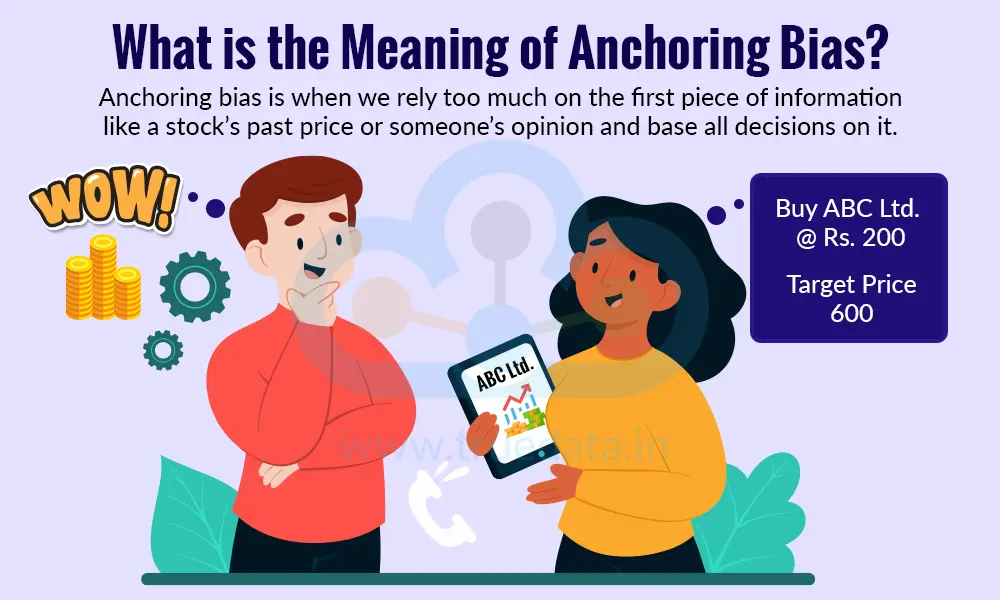
The anchoring bias is a cognitive bias that causes us to rely heavily on the first piece of information we are given about a topic The Decision Lab. Once that initial number, fact, or impression plants itself in your brain, it becomes an “anchor”—and everything else gets judged in relation to it.
The Spinning Wheel Experiment That Shocked Psychologists
In 1974, two brilliant psychologists named Amos Tversky and Daniel Kahneman (who later won a Nobel Prize) conducted a famous experiment. They brought people into a lab and showed them a wheel with numbers from 1 to 100. They spun the wheel, and it randomly landed on a number.
Then came the clever part: they asked participants whether the percentage of African countries in the United Nations was higher or lower than the number on the wheel. Finally, they asked people to estimate the actual percentage.
The results were shocking. Tversky and Kahneman found that the anchoring value of the number on the wheel had a pronounced effect on the answers the subjects provided Nelson University—even though that number was completely random and had nothing to do with geography or politics!
If the wheel showed 10, people guessed around 25% African countries. If it showed 65, people guessed around 45%. A meaningless spinning wheel was controlling people’s judgments about world geography.
According to research from Harvard Law School’s Program on Negotiation PON – Program on Negotiation, anchoring happens when people use an initial reference point to guide all subsequent judgments, adjusting from it only slightly rather than evaluating information independently.
The Ancient Parable of the First Impression
There’s a story from the Hitopadesha about a young merchant learning to trade. His teacher told him: “The first price you hear will echo in your mind for the rest of the negotiation. If a seller says 1,000 rupees first, even 500 will sound cheap. But if he says 100 rupees first, then 500 will sound expensive—for the same item.”
The student asked, “But teacher, shouldn’t the true value matter most?”
The teacher smiled, “It should. But our minds don’t work that way. The first number we hear becomes the measuring stick for everything that follows.”
This ancient wisdom, told centuries before modern psychology existed, perfectly describes the anchoring bias.
Why Your Brain Falls for Anchors Every Time
Our brains love shortcuts. Making decisions from scratch is hard work—it requires research, comparisons, calculations. So instead, our minds grab onto the first piece of information available and use it as a starting point.
Here’s what happens:
Step 1: You encounter the first piece of information (the anchor).
Step 2: Your brain subconsciously accepts this as a reference point.
Step 3: When new information arrives, instead of evaluating it independently, you compare it to the anchor.
Step 4: You make “adjustments” from the anchor, but these adjustments are usually too small.
Research shows that adjustments are typically insufficient, resulting in estimations skewed toward the anchor Simply Psychology. It’s like trying to escape the gravitational pull of a planet—you might move away a little, but you never fully break free.
Anchoring in Your Daily Life (Yes, It’s Everywhere)
Shopping: Ever notice “Was ₹2,999, Now ₹1,499” tags? The original price is the anchor. Even if the item was never actually sold at ₹2,999, that number makes ₹1,499 seem like a steal. In experiments tested by MIT and the University of Chicago, a women’s clothing item sold best at $39 when an anchor price was included, rather than at the cheaper $34 price without an anchor Nelson University.
Salary Negotiations: The first salary figure mentioned in a job negotiation often determines the final number. If you say “I’m expecting ₹50,000” first, the final offer will likely be closer to that than if the employer says “We’re offering ₹30,000” first.
Exams: If your first test score is 95%, you’ll feel disappointed by an 85% later—even though 85% is objectively good. But if your first score was 60%, you’d be thrilled by 85%.
Relationships: Your first boyfriend/girlfriend becomes the anchor for all future relationships. You unconsciously compare everyone to that first experience.
College Choices: A student may evaluate colleges based on the condition of dorms after hearing about one school with excellent facilities, overshadowing other critical factors such as academic programs or location EBSCO.
The Dark Side: How Anchoring Can Hurt You
In Medicine: Doctors can fall victim too. If the first diagnosis they consider is a common cold, they might underestimate symptoms that actually indicate something more serious. This is called anchoring bias with critical implications in healthcare.
In Court: If a prosecutor demands a 10-year prison sentence, judges often give sentences close to that anchor—even if 10 years was unreasonably high to begin with.
In Business Deals: The first offer in any negotiation has tremendous power. Skilled negotiators know this and often make extreme first offers to shift the entire negotiation in their favor.
In Grades and Performance: Teachers who see a student’s previous poor grades might be anchored to expect poor work, causing them to grade more harshly even when the student improves.
The Wisdom of Breaking Free from Anchors
The Bhagavad Gita teaches that true wisdom comes from seeing things as they really are, not through the lens of our preconceptions. Anchoring bias is exactly that—a preconception that distorts reality.
Here’s how to fight back against anchoring:
Do Your Research First: Before entering any situation where numbers matter (buying, selling, negotiating), research the true value independently. Don’t let the first number you hear become your only reference point.
Question the First Number: Ask yourself: “Why is this the first number I’m hearing? Who benefits from me accepting it as normal?”
Use Multiple Anchors: Don’t rely on a single reference point. If buying a phone, look at prices from 5-10 different sellers before making judgments about value.
Start Fresh: When evaluating something important, try to clear your mind of all previous numbers and impressions. Judge each option on its own merits.
Be the First to Speak: In negotiations, whoever mentions the first number often controls the conversation. Don’t be afraid to go first—but make sure you’ve done your research!
Delay Your Decision: Anchors have stronger power when you decide immediately. Take time to think without the anchor in front of you.
The Buddha’s Teaching on Perception
The Buddha taught that much of our suffering comes from mistaking our perceptions for reality. Anchoring bias is a perfect example: we mistake our mental reference point (the anchor) for objective truth.
The wise person recognizes that the first piece of information is just that—first. Not necessarily best, not necessarily true, not necessarily relevant. Just first.
The next time someone throws out a number—a price, a salary, an estimate—notice it, but don’t let it trap you. Your brain will try to use it as an anchor. But you have the power to recognize the anchor for what it is: just information, not truth.
After all, if a random spinning wheel can influence people’s estimates about world geography, imagine what deliberate anchors are doing to your daily decisions.
Frequently Asked Questions
Q1: Can you avoid anchoring bias if you know about it?
Unfortunately, research suggests that even when people know about anchoring and are warned beforehand, the effect can still influence their judgment. However, awareness helps you catch and correct it more often.
Q2: Are some people more resistant to anchoring bias than others?
Studies show mood affects susceptibility—people in positive moods are less affected by anchoring than those in sad or neutral moods. Experts in specific fields also show less anchoring bias when making judgments in their domain of expertise.
Q3: How can students use anchoring bias to their advantage?
In group projects, volunteer to present your ideas first to anchor the discussion around your perspective. When negotiating extensions or grades, frame the conversation around reasonable anchors that work in your favor.
Q4: Why do prices ending in .99 work so well?
This combines anchoring with another bias. ₹39 isn’t perceived as just ₹1 cheaper than ₹40—our brains anchor on the first digit (3 vs 4), making ₹39 feel more like ₹30 than ₹40. Charm pricing increases sales by an average of 24%.
Q5: Can anchoring bias be useful?
Yes! It helps our brains make quick decisions without analyzing everything from scratch. The problem is only when anchors are irrelevant, manipulative, or lead us to poor decisions. Using good anchors (research-based reference points) can actually improve decision-making.
Observer Voice is the one stop site for National, International news, Sports, Editor’s Choice, Art/culture contents, Quotes and much more. We also cover historical contents. Historical contents includes World History, Indian History, and what happened today. The website also covers Entertainment across the India and World.

