

Trump Aims to Reconstruct $1.6 Trillion Revenue Following Court Setback and Expanding Trade Investigations

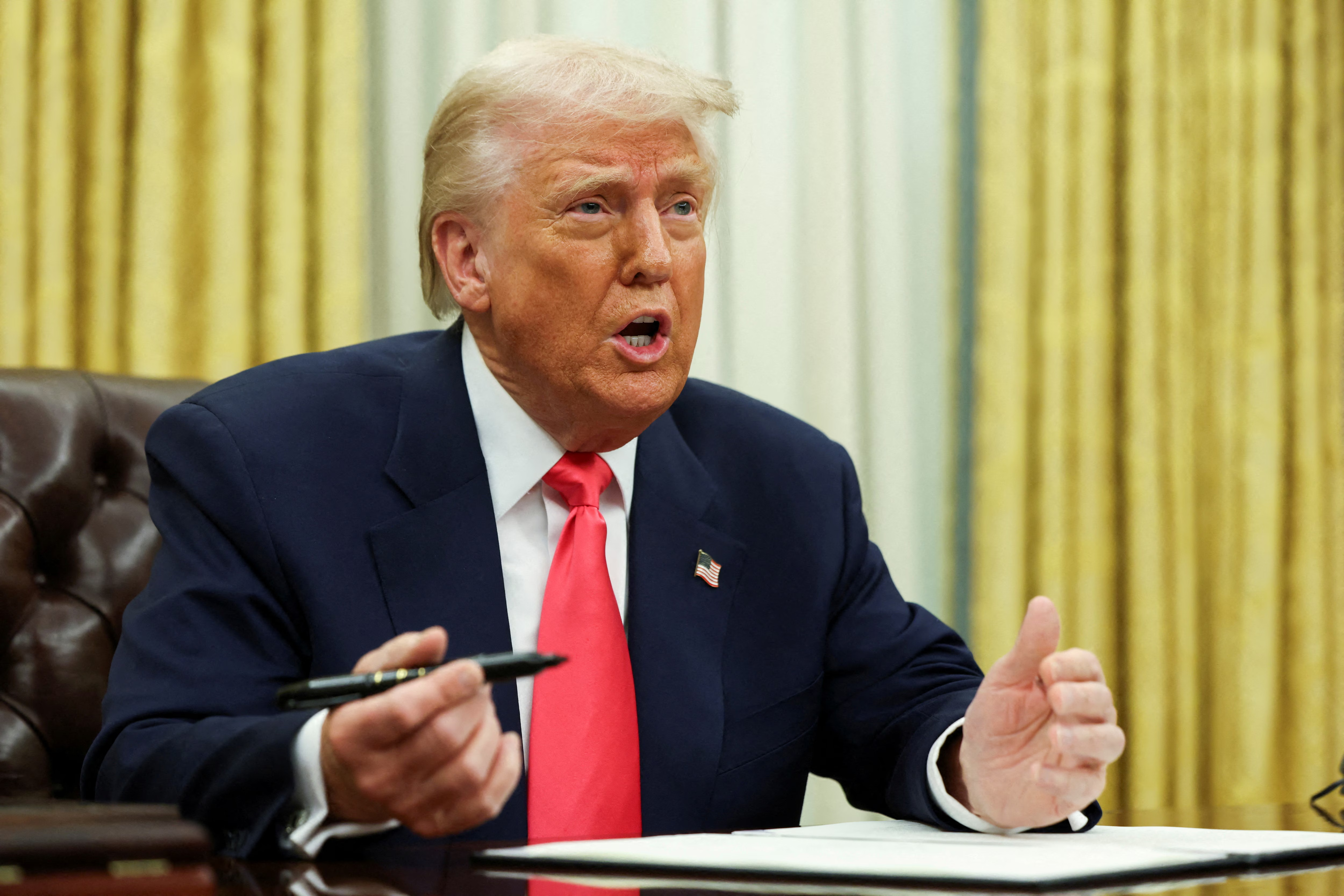
The Trump administration is ramping up efforts to recover approximately $1.6 trillion in tariff revenue following a Supreme Court ruling that invalidated several of the president’s import duties. Officials are now exploring new investigations and legal avenues to implement replacement tariffs. However, experts warn that the complexity of these alternative routes may hinder the administration’s ability to swiftly regain lost revenue, which was initially expected to help offset the costs of tax cuts.
New Investigations Under Section 301
U.S. Trade Representative Jamieson Greer announced that the administration will initiate investigations into 16 economies, including the European Union, to determine if government subsidies are creating excessive factory capacity that disadvantages American manufacturing. This inquiry will also focus on major players like China, South Korea, and Japan. A second investigation will assess whether the failure of various countries to ban goods produced with forced labor constitutes an unfair trade practice that harms U.S. interests. This review will encompass the EU, China, Mexico, Canada, Australia, and Brazil.
Both investigations are being conducted under Section 301 of the 1974 Trade Act, which mandates consultations with the targeted countries, public hearings, and input from affected industries. Hearings addressing factory-capacity concerns are scheduled for May 5, while discussions on forced labor will take place on April 28. This approach marks a shift from the emergency measures used by Trump in his first year, which allowed for immediate tariff imposition through executive orders.
Challenges in Revenue Recovery
Experts indicate that recovering the lost tariff revenue will be a complex and lengthy process. Elena Patel, co-director of the Urban-Brookings Tax Policy Center, noted that while the administration might eventually achieve a similar effective tariff rate as before, the new strategy will likely make it easier for companies to contest these tariffs. This could create uncertainty regarding revenue until all disputes are resolved.
The administration’s current strategy includes a temporary 10 percent tariff on all imports, which can only remain in effect for 150 days. Although Trump has hinted at raising this rate to 15 percent, he has not yet taken that step. Additionally, around two dozen U.S. states have already challenged the new tariffs, further complicating the administration’s efforts to stabilize revenue streams.
Tariffs as a Revenue Source
The administration’s renewed focus on tariffs as a revenue source comes amid projections of significant federal budget deficits in the coming years. Erica York, vice president of federal tax policy at the Tax Foundation, highlighted that the first investigation could cover about 70 percent of imports, while the second might extend to nearly all of them. This broad scope suggests that the administration’s goal may not solely be to address specific trade issues but rather to recreate a comprehensive tariff framework.
Trump has argued that tariffs can compel foreign nations to contribute to U.S. government funding. However, recent studies, including those from the Federal Reserve Bank of New York and Harvard University, indicate that the financial burden of tariffs primarily falls on American companies and consumers. In his recent State of the Union address, Trump even suggested that tariffs could serve as an alternative to income tax.
Long-term Implications
The Supreme Court’s ruling on February 20, which eliminated emergency tariffs, has led to an estimated loss of $1.6 trillion in expected revenue over the next decade. While some tariffs remain in place, including those on China and Canada, the administration’s reliance on tariffs as a primary revenue tool is unprecedented. Analysts note that previous administrations have typically used tariffs more narrowly to protect specific industries rather than as a broad fiscal strategy.
Kent Smetters, executive director of the Penn Wharton Budget Model, emphasized that this marks the first time tariffs have been predominantly utilized as a means of raising revenue. Patel further argued that raising revenue through legislation would provide more predictability, suggesting that Congress should consider imposing a broad-based tariff if revenue generation is the goal.
Observer Voice is the one stop site for National, International news, Sports, Editor’s Choice, Art/culture contents, Quotes and much more. We also cover historical contents. Historical contents includes World History, Indian History, and what happened today. The website also covers Entertainment across the India and World.
Follow Us on Twitter, Instagram, Facebook, & LinkedIn

