

Typhoid: The Ancient Scourge Still Claiming Lives in the Antibiotic Era

Key Facts
- Typhoid fever causes an estimated 11–20 million cases and 128,000–161,000 deaths worldwide each year
- Over 70% of cases occur in Asia, with Pakistan, India, and Bangladesh among the hardest-hit countries
- Children aged 5–15 years face the highest burden in endemic regions
- Drug-resistant strains now threaten 90% of isolates in some South Asian countries
- WHO prequalified typhoid conjugate vaccines (TCVs) achieve 81% efficacy in children
When Bangladesh reported over 10,000 typhoid cases in early 2024—a 40% spike from the previous year—WHO’s Southeast Asia office issued an urgent call for accelerated vaccination programs. The outbreak underscored what public health officials have warned for years: typhoid hasn’t disappeared. It’s evolved. This article examines typhoid fever through WHO’s latest epidemiological data, explores why a disease with known prevention tools still kills thousands annually, and tracks the global health initiatives racing against antimicrobial resistance.
What Is Typhoid? — WHO’s Definition
According to WHO, typhoid fever is a life-threatening infection caused by the bacterium Salmonella enterica serotype Typhi (S. Typhi). The disease spreads through contaminated food and water, particularly in regions where sanitation infrastructure fails to meet minimum standards. Unlike many foodborne illnesses that resolve within days, typhoid—if untreated—produces sustained fever, weakness, abdominal pain, and in severe cases, intestinal perforation or neurological complications. WHO classifies it as a neglected tropical disease, though its reach extends well beyond tropical zones into densely populated urban slums across continents.
Global Burden — WHO Prevalence Data
WHO’s 2024 global burden estimates place annual incidence between 11 million and 20 million cases, with case-fatality rates ranging from less than 1% in areas with prompt antibiotic access to over 10% where treatment delays persist. South Asia shoulders the heaviest burden—Pakistan alone reported incidence rates exceeding 500 cases per 100,000 population in some districts. Sub-Saharan Africa follows, where surveillance gaps likely mask the true toll.
Children bear disproportionate risk. WHO data shows that in endemic countries, 80% of typhoid cases occur in children under 15, with peak incidence between ages 5 and 9. Urban slums concentrate transmission: research published in The Lancet Global Health found incidence rates 10 times higher in informal settlements compared to planned urban areas. Climate events worsen the pattern—flooding in Pakistan’s Sindh province in 2022 triggered case surges that persisted for 18 months.
The economic burden mirrors the health toll. A cost-effectiveness analysis in PLOS Neglected Tropical Diseases estimated that typhoid costs endemic countries $3.5 billion annually in healthcare expenditures and lost productivity. Yet this calculation likely underestimates true costs, as it doesn’t capture long-term disability from severe cases or deaths in areas without vital registration systems.
Causes, Transmission & Risk Factors
Salmonella Typhi enters the body through the fecal-oral route—ingestion of food or water contaminated with feces from infected individuals or asymptomatic carriers. WHO identifies chronic carriers (individuals who shed bacteria for over a year post-infection) as silent transmission engines: roughly 1–5% of recovered patients become carriers, capable of contaminating water supplies for decades.
The bacterium invades the intestinal epithelium, enters lymphoid tissue, and spreads via the bloodstream to the liver, spleen, and bone marrow. This systemic dissemination explains typhoid’s characteristic prolonged fever pattern—unlike gastroenteritis, which primarily affects the gut lining.
WHO’s framework for water safety highlights infrastructure gaps as the primary risk amplifier. In regions where sewage mingles with drinking water sources, a single carrier can infect dozens. Street food prepared with contaminated water, ice made from unsafe sources, and raw produce irrigated with wastewater all serve as vectors. During the 2016 Zimbabwe outbreak, investigators traced 10,000 cases to a single municipal water point.
Behavioral factors intersect with infrastructure. Households lacking handwashing facilities face 3.2 times higher risk, according to CDC surveillance. Yet framing this as “poor hygiene” obscures the structural reality: when clean water costs more than contaminated sources, economics—not knowledge—drive exposure.
Signs, Symptoms & Health Impacts
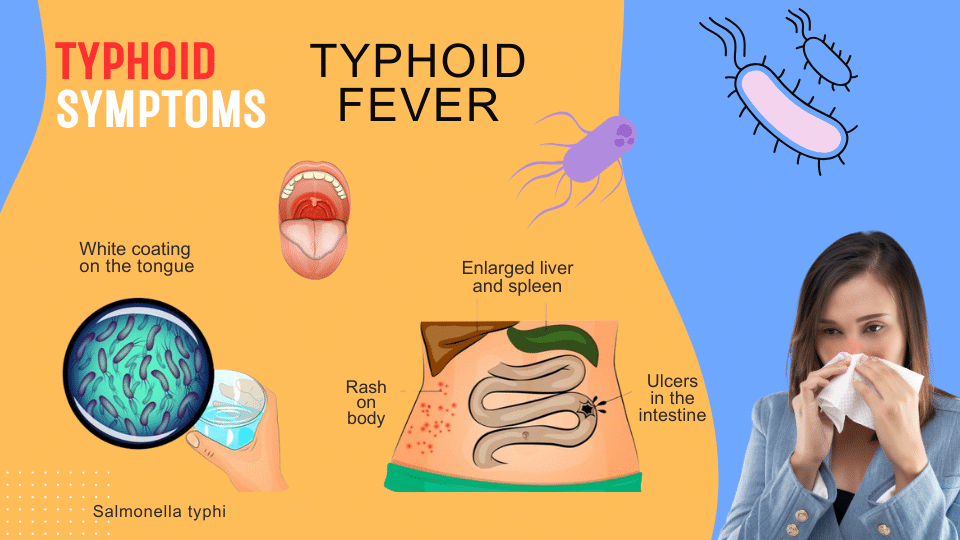
WHO identifies typhoid’s clinical progression in distinct phases. The first week brings sustained fever (39–40°C), headache, and malaise—symptoms easily mistaken for malaria or dengue in co-endemic regions. By week two, if untreated, patients develop the characteristic “typhoid state”: apathy, confusion, and the rose-colored spots (faint salmon-pink macules on the trunk) that appear in 30% of light-skinned patients but often go unnoticed in darker complexions.
Week three marks the danger zone. Intestinal complications emerge: perforation occurs in 1–3% of hospitalized cases, typically at Peyer’s patches in the terminal ileum. This surgical emergency carries 10–30% mortality even with intervention. Intestinal hemorrhage, though less common than perforation, can prove equally catastrophic. Neurological manifestations—delirium, meningitis, and rarely, seizures—complicate 10–15% of severe cases.
Children present differently. WHO notes that in endemic areas, pediatric typhoid often manifests with diarrhea rather than constipation, making diagnosis harder. Infants may show only fever and irritability, leading to delayed recognition until complications develop.
Similar to the acute viral hemorrhagic illness caused by Lassa virus, typhoid’s non-specific early symptoms delay diagnosis and treatment.
Treatment & Health Response
WHO reports that current treatment approaches depend critically on antimicrobial susceptibility patterns—a landscape transformed by resistance. For decades, first-line antibiotics (chloramphenicol, ampicillin, trimethoprim-sulfamethoxazole) controlled typhoid effectively. By the late 1980s, multidrug-resistant (MDR) strains emerged across South Asia, rendering these drugs ineffective.
Fluoroquinolones became the new standard, but resistance followed within a decade. WHO’s 2023 surveillance data shows that extensively drug-resistant (XDR) typhoid—resistant to fluoroquinolones, third-generation cephalosporins, and older drugs—now circulates in Pakistan, with sporadic cases detected across 15 countries. These strains leave clinicians with azithromycin and carbapenems, often reserved for last-resort use.
Treatment access gaps compound the resistance crisis. In rural South Asia and sub-Saharan Africa, patients often receive antibiotics only after fever persists for days, increasing complication risk. A BMJ Global Health study found that in Bangladesh and Nepal, 40% of patients received inappropriate antibiotics initially, either because providers lacked diagnostics or prescribed based on cost rather than susceptibility.
Blood culture—the diagnostic gold standard—remains unavailable in most endemic settings. WHO estimates that fewer than 30% of suspected cases in low-income countries receive laboratory confirmation, forcing clinicians to treat empirically. Rapid diagnostic tests show promise, but sensitivity issues and supply chain barriers limit deployment.
Prevention & WHO Strategies
WHO’s prevention framework rests on three pillars: vaccination, water and sanitation infrastructure (WASH), and food safety. The game-changer arrived in 2018 with WHO’s prequalification of typhoid conjugate vaccines (TCVs). Unlike older typhoid vaccines, TCVs work in children under two, provide longer protection (likely lifelong), and induce herd immunity by reducing transmission.
WHO’s Strategic Advisory Group of Experts recommended routine TCV introduction in endemic countries, prioritizing areas with high burden or antimicrobial resistance. By early 2024, Pakistan, Liberia, Zimbabwe, and Nepal had launched campaigns, with India and Bangladesh planning rollouts.
Yet vaccination alone can’t eliminate typhoid. As WHO reported during the 8th UN Global Road Safety Week, structural interventions require sustained political will—a principle equally applicable to WASH infrastructure. Studies show that improved water sources and sanitation reduce typhoid incidence by 40–70%, but progress stalls in informal settlements where tenure insecurity discourages infrastructure investment.
Food safety interventions target street vendors and informal food handlers through training and certification programs. However, enforcement remains weak. WHO’s Five Keys to Safer Food framework (keep clean, separate raw and cooked, cook thoroughly, keep food at safe temperatures, use safe water and raw materials) provides the blueprint, but implementation requires regulatory capacity most endemic countries lack.
WHO’s Global Efforts & Analysis
WHO’s Defeating Typhoid initiative, launched in 2017, coordinates multilateral action across endemic countries. The Global Typhoid Genomics Consortium, established in 2020, tracks antimicrobial resistance patterns through whole-genome sequencing—revealing that XDR strains share common ancestry, suggesting clonal expansion rather than independent emergence.
Gavi, the Vaccine Alliance, committed $85 million in 2019 to support TCV introduction in 50 endemic countries by 2030. By April 2024, the program had delivered over 60 million doses, averting an estimated 200,000 cases. Modeling published in PLOS Medicine projects that if coverage reaches WHO targets, vaccines could prevent 46% of cases and 55% of deaths by 2040.
The World Health Assembly resolution WHA73.5, adopted in 2020, called for integrated strategies combining vaccination, WASH, and antimicrobial stewardship. Progress varies wildly. Pakistan’s Sindh province achieved 91% coverage in its first campaign, while supply shortages delayed Zimbabwe’s planned expansion by 18 months.
Here’s what surveillance reveals: typhoid isn’t disappearing in endemic zones—it’s polarizing. Countries with strong WASH infrastructure and high vaccine coverage see incidence drop below outbreak thresholds. Those without face rising case numbers and circulating XDR strains. WHO’s 2030 elimination targets look achievable in some regions, distant dreams in others. The question isn’t whether we have the tools—vaccines work, clean water works. The question is whether resource allocation will match epidemiological need before resistance outpaces treatment options entirely.
This mirrors challenges seen in other neglected diseases, much like the mosquito-borne zoonosis that devastated livestock across Africa and crossed into Arabia, where surveillance gaps and delayed intervention amplify disease impact.
Frequently Asked Questions
According to WHO, yes—typhoid infection doesn’t provide lifelong immunity. Natural infection produces partial protection lasting 3–7 years, but reinfection remains possible, especially with different Salmonella Typhi strains. WHO data shows reinfection rates of 2–5% in endemic areas. Vaccination with typhoid conjugate vaccines offers more durable protection than natural infection.
WHO reports that untreated typhoid fever typically produces sustained high fever for 3–4 weeks, with gradual recovery in survivors extending over several months. However, case-fatality rates in untreated populations range from 10–30%, with death usually occurring in the third or fourth week from complications like intestinal perforation or overwhelming sepsis.
Both are enteric fevers caused by Salmonella species, but typhoid results from S. Typhi while paratyphoid comes from S. Paratyphi A, B, or C. WHO notes that paratyphoid generally causes milder illness with lower complication rates, but clinical symptoms overlap significantly, making laboratory confirmation essential for differentiation. Current typhoid conjugate vaccines don’t protect against paratyphoid.
Not through casual contact. WHO clarifies that typhoid spreads via the fecal-oral route—through ingestion of food or water contaminated with feces from infected persons or carriers. Direct person-to-person transmission can occur through poor hand hygiene after using the toilet, particularly in households lacking handwashing facilities. Respiratory spread doesn’t occur.
WHO identifies inadequate water, sanitation, and hygiene infrastructure as the primary driver. In areas where sewage contaminates drinking water sources, where food safety regulations aren’t enforced, and where healthcare access delays diagnosis and treatment, typhoid persists. Poverty, rapid urbanization creating informal settlements, and climate events disrupting water systems all perpetuate transmission in endemic regions.
Sources
- World Health Organization. Typhoid. https://www.who.int/health-topics/typhoid
- World Health Organization. Typhoid Fact Sheet. https://www.who.int/news-room/fact-sheets/detail/typhoid (2024)
- Antillón M, et al. “The burden of typhoid fever in low- and middle-income countries: A meta-regression approach.” PLOS Neglected Tropical Diseases, 2017.
- Stanaway JD, et al. “The global burden of typhoid and paratyphoid fevers: a systematic analysis for the Global Burden of Disease Study 2017.” The Lancet Infectious Diseases, 2019.
- Centers for Disease Control and Prevention. Typhoid Fever. https://www.cdc.gov/typhoid-fever/index.html
Disclaimer
This article adapts publicly available information from WHO’s Typhoid page. This content is for informational and educational purposes only and does not constitute medical advice. ObserverVoice.com is a news and information platform—not a healthcare provider.
Observer Voice is the one stop site for National, International news, Sports, Editor’s Choice, Art/culture contents, Quotes and much more. We also cover historical contents. Historical contents includes World History, Indian History, and what happened today. The website also covers Entertainment across the India and World.

