

Scabies: The Neglected Skin Disease Affecting 200 Million People Worldwide

Key Facts Box
- 200 million people globally have scabies at any given time, according to WHO estimates
- Scabies is caused by the Sarcoptes scabiei mite, measuring just 0.3-0.5mm in length
- Superinfection affects 20-50% of scabies cases in resource-poor settings, leading to serious complications
- WHO roadmap targets 70% coverage of scabies treatment in endemic countries by 2030
- The disease burden is highest in tropical regions where prevalence can reach 25-30% in some communities
In June 2024, WHO published updated guidance on scabies control in endemic settings, marking a significant shift in how the global health community addresses this ancient parasitic disease. The move comes as recent outbreak data from Pacific Island nations shows scabies prevalence exceeding 35% in some communities—rates not seen in decades. This article examines WHO’s framework for understanding scabies transmission, its devastating impact on vulnerable populations, and the organization’s ambitious elimination strategy. These efforts align with broader health initiatives targeting neglected tropical diseases worldwide.
What Is Scabies? — WHO’s Definition
According to WHO, scabies is a parasitic infestation of the skin caused by the microscopic mite Sarcoptes scabiei var. hominis. The female mite burrows into the upper layer of human skin to lay eggs, triggering an intense allergic reaction that causes severe itching and rash. WHO classifies scabies as a neglected tropical disease (NTD), recognizing its disproportionate impact on impoverished communities with limited access to healthcare and clean water.
The condition exists in two primary forms: ordinary scabies, affecting most patients, and crusted scabies (formerly called Norwegian scabies), a severe form occurring in immunocompromised individuals where thousands or millions of mites infest the body simultaneously.
Global Burden
WHO estimates that more than 200 million people are affected by scabies at any given time, though the true burden likely exceeds this figure due to underreporting. The disease affects all socioeconomic levels but disproportionately impacts resource-poor communities in tropical and subtropical regions.
According to the Global Burden of Disease Study 2019, scabies ranks among the leading causes of disability from skin conditions globally. Pacific Island nations report particularly alarming rates—Fiji documented prevalence of 36% among children in some communities, while Solomon Islands surveys found rates exceeding 25% in rural areas.
Indigenous populations face elevated risk. Australian Aboriginal communities experience scabies prevalence 6-7 times higher than non-Indigenous populations, with rates reaching 50% among children in remote settlements. Refugee camps, prisons, long-term care facilities, and homeless shelters consistently report outbreak clusters.
The disease burden extends beyond skin irritation. WHO data indicates that bacterial superinfection—primarily Group A Streptococcus and Staphylococcus aureus—complicates 20-50% of scabies cases in endemic settings, potentially leading to serious conditions including post-streptococcal glomerulonephritis and acute rheumatic fever.
Causes, Transmission & Risk Factors
The scabies mite lives exclusively on human hosts, unable to survive more than 48-72 hours away from human skin. According to CDC transmission data, the parasite spreads primarily through prolonged skin-to-skin contact—typically 15-20 minutes or more. Sexual contact represents a common transmission route among adults, while children typically contract the disease through close contact during play or sleeping arrangements.
WHO identifies several key risk factors that amplify transmission:
Overcrowding and poverty: Households with more than three people per room show significantly elevated scabies rates. Limited access to water for bathing and washing clothes perpetuates transmission cycles.
Immunocompromised status: Individuals with HIV/AIDS, those receiving immunosuppressive therapy, or patients with conditions like HTLV-1 infection face higher risk of developing crusted scabies. Research published in Clinical Microbiology Reviews demonstrates that a single crusted scabies patient can harbor 2-3 million mites compared to 10-15 mites in ordinary cases.
Institutional settings: Nursing homes, prisons, and military barracks create ideal conditions for transmission due to close contact and shared bedding. Healthcare workers face occupational exposure when treating undiagnosed cases.
Climate: Warm, humid environments favor mite survival and reproduction, explaining higher prevalence in tropical regions compared to temperate zones.
Signs, Symptoms & Health Impacts
WHO identifies intense itching—particularly severe at night—as the hallmark symptom of scabies, typically beginning 2-6 weeks after initial infestation. The itching results from the body’s allergic reaction to mite proteins, eggs, and fecal matter, not from the mites themselves.
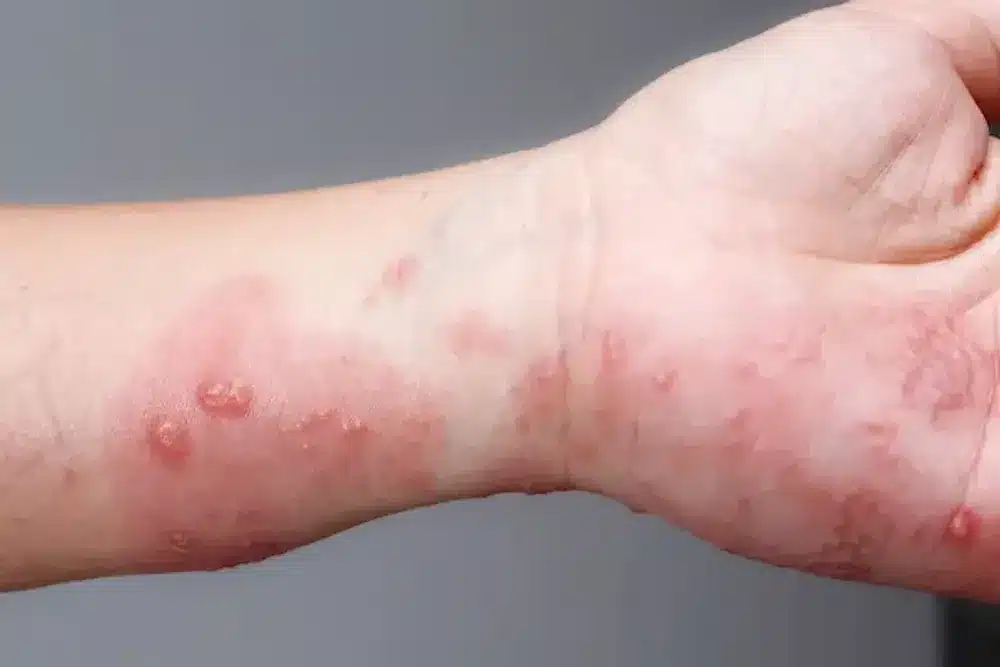
The characteristic rash appears as small red bumps, often forming lines where mites have burrowed. Common sites include finger webs, wrists, elbows, armpits, waistline, buttocks, and genital areas in adults. Infants and young children may develop lesions on the head, neck, palms, and soles—areas typically spared in adults.
Crusted scabies presents differently, with thick, gray crusts containing massive mite populations covering large body areas. This form causes less itching despite the overwhelming infestation, making delayed diagnosis common. The condition poses serious transmission risk as affected individuals shed countless mites into their environment.
WHO emphasizes the secondary complications that define scabies as a serious public health threat:
Bacterial superinfection: Scratching damages skin integrity, creating entry points for bacteria. Studies in endemic regions document that 50-70% of children with scabies develop impetigo. Group A Streptococcal skin infections can trigger post-infectious glomerulonephritis and contribute to rheumatic heart disease burden.
Psychological impact: Chronic severe itching disrupts sleep, impairs concentration, and affects school and work performance. The visible rash carries social stigma in many communities.
Outbreak potential: Crusted scabies patients can spark explosive outbreaks in institutions, sometimes infecting dozens of contacts before diagnosis.
Similar to neglected tropical diseases affecting 1.6 billion people, scabies disproportionately impacts marginalized populations with limited healthcare access.
Treatment & Health Response
WHO reports that current scabies treatment relies primarily on topical medications applied to the entire body from neck down (including scalp in young children). Permethrin 5% cream represents the first-line therapy, requiring application for 8-12 hours before washing off, with a second treatment one week later.
Alternative topical treatments include:
- Benzyl benzoate 25% emulsion (requires three consecutive daily applications)
- Sulfur ointment 5-10% (safe during pregnancy, less effective than permethrin)
- Crotamiton 10% (multiple applications needed, lower cure rates)
For crusted scabies or outbreak settings, WHO guidance increasingly supports oral ivermectin as a game-changing intervention. Clinical trials demonstrate that a single 200 mcg/kg dose achieves cure rates comparable to permethrin, with a second dose seven days later recommended for severe cases. Mass drug administration using ivermectin has successfully controlled outbreaks in institutional settings.
However, significant treatment barriers persist globally:
Access gaps: Many endemic countries lack registered scabies medications. Permethrin remains unavailable or unaffordable in much of sub-Saharan Africa and parts of Asia. Ivermectin, though widely available for other NTDs, lacks regulatory approval for scabies in numerous countries.
Cost barriers: Out-of-pocket treatment costs can exceed weekly household income in low-resource settings, preventing families from treating all members simultaneously—the key to breaking transmission.
Incomplete treatment: Successfully eliminating scabies requires treating the entire household plus close contacts on the same day, washing all bedding and clothing, and completing follow-up doses. These logistical requirements overwhelm many affected families.
Resistance concerns: While permethrin resistance has been documented in some regions, the clinical significance remains debated. Ivermectin resistance has not been definitively proven in human scabies.
The treatment landscape differs dramatically between resource-rich and resource-poor settings, raising questions about health equity that WHO’s NTD roadmap seeks to address.
Prevention & WHO Strategies
WHO’s scabies prevention framework emphasizes that individual treatment alone cannot control endemic disease—population-level interventions targeting transmission pathways are essential. The organization recommends a multipronged approach:
Mass drug administration (MDA): In highly endemic areas (prevalence >10%), WHO supports community-wide ivermectin distribution, treating all residents regardless of symptoms. Fiji’s ivermectin MDA campaigns achieved 94% coverage in target communities, reducing prevalence from 36% to under 2% within 12 months.
Integrated NTD programs: Scabies control increasingly piggybacks on existing MDA platforms for lymphatic filariasis, onchocerciasis, and other ivermectin-responsive NTDs, improving cost-effectiveness.
Environmental control: While mites die within 48-72 hours off human skin, WHO recommends washing clothes and bedding in hot water (50°C minimum) and drying in direct sunlight or hot dryers. Items that cannot be washed should be sealed in plastic bags for 72 hours.
Institutional protocols: Healthcare facilities, prisons, and care homes need robust screening protocols, isolation procedures for diagnosed cases, and prophylactic treatment for contacts.
Health education: Community awareness campaigns must combat stigma while promoting early treatment-seeking and household-level interventions. Messaging should emphasize that scabies affects people of all socioeconomic levels.
Water and sanitation: Improving access to clean water and bathing facilities addresses fundamental drivers of transmission in resource-poor communities.
WHO recognizes that sustainable scabies control requires addressing social determinants of health—overcrowding, poverty, and healthcare access barriers—that create conditions for endemic transmission. This echoes challenges facing disease control efforts in conflict zones like Gaza.
WHO’s Global Efforts
WHO’s formal recognition of scabies as a neglected tropical disease in 2017 marked a turning point in global control efforts. The 2021-2030 NTD Roadmap includes scabies among 20 diseases targeted for control, elimination, or eradication, setting specific milestones:
- Develop and validate standardized diagnostic tools by 2023
- Achieve ivermectin regulatory approval for scabies in at least 10 endemic countries by 2025
- Reach 70% treatment coverage in endemic districts by 2030
- Integrate scabies control into existing NTD platforms by 2024
In June 2020, WHO published its first comprehensive scabies management guidelines, providing evidence-based recommendations for individual treatment, outbreak response, and population-level control. The document represents years of consultation with dermatologists, infectious disease specialists, and public health experts.
The International Alliance for the Control of Scabies (IACS), established in 2012, partners with WHO to advance research and advocacy. IACS developed the 2020 consensus diagnostic criteria that standardize scabies diagnosis for epidemiological studies and clinical trials—a critical step given historical inconsistency in case definitions.
WHO’s Essential Medicines List now includes both permethrin and ivermectin for scabies, signaling to national governments and procurement agencies that these treatments should be available at all healthcare levels. However, actual availability lags far behind this recommendation in many endemic countries.
Recent regional initiatives show promise. The Pacific Community, supported by WHO’s Western Pacific Regional Office, implemented integrated scabies-impetigo control programs across eight island nations starting in 2019. Preliminary data released in 2023 indicates dramatic prevalence reductions where MDA achieved high coverage.
Australia’s scabies research investments have yielded insights applicable globally. The Murdoch Children’s Research Institute’s One Disease project demonstrated that treating crusted scabies patients reduces community transmission—a finding that shaped WHO’s outbreak response protocols.
The path forward isn’t without obstacles. Ivermectin procurement costs remain prohibitive for many endemic countries without donor support. Diagnostic challenges persist—trained healthcare workers can identify scabies clinically, but laboratory confirmation requires expertise and equipment unavailable in most endemic settings. And as with noma’s recent NTD classification, formal recognition doesn’t automatically translate to funding or political prioritization.
Yet the 2024 WHO guidance update signals sustained commitment. Unlike many diseases requiring complex interventions, scabies can be controlled with existing, affordable tools—if deployed systematically. The question isn’t whether elimination is technically feasible, but whether the global health community will sustain focus on a disease that has plagued humanity since ancient times yet remains invisible in policy discussions.
For observers tracking world history’s recurring patterns, scabies control efforts reflect a familiar tension: ancient diseases persist not because we lack solutions, but because affected populations lack power to demand them.
Frequently Asked Questions
According to WHO, people infected with scabies for the first time typically develop symptoms 2-6 weeks after infestation as the immune system becomes sensitized to the mites. Those who’ve had scabies previously may develop symptoms within 1-4 days of re-exposure since their immune system recognizes the parasite more quickly.
WHO reports that scabies mites can survive away from human skin for 48-72 hours under normal room conditions. While transmission primarily occurs through prolonged skin-to-skin contact, sharing bedding, clothing, or furniture with someone who has crusted scabies poses higher risk due to the massive mite numbers involved.
No. WHO emphasizes that scabies affects people across all socioeconomic levels regardless of personal hygiene. The disease spreads through close physical contact, not uncleanliness. However, crowded living conditions without adequate access to water for treatment and washing do facilitate transmission and make control more challenging.
According to WHO, the intense itching in scabies results from an allergic reaction to mite proteins, eggs, and waste products. Even after treatment kills all mites, these allergens remain in the skin for several weeks, continuing to trigger immune responses. Persistent itching doesn’t necessarily mean treatment failed.
WHO clarifies that human scabies is caused by Sarcoptes scabiei var. hominis, which is host-specific to humans. While other Sarcoptes variants infest animals (causing mange), these mites cannot complete their life cycle on human skin. Animal mites may cause temporary itching but don’t establish infestation or require treatment.
Sources
- World Health Organization. (2024). Scabies. Retrieved from https://www.who.int/health-topics/scabies
- World Health Organization. (2020). WHO guidelines for the treatment of Treponema pallidum (syphilis), and scabies. WHO/2019-nCoV/IPC_PPE_use/2020.4
- Engelman, D., et al. (2020). “The 2020 International Alliance for the Control of Scabies Consensus Criteria for the Diagnosis of Scabies.” PLoS Neglected Tropical Diseases, 14(8).
- Centers for Disease Control and Prevention. (2023). Parasites – Scabies. Retrieved from https://www.cdc.gov/parasites/scabies/
- Romani, L., et al. (2020). “The epidemiology of scabies and impetigo in relation to demographic and residential characteristics: Baseline findings from the Skin Health Intervention Fiji Trial.” The Lancet Infectious Diseases, 20(5).
DISCLAIMER
This article adapts publicly available information from WHO’s Scabies page. This content is for informational and educational purposes only and does not constitute medical advice. ObserverVoice.com is a news and information platform—not a healthcare provider.
Observer Voice is the one stop site for National, International news, Sports, Editor’s Choice, Art/culture contents, Quotes and much more. We also cover historical contents. Historical contents includes World History, Indian History, and what happened today. The website also covers Entertainment across the India and World.

