

Home Cleaning Services: Picking a Cadence That Works

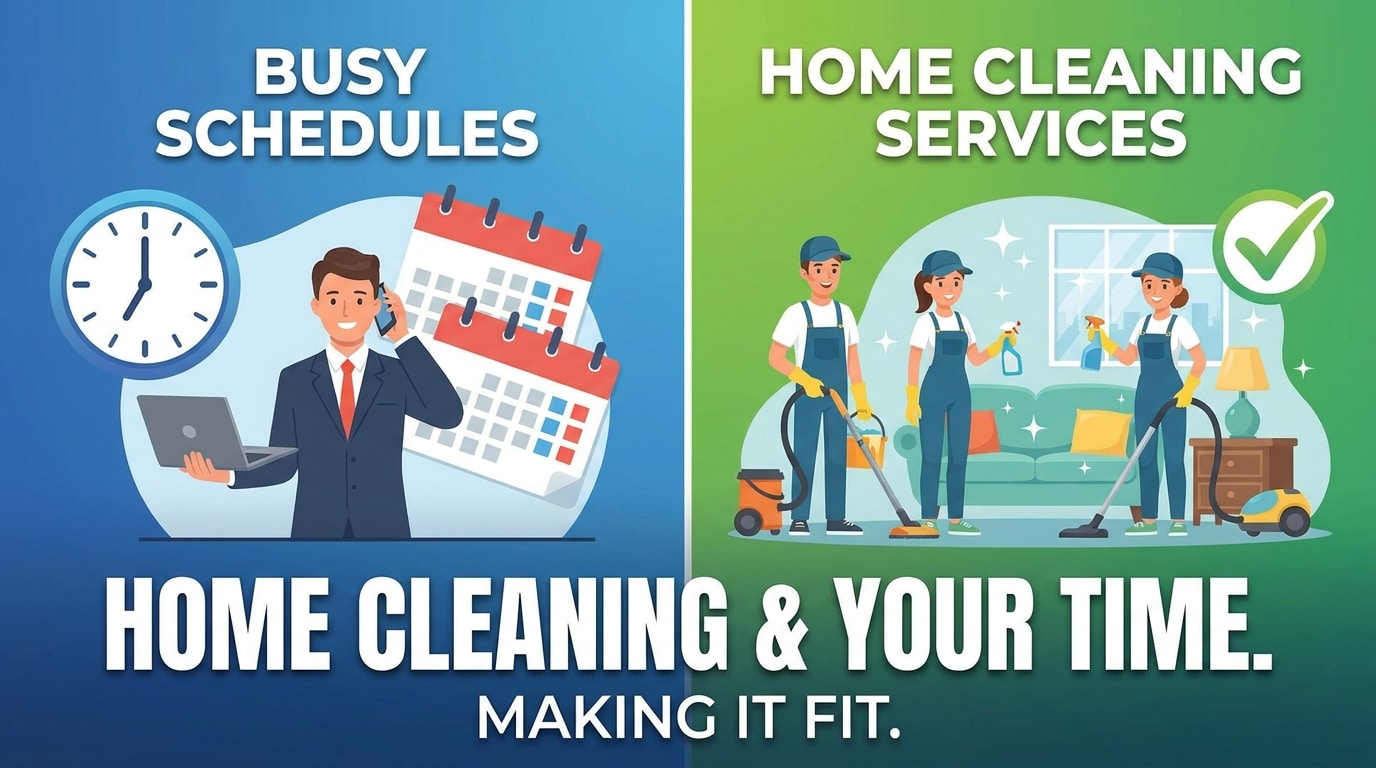
A figure circulates in articles about household chores: roughly 226 hours a year spent cleaning. It comes from taking a daily average out of the American Time Use Survey and multiplying by 365. The arithmetic is wrong, and the way it is wrong tells you something useful about the problem.
Time-use surveys report two different things. How long an activity takes on days when someone does it, and how many people do it on any given day. Multiply the first by 365 and you have assumed everybody cleans every day, which nobody does.
What the survey actually found
The Bureau of Labor Statistics interviews around 7,700 people for each annual round. Its 2024 results show that 80% of people did some household activity on an average day, spending about two hours on it.
Housework specifically is far less universal. Participation runs at 41% on weekend days against 36% on weekdays — meaning most people, most days, do not clean at all. The backlog goes somewhere, and where it goes is the weekend.
The distribution is uneven in a second way. Table 1 of the survey shows women averaging 2.7 hours on household activities on the days they did them, against 2.3 hours for men. That gap has narrowed over decades without closing.
Employment sharpens it further. Among adults living with children under 18, those not employed spent about 2.9 hours a day on household activities against 1.8 hours for those employed. An hour of difference, every day, driven by whether someone also holds a job.
The gap is structural, not a discipline problem
Read those numbers together and the shape of the problem changes. A dual-income household with young children is not failing to clean because its members lack organisation. An employer now buys the hour that used to absorb housework.
That reframes what a cleaning service sells. Not a spotless worktop — a spotless worktop lasts a day. What it removes is a recurring decision: what needs doing, when, and who is going to do it. Households running on two schedules and a shared calendar spend real effort on that negotiation before anyone picks up a cloth.
It also explains why households who try it rarely drop it. They are not weighing the cost against an hour of labour. They are weighing it against the argument.
Cadence matters more than duration
Home cleaning services typically sell weekly, biweekly or monthly schedules, and the right interval depends on how fast mess accumulates rather than on floor area. Pets, children and working from home all raise accumulation rate. Two people out of the house eleven hours a day generate very little.
Getting the interval wrong produces the two standard complaints. Too long, and the home never feels clean between visits, which reads as poor work when it is actually poor scheduling. Too short, and the household pays for frequency it does not need.
Maintenance cleaning and deep cleaning also solve different problems. Maintenance assumes a baseline and holds it. A home that has slipped for months needs an intensive first visit to establish that baseline, and booking a routine slot instead guarantees disappointment on both sides.
Where the health claim holds up, and where it does not
Cleaning companies lean on indoor air quality in their marketing, and the evidence here is narrower than the copy suggests.
The EPA’s guidance on controlling asthma triggers identifies dust mites as a genuine trigger, concentrated in bedding, fabric-covered furniture, carpets and soft toys. Body parts and droppings are the allergenic material.
Then comes the part that undercuts a lot of cleaning copy. Ordinary vacuuming does not remove dust mites, and does not meaningfully reduce dust mite allergen levels. Agitating a carpet without adequate filtration can put allergen into the air rather than take it out.
What the evidence supports is narrower and more specific. The National Heart, Lung, and Blood Institute’s guidance on reducing allergens at home points to mattress and pillow encasings, washing bedding weekly in hot water, keeping relative humidity below 50%, and vacuuming with HEPA filtration. The EPA’s broader indoor air quality material sets the same expectations.
None of that happens by default on a standard visit. A household buying cleaning for allergy reasons should say so, and ask specifically about vacuum filtration and bedding protocol.
What to settle before the first visit
Three things determine whether this works, and price is not among them.
Agree the scope in writing, task by task. Interior windows, inside the oven, skirting boards and bed linen are the four items most often assumed by one side and excluded by the other.
Fix the cadence against your accumulation rate, then review it after a month rather than at the twelve-month mark. And if anyone in the household has asthma or a dust allergy, treat filtration as a specification rather than a preference.
The households that get value out of this treat the schedule as the product. A single visit resets a house. Only the interval keeps it reset.
Observer Voice is the one stop site for National, International news, Sports, Editor’s Choice, Art/culture contents, Quotes and much more. We also cover historical contents. Historical contents includes World History, Indian History, and what happened today. The website also covers Entertainment across the India and World.

