

Transforming from Defence Importer to Exporter: The Impact of Make in India on Global Markets in 2025

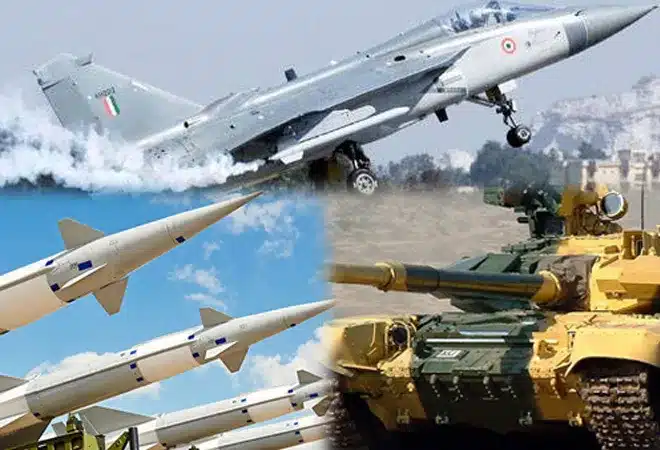
For the defense sector, 2025 marks a pivotal year of reforms aimed at enhancing India’s military capabilities across various domains, including cyber, space, artificial intelligence, and robotics. The Indian defense ecosystem, characterized by a blend of large corporations, MSMEs, and international collaborations, is witnessing significant advancements. Notable achievements include the unveiling of cutting-edge technologies and a surge in defense exports, particularly the BrahMos missile, which has garnered interest from several countries. With a defense budget of Rs 6,81,210 crore, India is positioning itself among the world’s leading military powers.
Advancements in Defense Technology
In 2025, the Defense Research and Development Organization (DRDO) showcased groundbreaking technologies, including the Hypersonic Glide Vehicle (HGV) and the Transporter Erector Launcher (TEL) as part of the Long-Range Anti-Ship Missile (LR-ASHM) program. The Indian defense landscape is evolving rapidly, with numerous systems unveiled this year, such as unmanned systems, India’s first Generation 5 AI-driven imaging seeker, and advanced exoskeletons. This technological growth is driven by the dual objectives of achieving self-reliance and enhancing global competitiveness. The private sector has made a substantial contribution, accounting for approximately 23% of the total defense production, which stands at Rs 1,50,590 crore. The integration of nearly 16,000 MSMEs into the supply chain of defense public sector undertakings (DPSUs) and private manufacturers has further strengthened India’s defense capabilities.
Record Defense Exports and International Collaborations
India’s defense exports have reached a historic high of Rs 23,620 crore, with the BrahMos missile emerging as a standout success. Countries such as Indonesia, South Africa, and several Middle Eastern nations have expressed interest in acquiring this advanced missile system. As one of the top five military spenders globally, India has allocated approximately Rs 2,67,000 crore for modernization efforts. This modernization strategy balances indigenous acquisitions with necessary imports to address immediate capability gaps. Notably, in April 2025, India and France finalized a deal worth around Rs 63,000 crore for 26 Rafale-Marine fighter jets. Additionally, under the Foreign Military Sales (FMS) route, India plans to import 100 Javelin Missile Systems and 216 Excalibur tactical projectiles from the United States.
Policy Revisions and Future Directions
The Indian government is actively revising its defense procurement policies to streamline processes and enhance efficiency. The Ministry of Defence has engaged stakeholders to update the Defence Acquisition Procedure (DAP), with the new DAP 2025 eagerly anticipated by the industry. Meanwhile, the Defence Procurement Manual (DPM) 2009 has undergone a comprehensive revision, resulting in the release of DPM 2025 in September 2025. This updated manual introduces decentralized decision-making authority, aimed at expediting approvals and reducing bureaucratic delays. Furthermore, the Technology Perspective and Capability Roadmap (TPCR) 2025 has been released, outlining the Indian Armed Forces’ requirements and providing the industry with a clear understanding of capability needs for the next 15 years.
India’s Position in the Global Defense Landscape
India’s trajectory in defense production has significantly improved, with indigenous production now meeting nearly 65% of its defense requirements. This marks a remarkable shift from a decade ago, driven by successful platforms such as BrahMos, Pinaka, Akash, and Tejas. While India has developed cost-effective and battle-proven systems, certain advanced domains, including next-generation propulsion and stealth technologies, require further development. As India aspires to become a global leader, it is essential to expand defense engagement beyond arms trade to include strategic technology partnerships and joint development initiatives. Bilateral agreements with countries like Australia, Canada, and the United States focus on emerging technologies and critical mineral security, aiming to de-risk supply chains. As 2026 approaches, India is poised to build on its achievements, enhancing localization, integrating legacy systems with emerging technologies, and advancing AI-enabled warfare systems. The Indian defense industry stands at the threshold of a new era, ready to navigate the complexities of a rapidly changing global landscape.
Observer Voice is the one stop site for National, International news, Sports, Editor’s Choice, Art/culture contents, Quotes and much more. We also cover historical contents. Historical contents includes World History, Indian History, and what happened today. The website also covers Entertainment across the India and World.
Follow Us on Twitter, Instagram, Facebook, & LinkedIn

