

India-New Zealand Free Trade Agreement: Implications of Zero Duty on All Indian Exports for Trade

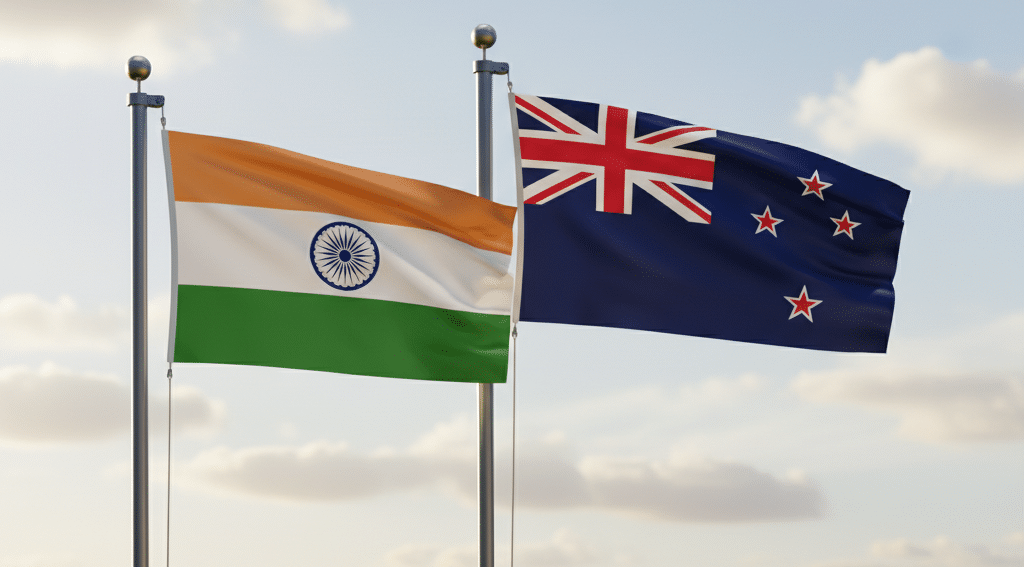
Prime Minister Narendra Modi of India and New Zealand’s Prime Minister Christopher Luxon have finalized a significant Free Trade Agreement (FTA) aimed at enhancing economic ties between the two nations. Announced during a recent telephonic conversation, the agreement is expected to bolster trade, investment, and innovation, creating new opportunities across various sectors. The FTA, which began negotiations during Luxon’s visit to India in March 2025, is seen as a pivotal step in deepening bilateral relations and expanding market access.
Key Features of the India-New Zealand FTA
The India-New Zealand Free Trade Agreement is designed to provide substantial benefits to both countries. Once implemented, Indian exports to New Zealand will enjoy zero-duty access, with tariffs eliminated across all lines. This is anticipated to significantly benefit farmers, micro, small, and medium enterprises (MSMEs), and women-led businesses, particularly in labor-intensive sectors such as textiles, apparel, leather, and footwear. Additionally, the agreement is expected to enhance manufacturing sectors, including engineering, automobiles, electronics, and pharmaceuticals, thereby fostering deeper economic cooperation.
The FTA aims to double bilateral trade within the next five years, with New Zealand committing to invest $20 billion in India over the next 15 years. This investment will focus on manufacturing, infrastructure, services, and innovation, providing a substantial boost to India’s economic landscape. The agreement also emphasizes agricultural cooperation, allowing Indian farmers improved access to New Zealand’s market for various products, including fruits, vegetables, and processed foods. Initiatives like the Agricultural Productivity Partnership will help farmers increase productivity and income.
Services and Mobility Provisions
A significant aspect of the FTA is its focus on services and mobility. New Zealand has offered market access in 118 service sectors and extended Most Favoured Nation (MFN) treatment in 139 sectors. In return, India has granted New Zealand access in 106 service sectors. Notably, the agreement includes an annex on health and traditional medicine services, marking a first for New Zealand in its trade agreements.
Mobility provisions are also a highlight of the pact. For the first time, New Zealand has established an Annex on Student Mobility and Post Study Work Visas, allowing Indian students to work 20 hours per week while studying. Graduates in Science, Technology, Engineering, and Mathematics can obtain post-study work visas for up to three years, while those with master’s degrees can stay for up to three years, and doctoral graduates for up to four years. Furthermore, the agreement introduces Temporary Employment Entry Visas for 5,000 Indian professionals in skilled occupations, along with a Working Holiday Visa for 1,000 young Indians annually.
Impact on Trade and Economic Relations
The FTA is poised to significantly impact trade relations between India and New Zealand. Currently, India’s average MFN tariff stands at 16.2 percent, which will decrease to 13.18 percent upon the agreement’s implementation, eventually reaching 9.06 percent by the tenth year. The agreement extends market access on 70.03 percent of tariff lines, while 29.97 percent remain excluded, primarily covering sensitive sectors such as dairy and sugar.
Christopher Luxon expressed optimism about the agreement’s potential, stating that it could increase New Zealand’s exports to India by $1.1 billion to $1.3 billion annually over the next two decades. He emphasized that boosting trade would create more jobs and opportunities for New Zealanders. The FTA is expected to strengthen the friendship between the two countries, providing Kiwi businesses access to India’s vast consumer market of 1.4 billion people.
In the fiscal year 2024-25, bilateral merchandise trade reached $1.3 billion, with total trade in goods and services approximating $2.4 billion. The services trade alone accounted for $1.24 billion, highlighting the growing economic interdependence between India and New Zealand.
Observer Voice is the one stop site for National, International news, Sports, Editor’s Choice, Art/culture contents, Quotes and much more. We also cover historical contents. Historical contents includes World History, Indian History, and what happened today. The website also covers Entertainment across the India and World.

