

PM Modi Advocates for ‘Blue Book’ of Bullet Train Project Lessons as Engineers Provide On-Ground Insights

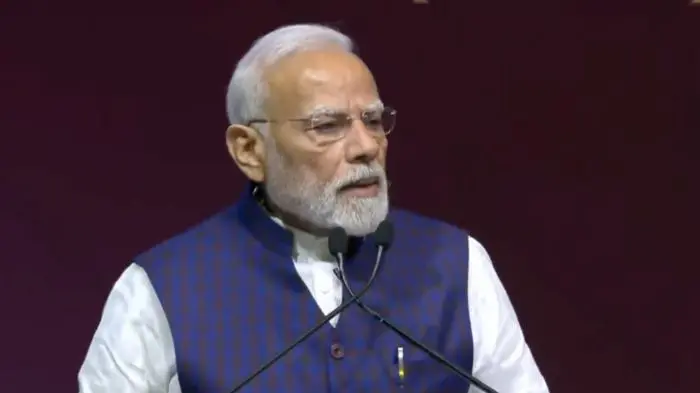
Prime Minister Narendra Modi has urged engineers involved in the Mumbai–Ahmedabad bullet train project to meticulously document their technical experiences. Speaking in Surat, he emphasized that such documentation would serve as a valuable resource for future high-speed rail initiatives across India, minimizing the need for repeated experimentation. Modi highlighted the importance of compiling these insights into a comprehensive “Blue Book” to guide future teams in understanding the rationale behind decisions made during the project.
Engineers Share Their Experiences
During his visit, Prime Minister Modi interacted with engineers and workers on the Mumbai–Ahmedabad High Speed Railway (MAHSR) corridor. He reviewed the project’s progress, focusing on construction milestones and timelines. Engineers shared their experiences, showcasing the project’s smooth advancement. One engineer from Kerala described her role at the Noise Barrier Factory in Navsari, where robotic systems are utilized for welding rebar cages. She expressed pride in contributing to India’s first bullet train, calling it a “dream project” for her and her family. Another team member, Shruti from Bengaluru, who serves as the Lead Engineering Manager, detailed the design-review and engineering-control processes. She explained that her team evaluates the pros and cons at each execution stage, exploring alternatives to ensure an error-free delivery. Modi noted that these stories reflect the motivation derived from contributing to nation-building, drawing parallels with India’s early space missions.
Significant Progress on the 508-km Corridor
The Mumbai–Ahmedabad bullet train project spans 508 kilometers, with 352 kilometers located in Gujarat and Dadra & Nagar Haveli, and 156 kilometers in Maharashtra. It connects major cities, including Ahmedabad, Vadodara, Surat, Vapi, Thane, and Mumbai. The project employs advanced engineering techniques, with approximately 85 percent of the route—about 465 kilometers—constructed on elevated viaducts. This design minimizes land disruption and enhances safety. According to the Prime Minister’s Office, 326 kilometers of viaduct work has been completed, along with 17 out of 25 planned river bridges. Once operational, the bullet train is expected to reduce travel time between Mumbai and Ahmedabad to around two hours, significantly improving inter-city mobility.
Impact on Economic Development
The government anticipates that the bullet train project will stimulate business, tourism, and economic activity along the corridor. By enhancing connectivity between major urban centers, the initiative is expected to catalyze regional development. The project not only aims to improve transportation efficiency but also seeks to create job opportunities and boost local economies. As the construction progresses, the focus remains on ensuring that the project meets its timelines and quality standards, paving the way for future high-speed rail projects across India.
Observer Voice is the one stop site for National, International news, Sports, Editor’s Choice, Art/culture contents, Quotes and much more. We also cover historical contents. Historical contents includes World History, Indian History, and what happened today. The website also covers Entertainment across the India and World.

