

Why Businesses Are Switching to Cloud CRM

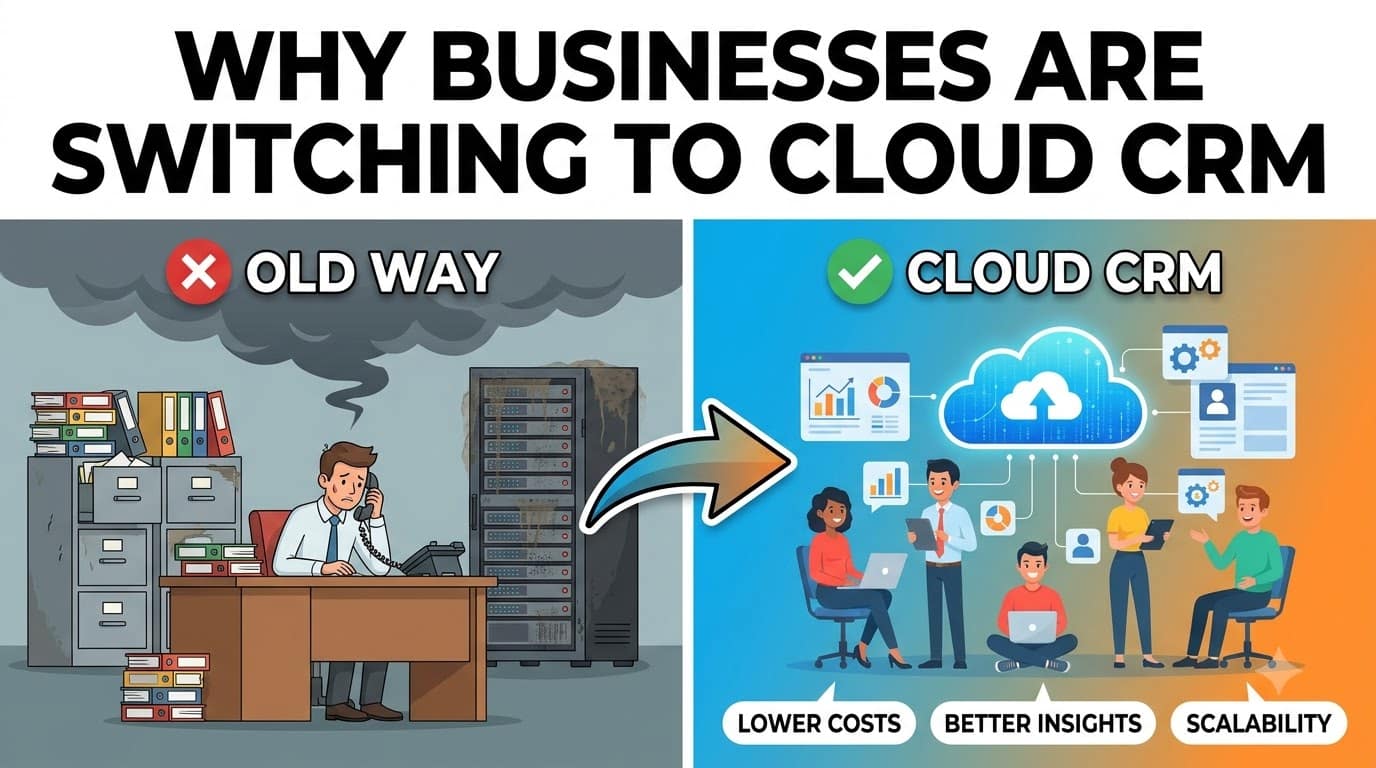
Most Indian businesses didn’t sit down and plan a move to the cloud. It happened because something broke. A hot lead went cold inside a WhatsApp thread. A server died during quarter end closing. A rep in Pune couldn’t see what head office had already promised a client in Coimbatore.
Cloud CRM software fixes a fairly specific set of problems, and the real reasons companies switch are far more practical than most vendor pages let on.
What Is Cloud CRM Software?
A cloud CRM is customer relationship management software hosted on the provider’s servers and accessed through a browser or a mobile app. You pay a subscription per user instead of buying hardware and perpetual licences. Updates, backups and uptime sit with the vendor rather than your IT team.
That’s the mechanical difference. The business logic behind the shift is where it gets interesting.
Globally, cloud already accounts for the majority of CRM spending. Grand View Research put the cloud segment at 59.4 percent of the market in 2025, and other analyst houses tracking new deployments specifically place that figure far higher. India’s CRM market is estimated at roughly USD 2.5 billion in 2025 and growing at a healthy clip. The direction isn’t in dispute anymore. The reasoning is worth unpacking.
Main Reasons Businesses Are Switching to Cloud CRM System
1. Lower Upfront Costs
Buying an on premise CRM means a server, licences, an annual maintenance contract, and someone competent to keep it patched. That’s capital expenditure, plus a slow depreciation you feel for years.
Cloud pricing behaves differently. Ten users on a mid tier plan at ₹800 per user per month works out to ₹96,000 a year, plus 18 percent GST that a registered business reclaims as input credit. No server. No AMC. No emergency call to a vendor’s support engineer at 11 pm before a board review.
The trade is real, though. You’re renting, not owning, and the meter never stops. More on that below.
2. Helps Remote and Field Sales Teams Stay Connected
This one drives more switches in India than cost does, in my experience with SME sales teams.
Field sales is the norm across manufacturing distribution, pharma, real estate, insurance and B2B trading. Reps take orders in a client’s factory, not at a desk. According to DataReportal’s report India crossed 806 million internet users by January 2025, with the overwhelming majority accessing the internet on a phone. A CRM that only opens on an office desktop is functionally invisible to the people generating revenue.
The catch nobody mentions in the brochure: rural and tier 3 connectivity is still patchy. Rural internet penetration sits well below urban levels. If your reps work in industrial belts outside city limits, offline data capture that syncs later isn’t a nice extra. It’s the whole requirement.
3. Improves Lead Response Time and Sales Efficiency
Two older studies still describe Indian SME behaviour uncomfortably well.
The 2007 lead response research by Dr James Oldroyd at MIT, run with InsideSales across 15,000 leads, found the odds of qualifying a lead called within five minutes were dramatically higher than one called at the thirty minute mark. A 2011 Harvard Business Review audit of 2,241 companies then found only 37 percent responded within an hour, and 23 percent never responded at all.
Both studies are dated. The behaviour hasn’t changed.
A business spending ₹50,000 a month on lead generation, then letting enquiries sit unassigned for two days, doesn’t have a marketing problem. It has a routing problem.
Cloud systems win here for a boring reason: a lead from a website form or a marketplace listing lands in one shared pipeline, assigned instantly, visible to a manager on a phone. Spreadsheets can’t do that, and neither can a CRM sitting behind an office VPN.
4. Supports Data Compliance and Security in India
This is the section most competitor articles skip entirely, and it’s now the strongest argument for choosing carefully.
The Digital Personal Data Protection Rules were notified in November 2025, with full compliance obligations landing in May 2027. If your business stores customer names, phone numbers and purchase history, you are a Data Fiduciary under the Act. That carries duties: clear notice, verifiable consent, purpose limitation, accuracy, reasonable security safeguards including encryption and access logging, erasure once the purpose ends, and a response window for data principal requests.
Penalties have teeth. Failure to implement reasonable security safeguards attracts up to ₹250 crore. Failure to report a breach, up to ₹200 crore.
Layer on the rest of the Indian stack:
- CERT-In directions require ICT system logs to be maintained for a rolling 180 days and stored in India, with cyber incidents reported within six hours of being noticed
- The RBI’s 2018 payment system data circular requires the entire payment data set to be stored in India, and that obligation is stricter than the DPDP baseline for anyone in financial services
- E-invoicing applies above ₹5 crore annual turnover, with a 30 day reporting window for businesses at or above ₹10 crore since April 2025
Smaller entities get graded relief. Non significant fiduciaries aren’t expected to appoint a full time data protection officer or run annual impact assessments. Still, the practical consequence is simple: your CRM vendor’s hosting location, audit trails and consent capture features are now due diligence items, not IT trivia.
Cloud CRM vs On-Premise CRM: Which Is Better?
| Dimension | Cloud CRM | On premise CRM |
| Upfront cost | Subscription per user, typically ₹200 to ₹2,600 monthly | Servers, licences, setup capital |
| Time to go live | Days | Weeks to months |
| Maintenance | Vendor managed, automatic updates | Your IT team patches and upgrades |
| Scaling | Add or remove users instantly | Constrained by hardware |
| Security duty | Shared: vendor secures the platform, you remain the Data Fiduciary | Entirely yours |
| Customisation | Configurable within platform limits | Deep, down to code |
| Access | Any device, anywhere | Usually office or VPN bound |
| Data residency | Depends on the vendor’s India hosting | Fully under your control |
How Much Does Cloud CRM Software Cost in India?
Published India pricing for SMB tier cloud CRM generally runs between ₹200 and ₹2,600 per user per month on annual billing. Free tiers for two or three users are common. Indian built platforms cluster at the lower end, global enterprise suites sit far above it.
Watch the tier structure rather than the headline price.
The features most buyers actually want, workflow automation, scoring, AI assistance, sit two tiers up from entry level almost everywhere. A ₹800 plan becomes a ₹2,400 plan the moment automation becomes non negotiable. Budget for storage overages, integration work and any premium support tier separately.
Disadvantages of Cloud CRM Software You Should Know
An honest list, because pretending otherwise wastes your time:
- Subscription creep: Cost scales linearly with headcount forever. At 80 users the maths starts favouring alternatives that looked absurd at eight.
- Lock in: Proprietary data models and custom fields make exports messier than vendors imply. Ask about export formats before you sign, not during a dispute.
- API and storage limits: Fine print. Usually discovered during an integration project, never before.
- Customisation ceilings: You configure what the platform allows. Deep process rewrites need code, and cloud platforms don’t always let you write it.
- The shared responsibility gap: Your provider secures the infrastructure. You remain legally accountable for consent, access control and lawful use. Plenty of businesses assume buying cloud software outsources compliance. It doesn’t.
- Connectivity dependence: Already covered, still the most common source of rep frustration.
How to Successfully Implement Cloud CRM Software
Software choice matters less than most buyers think.
Analyst estimates of CRM projects that fail to deliver planned benefits range from around 30 percent to as high as 70 percent depending on the methodology, with roughly 55 percent a defensible middle figure. The causes are consistently human, not technical. Poor user adoption accounts for the largest share, followed by bad data quality and insufficient training. Platform limitations explain under one tenth of failures.
Practical version: phased rollouts beat big bang launches by a wide margin. Set aside 15 to 25 percent of your project budget for training and change management. Expect three to six months to reach genuine adoption in a 10 to 100 user business, not three weeks.
And clean your data before migration. Importing four years of duplicate contacts into a new system just relocates the problem.
Cloud CRM Software Buying Checklist
- Can a non technical rep use it without a manual? Adoption is the single biggest failure point
- Does the mobile app support offline capture, click to call and WhatsApp?
- Does it pull leads from your actual sources: website forms, marketplaces, social, telephony?
- Does it connect to your accounting and invoicing stack?
- India hosting, encryption, role based access, audit logs, consent records?
- Transparent rupee pricing with a proper GST invoice?
- Can you export everything, cleanly, on demand?
Businesses switching to cloud CRM in 2026 aren’t chasing a trend. They’re solving for mobile teams, faster lead response, and a compliance regime that now attaches real numbers to carelessness. Get the evaluation right and the software becomes invisible, which is exactly what good operational software should be.
Before shortlisting any platform, write down the three problems you actually want solved: lead response, field visibility, or compliance readiness. Then run a two week trial with one sales team and no more. The right system reveals itself quickly when tested against a real pipeline instead of a feature list.
Observer Voice is the one stop site for National, International news, Sports, Editor’s Choice, Art/culture contents, Quotes and much more. We also cover historical contents. Historical contents includes World History, Indian History, and what happened today. The website also covers Entertainment across the India and World.

