

Breaking Down Diablo 4’s Endgame Progression Systems

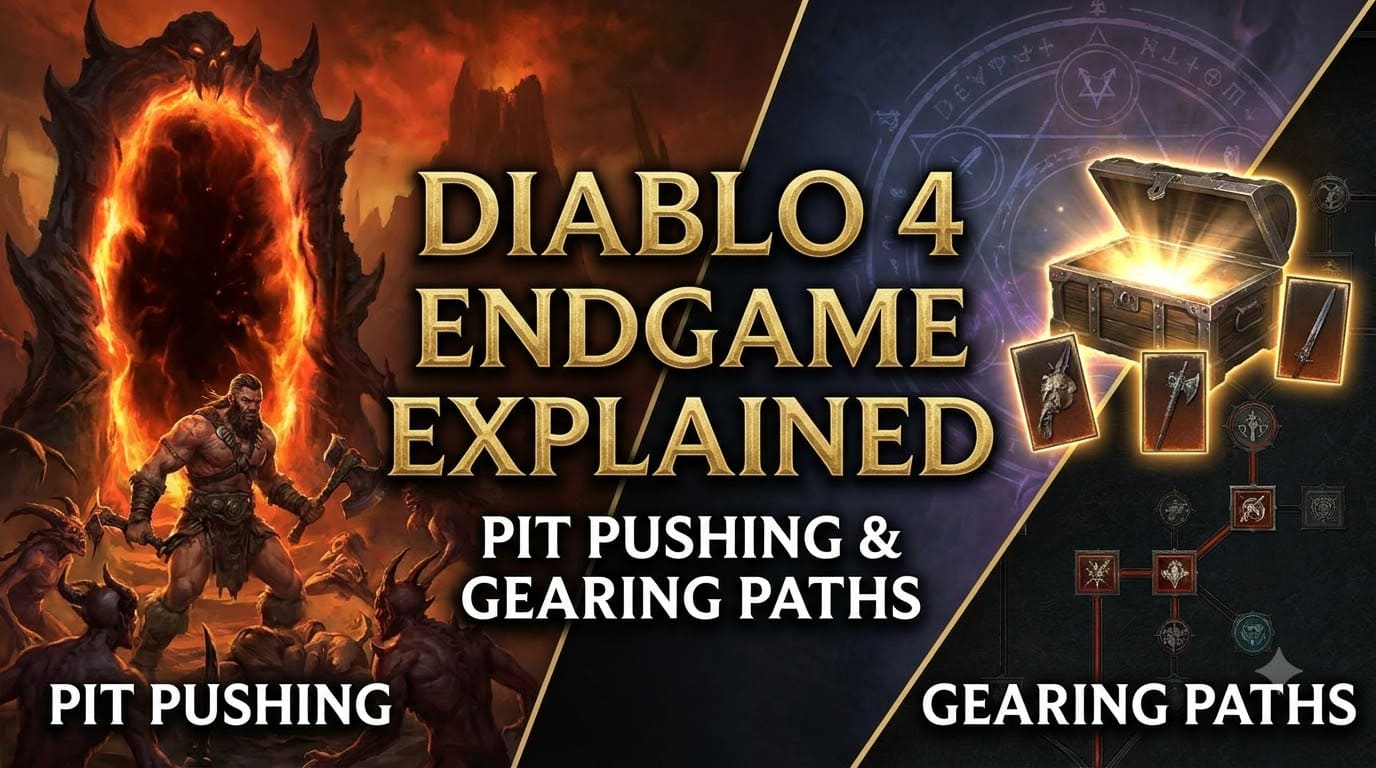
Diablo 4’s endgame loop feels pretty familiar by now, no matter how many seasonal resets roll through: gear upgrades feed into Nightmare Dungeons, those dungeons fuel your glyph progression, and your glyph levels ultimately dictate how high you can climb in the Pit.
Season of Death Awakening mixed up the specific rewards and dropped activities like the Deathtoll Chamber into the rotation, but the core grind that’s held the game together since the big itemization overhaul remains completely intact.
The Four Systems That Define Endgame
Most of a level 100 character’s playtime gets split across four activities, and each one feeds into the others rather than standing alone:
- Nightmare Dungeons – the main source of glyph experience and targeted gear farming
- The Pit – an infinitely scaling dungeon that measures raw character power
- Helltides – open-world farming for Forgotten Souls, gold, and mid-tier gear
- Uber bosses – the highest-value loot targets, gated behind summoning materials
None of these exist in isolation. A character stuck at a low Pit tier almost always traces the problem back to under-leveled glyphs, which means more time in Nightmare Dungeons before the Pit becomes worth pushing again. It’s also why so many trade-chat conversations about Diablo 4 boosts happen right at that wall, when a player can see exactly what’s holding their build back but doesn’t want to spend another week grinding glyph experience to fix it.
Nightmare Dungeons Still Set the Pace
Sigils determine which Nightmare Dungeon a player enters and at what monster level, and running higher-tier sigils remains the fastest way to level Paragon glyphs. Season 14 added the Rupture affix, which spawns Deathtoll Chamber access points inside dungeons after closing enough Tears — a detour worth taking since the chamber is currently the best source of Superior Lair Keys for opening Hoards in Torment difficulty.
Gravehounds, part of the new Risen monster family introduced this season, spawn from Ruptures and drop orbs that feed a nearby Exarch. Killing the hounds before those orbs reach it keeps the fight manageable, which matters more in higher-level Nightmare Dungeons where the Exarch’s empowered attacks can chunk a build that isn’t paying attention. Groups that can’t quite clear those higher sigils sometimes bring in a D4 carry for the run rather than dropping back down to an easier tier and losing out on the better glyph experience.
Pushing the Pit Without Wasting Runs
The Pit has no affixes or seasonal modifiers layered on top of it — just monster level scaling and a strict time limit, which makes it the cleanest way to compare two builds or gear sets against each other. Dying costs 30 seconds off the clock rather than ending the run outright, so a Pit push rewards efficient clearing over cautious play.
| Pit Tier Range | Typical Player State | Main Bottleneck |
| 1–30 | Fresh level 100, early gearing | Aspect and affix rolls |
| 30–60 | Full build online, Paragon in progress | Glyph levels |
| 60–100 | Optimized build, strong Uber gear | Damage and survivability balance |
| 100+ | Min-maxed, meta-adjacent build | Marginal stat optimization |
Most players plateau somewhere in the 30–60 range simply because glyphs take longer to level than gear takes to acquire. Pushing past that wall usually means running Nightmare Dungeons specifically for glyph experience rather than loot. It’s a common enough wall that a quick D4 boost through a handful of high-tier sigils shows up as a suggestion in clan chat almost every season.
Gearing Paths Worth Prioritizing
Aspect quality still matters more than raw item level for most builds, since a well-rolled Legendary or Mythic aspect can outperform a higher-level item with mediocre affixes. The Horadric Cube remains the primary tool for extracting and imprinting aspects, and knowing which dungeons drop which aspects saves a lot of wasted Nightmare Dungeon runs.
Uber Unique farming sits at the top of the gearing ladder for a reason — items like Andariel’s Visage or Grandfather change how a build plays rather than just improving its numbers. Summoning materials for Uber bosses like Duriel or Andariel drop from specific world content, which keeps that farming tied to activities players are already doing rather than requiring a separate detour.
How Professional Runs Fit Into the Loop
Not every player wants to spend a full season grinding glyphs before their build feels finished, and that’s the gap a Diablo 4 boost is built to close for anyone who’d rather skip straight to the content they actually enjoy.
It tends to work best as a supplement rather than a full replacement for playing the game — someone might use a run to clear a Pit tier their current gear can’t handle yet, or to farm a specific Uber boss they’ve been unlucky with, while still doing the rest of their leveling and gearing themselves. That distinction matters more in Diablo 4 than in a lot of other games, since so much of the endgame satisfaction comes from watching a build actually come together.
What a run actually costs depends heavily on the target — a single Uber boss kill and a full Pit-pushing session sit at very different points on any Diablo 4 boost price list, since one takes minutes and the other can take hours of coordinated play.
Uber Boss Farming and Season-Long Goals
Duriel, Andariel, Lilith, and the Season 14 additions all require specific summoning materials gathered from different parts of the map, which is part of why coordinated groups tend to split up farming routes rather than each player collecting everything solo. A Diablo 4 carry through one of these fights is a fairly common ask in trade chat during the first few weeks of a season, mostly from players who’ve got the materials but not yet the build strength to clear it safely.
Some players decide to buy Diablo 4 boost runs specifically for the fights their class struggles with that season, rather than switching builds just to clear one boss they might not fight again for months.
As a season matures and builds hit their stride, D4 boosting requests naturally pivot away from gear farming toward high-tier Pit pushes, typically driven by players aiming for leaderboard spots or bragging rights with their clanmates.
Diablo 4 boosters focusing on carry services tend to divide their expertise; some specialize strictly in Uber boss farming, while others master high-tier Pit runs. Because the precise build optimization required for each activity varies so significantly, finding players who excel equally at both is a rare exception.
Building a Character That Holds Up Across Seasons
The specific bosses, affixes, and dungeon mechanics change every season, but the core approach to Diablo 4 progression hasn’t: level glyphs deliberately instead of passively, prioritize aspect quality over raw item level, and treat the Pit as a diagnostic tool rather than a race. A character built around those fundamentals adapts to whatever the next season introduces far more easily than one built around chasing a single season’s specific meta. Some players will get there entirely on their own; others will lean on Diablo 4 carries for the one wall they can’t get past, and neither approach says much about how the rest of their season goes.
For a deeper breakdown of current build rankings and Uber boss mechanics, Icy Veins’ Diablo 4 guides remain one of the more reliably updated community resources each season.
Observer Voice is the one stop site for National, International news, Sports, Editor’s Choice, Art/culture contents, Quotes and much more. We also cover historical contents. Historical contents includes World History, Indian History, and what happened today. The website also covers Entertainment across the India and World.
Follow Us on Twitter, Instagram, Facebook, & LinkedIn

