

Why Brand Reputation in 2026 Means More Than What Shows Up on Page One

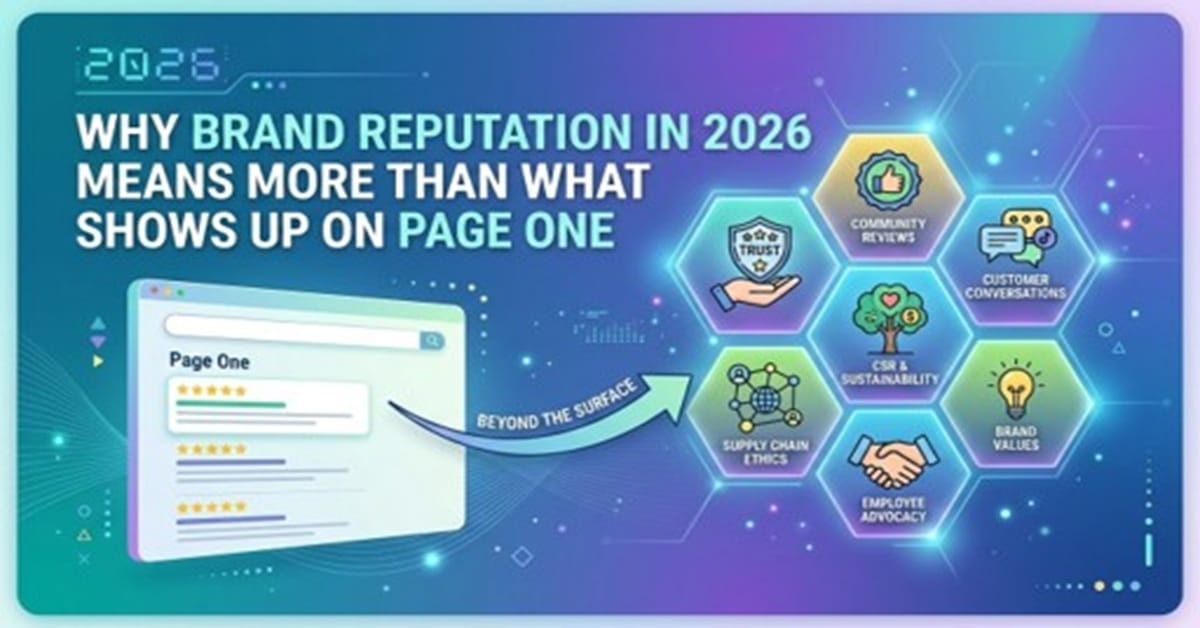
Algorithms now curate brand perception before prospects ever conduct a search. Brand reputation has become the primary driver of digital visibility, and page one placement no longer tells the full story. AI discovery tools, voice assistants, and real-time social validation can elevate or erode trust within seconds. From influencer sentiment to crisis velocity on third-party platforms, the factors shaping long-term brand equity extend well beyond traditional rankings.
The Shift Beyond Search Rankings
By 2025, 68% of Google searches end without a click, driven by AI Overviews and featured snippets, according to SparkToro’s 2024 study. Three visibility formats have emerged that bypass traditional clicks entirely: AI Overviews deliver synthesized answers at the top of results, featured snippets pull specific content into highlighted boxes, and knowledge panels display entity information on the right side of the screen.
Each format requires optimization that differs from standard ranking tactics. Structured data schema helps populate knowledge panels with accurate brand information. E-E-A-T author boxes increase the chances of AI systems citing content. FAQ schema markup improves eligibility for featured snippet placement.
SimilarWeb data show a 34% average drop in CTR when AI Overviews appear in search results. Gartner forecasts that zero-click searches will reach 75% by 2026. In this environment, entity reputation and brand authority carry more weight than individual page rankings.
AI Agents and Zero-Click Discovery
Perplexity AI now processes 500 million queries monthly, with citation links appearing in only 12% of responses, according to their 2024 transparency report. AI agents reshape how audiences discover information without ever clicking through to original sources. Brand mentions can occur inside AI-generated answers that users never trace back to a specific URL.
Three platforms drive this shift, each with its own citation logic. Perplexity prioritizes .edu and .gov sources when selecting brand mentions. ChatGPT Search weighs recent news from 50 approved outlets when pulling citations. Google’s AI Mode favors pages that include FAQ schema markup.
Brands can target inclusion across these systems. Publishing original research with data tables helps secure visibility in Perplexity results. Securing ChatGPT citations requires HARO responses placed in approved outlets. Citation velocity benchmarks suggest three to five brand mentions in authoritative sources within 90 days support AI agent pickup.
Voice Assistants and Smart Ecosystems
Amazon Alexa handles 1 billion voice requests weekly, with 73% of local business queries answered from Google My Business data alone. Each voice ecosystem demands specific technical adjustments to maintain consistent brand signals across smart devices.
Optimizing for Alexa requires complete NAP consistency across Google My Business profiles, as well as voice-friendly question-and-answer content that devices can surface accurately in response to customer inquiries. Google Assistant responds to Local Business schema markup that includes opening hours and aggregate ratings, feeding those signals directly into knowledge panels and AI summaries. Apple Siri requires exact matching between Apple Maps listings and Google listings across all locations.
Discrepancies in business information across voice platforms create confusion for users and weaken brand perception. One major retailer reported significant increases in voice-driven inquiries after standardizing structured data across thousands of store listings. Review schema implemented consistently across locations reinforces the entity reputation signals that voice assistants rely on when generating answers.
Social Proof as Primary Filter
Search algorithms now place heavy weight on social proof when determining brand visibility. Peer validation and community sentiment function as primary discovery mechanisms before users ever reach a company site.
Brand reputation no longer tracks primarily through first-page positions. Online reputation management has expanded to include the trust signals that AI overviews, featured snippets, and social platforms use to evaluate authority. Companies focused only on first-page ranking miss the channels where brand perception increasingly forms.
Reviews and Community Sentiment
BrightLocal’s 2024 survey shows 76% of consumers trust online reviews as much as personal recommendations. Google reviews influence 42% of local pack rankings, according to a 2024 Whitespark analysis of more than 50,000 business listings.
Businesses should aim for 10 to 15 reviews per month to maintain their ranking positions. Reaching 25 or more monthly reviews often improves placement for local queries. Response rate targets should include responding to 95% of reviews within 24 hours using automation platforms such as ReviewTrackers or Birdeye.
Google reviews carry 2.1x the weight of Yelp reviews in local ranking calculations. Trustpilot scores influence 34% of B2B purchasing decisions, according to G2’s 2024 buyer survey. Crisis management protocols should include addressing negative reviews within 2 hours using prepared response templates.
Influencer and Peer Validation
Influencer marketing spend reached $21.1 billion globally in 2024, with micro-influencers delivering 60% higher engagement than macro accounts. Peer validation now includes unlinked brand mentions across Reddit threads, Discord communities, and niche Facebook groups, none of which traditional link-based tracking captures.
Glossier’s 2024 Reddit strategy generated 3,400 unlinked brand mentions and drove an 18% increase in referral traffic. Advocacy rate calculations, which measure the percentage of positive mentions from verified customers, reveal sentiment trends that affect brand visibility and search signals. Monitoring share of voice across these platforms provides clearer data than link counts alone.
How Crisis Velocity Affects Brand Reputation
United Airlines’ 2024 social media crisis trended for 47 hours, with 2.3 million negative mentions tracked by Brandwatch during peak velocity. The first 15 minutes after an incident surfaces often determine the direction coverage takes. Online reputation management teams need monitoring tools that deliver alerts within seconds, not minutes.
Three platforms support effective monitoring during high-pressure moments: Brandwatch provides real-time alerts with 15-second latency for early detection, Meltwater maps stakeholder relationships across different audience groups, and Talkwalker tracks image and video content as it appears across social platforms.
Clear response timelines limit damage once an issue surfaces:
- Initial acknowledgment within 30 minutes of detection
- A detailed statement within 2 hours
- A published resolution timeline within 6 hours to demonstrate accountability
Southwest Airlines experienced a 14-hour delay responding to weather cancellation complaints in 2024. That silence compounded the damage. Faster action would have reduced the impact on customer trust and media coverage.
An escalation framework keeps teams organized under pressure. Level 1 issues stay with customer service. Level 2 situations move to the PR department. Level 3 events require a C-suite statement.
Trust Signals in Algorithmic Feeds
Google’s December 2024 Helpful Content Update added 12 new E-E-A-T signals, including author credentials and content freshness timestamps. Trust signals are now verifiable ranking factors, not just best practices.
Seven signals appear consistently across strong algorithmic distributions:
- Author boxes with verifiable credentials established through Authoritative.io verification
- Last-updated dates within 30 days to communicate content freshness
- Original research with primary data that builds topical authority
- External citations from .edu domains that strengthen academic credibility
- HTTPS plus security badges that signal technical trustworthiness
- Consistent NAP across 15 or more directory listings
- First-party data ownership statements that demonstrate transparency
A Trust Flow score above 35 correlates with 23% higher algorithmic distribution, per Majestic 2024 data. Brands should audit each trust signal monthly to maintain compliance as algorithm requirements shift.
Brand Safety in Third-Party Platforms
The 2024 IAB Brand Safety report found 23% of programmatic ad placements appeared next to harmful content, costing brands $2.8 billion in unsafe impressions. Third-party environments require active oversight to protect brand perception.
Social platforms offer specific exclusion controls. Meta’s Brand Safety tools block placements across 47 sensitive categories, including political content, adult material, and tragic events. TikTok and X provide similar topic exclusions plus creator-level filtering. YouTube’s Video Claiming API allows brands to block mentions across 12 restricted categories before content goes live.
Programmatic networks benefit from third-party verification tools. DoubleVerify and Integral Ad Science enforce 95% viewability thresholds while scanning for brand risk indicators. Influencer agreements should include 30-day content removal clauses and FTC-compliant disclosure requirements to maintain consistent brand messaging across earned placements.
Long-Term Brand Equity vs. Short-Term Visibility
Interbrand’s 2024 valuation shows Apple maintains $502.7 billion in brand value despite ranking 47th for the keyword “smartphone.” Brand reputation builds equity that ranking tactics alone cannot replicate. Companies that chase first-page placement often watch those gains disappear with each algorithm update.
Three metrics separate equity building from ranking games:
- Brand search volume that compounds across multiple channels over time
- Direct traffic percentage showing how many visitors arrive without search engine mediation
- Branded conversion rates that outperform generic searches because trust already exists before the click
NetReputation has noted this distinction in its own writing, pointing out that brands investing in entity reputation tend to hold their ground more consistently across algorithm changes than those optimizing primarily for SERP position.
Thought leadership content requires extended production cycles to establish authority. Executive visibility programs that place leaders at industry conferences generate trust signals that paid placements cannot buy. Strategic partnerships with complementary brands expand reach while sharing credibility across different audiences.
Measuring Brand Reputation Beyond SERP Position
Adobe’s 2024 Digital Trends report identifies share of search as the top reputation metric replacing SERP position for many CMOs. Share of search is defined as the proportion of branded queries your company receives relative to total category searches. Modern brand reputation requires tracking multiple signals across different platforms and sources.
Seven KPIs provide a complete picture of brand health:
- Share of search: branded query volume compared to competitors via Google Trends and SEMrush (target: 15% or more of category searches)
- Share of voice: brand mentions across 200-plus sources tracked through Brandwatch
- Sentiment score: net positive mentions divided by total mentions through Lexalytics analysis (benchmark: 65% positive)
- Review velocity: new reviews per month via Birdeye (target: 25 or more monthly)
- NPS score: quarterly surveys through Qualtrics with at least 500 respondents
- Direct traffic percentage: branded vs. non-branded segmentation in Google Analytics 4
- Brand search volume: branded query trends tracked through SEMrush
Quarterly audits keep these metrics from drifting. Each review should compare the current share of search against the 15% target, check sentiment against the 65% threshold, verify review velocity, assess the completeness of NPS data, and analyze brand search volume trends against the prior quarter. Document competitor movements that might explain shifts in your own numbers before presenting findings to stakeholders.
Strategic Implications for 2026
Gartner’s 2025 forecast projects traditional SEO budgets will decline 34% by 2027 as reputation management spend increases 51%. Four strategic shifts define how organizations adapt:
- Budget reallocation from ranking tools toward reputation platforms, with annual investments of $15K to $50K on tools like Brandwatch or ReviewTrackers
- Organizational restructuring to include a Chief Reputation Officer reporting directly to the CMO
- Technology stack evolution that replaces rank tracking with entity monitoring using Mention alongside the Google Alerts API
- Measurement migration from keyword rankings to reputation scorecards tracking sentiment analysis, review velocity, and share of voice against three competitor entities
Implementation follows a structured quarterly timeline. Q1 2026 begins with a full audit of existing reputation assets across review profiles, media coverage, and social presence. Q2 deploys monitoring infrastructure and integrates alert systems with existing CRM and customer service platforms. Q3 centers on training cross-functional teams in crisis protocols to reduce response times when reputation threats emerge. Q4 establishes benchmarks against three competitor entities to measure progress and inform ongoing strategy.
Brands that treat reputation as a standalone discipline rather than a byproduct of SEO will hold their ground more consistently as search continues shifting toward generative and conversational formats.
Observer Voice is the one stop site for National, International news, Sports, Editor’s Choice, Art/culture contents, Quotes and much more. We also cover historical contents. Historical contents includes World History, Indian History, and what happened today. The website also covers Entertainment across the India and World.

