

Why We Think Someone Else’s Success Means Our Failure: The Zero-Sum Bias

During the annual science fair at Mumbai’s Cathedral School, two best friends—seventeen-year-old Rohan and Aditya—both submitted exceptional projects. Rohan created an innovative water purification system using local materials. Aditya designed a solar-powered device for small farmers. Both projects were impressive, original, and well-executed.
As the judging approached, their friendship became strained. Rohan found himself hoping Aditya’s project would have flaws. Aditya caught himself feeling anxious when teachers praised Rohan’s work. Each felt that if the other won, it meant they themselves had lost. They began viewing each other as opponents rather than friends pursuing a shared interest in science.
On results day, both were shocked: the judges awarded gold medals to both projects and recommended both for the state-level competition. “We don’t have to choose between excellent projects,” the head judge explained. “Both deserve recognition. One student’s success doesn’t diminish the other’s achievement. This isn’t a competition where only one can win—multiple people can succeed simultaneously.”
Rohan and Aditya felt embarrassed about their recent tension. They’d fallen into zero-sum thinking—assuming that any success for one meant failure for the other, when actually both could succeed together. Their teacher later explained: “You experienced zero-sum bias—incorrectly perceiving situations as win-lose when they’re actually win-win or can accommodate multiple winners. Zero-sum games exist—where one person’s gain requires another’s loss, like dividing a fixed pizza—but many situations aren’t zero-sum even though we treat them as if they are. Science isn’t a fixed pizza with limited slices. Both your projects can be excellent. Both can win awards. Both can inspire others. Your success doesn’t subtract from each other—it multiplies.”
This cognitive bias—treating non-zero-sum situations as if they were zero-sum competitions—affects friendships, business, international relations, and countless domains where cooperation could create shared benefits but competitive thinking prevents it. Understanding zero-sum bias reveals why we often create unnecessary conflicts by falsely believing someone else’s gain must be our loss.
What Is Zero-Sum Bias?
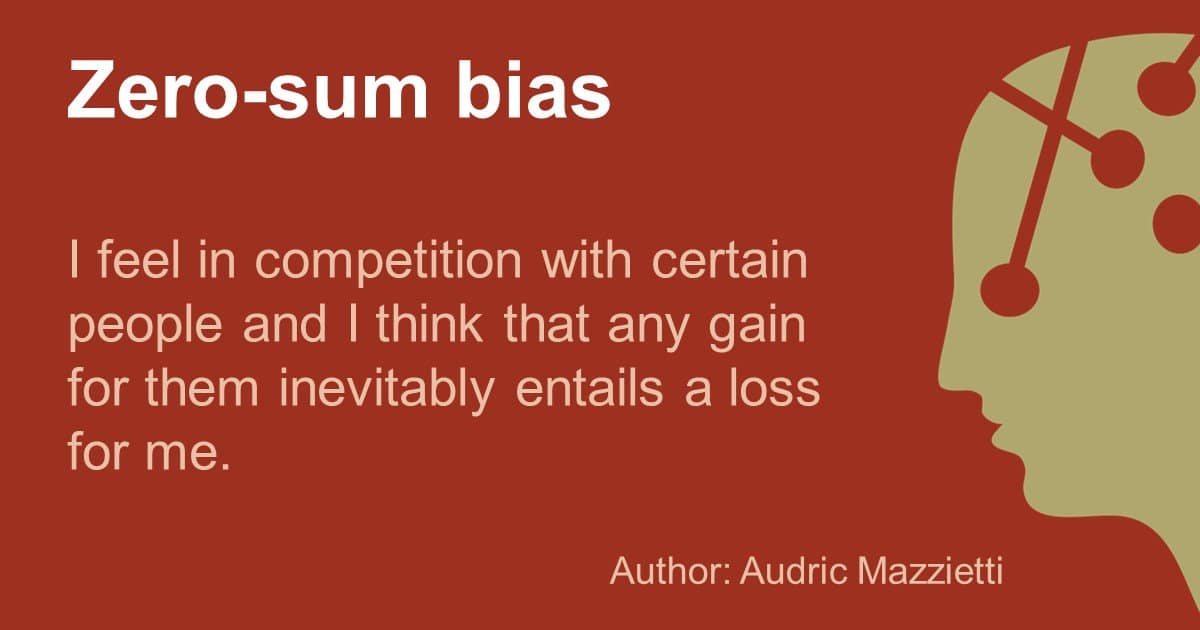
Zero-sum bias is the cognitive error of perceiving situations as zero-sum games (where one party’s gain equals another party’s loss, summing to zero) when the situations actually allow for mutual gain, mutual loss, or outcomes independent of each other. In true zero-sum situations, benefits are fixed and distributing them means one person’s gain requires another’s loss. In non-zero-sum situations (the vast majority of real life), multiple parties can gain simultaneously, or all can lose, or outcomes can be independent. Zero-sum bias causes treating non-zero-sum situations as zero-sum, creating competitive rather than cooperative approaches and missing opportunities for mutual benefit.
The phenomenon has been studied extensively in behavioral economics and social psychology. Research at Yale University found that people systematically overestimate how often situations are zero-sum, treating even obvious positive-sum situations (where cooperation creates more total value) as competitive win-lose scenarios. This bias increases conflict, reduces cooperation, and prevents mutually beneficial arrangements.
According to studies from Northwestern University, zero-sum bias operates through several mechanisms: competitive mindset activation (people default to competitive framing), scarcity perception (seeing resources as more limited than they are), and social comparison (judging own success relative to others’ rather than absolutely). These combine to create pervasive false perception that others’ gains harm you even when they don’t.
Research from University of Chicago demonstrates that zero-sum bias is particularly strong when: (1) outcomes are compared between parties (making relative positions salient), (2) resources appear finite (even when they can grow), (3) relationships are framed competitively (rivals, opponents), and (4) situations involve status or recognition (which people treat as zero-sum even when not). These conditions make zero-sum bias nearly automatic in many social contexts.
The Parable of the Two Farmers and the Expanding Harvest
A teaching tale tells of two neighboring farmers whose fields shared a border. The first farmer, through experimentation, discovered a new planting technique that doubled his crop yield. He had an abundant harvest, selling produce profitably at the market.
The second farmer saw this success and grew bitter. “My neighbor’s increased harvest means less for me,” he reasoned. “There are only so many customers at the market. If he sells more, I sell less. His gain is my loss.” He viewed the situation as zero-sum—a fixed amount of prosperity that his neighbor was capturing, leaving less for him.
But reality was different. The first farmer’s abundant harvest attracted more merchants to the region, drawn by the availability of quality produce. These merchants, visiting regularly, discovered the second farmer’s produce as well and began purchasing from both farmers. The market expanded. Customers seeing abundant produce began buying more vegetables overall. Both farmers’ incomes grew.
Additionally, the first farmer, proud of his discovery, taught his technique to the second farmer. Now both produced doubled yields. Together, they attracted even more merchants, established a reputation for the region’s agricultural excellence, and both prospered far beyond what either could have achieved alone.
A wise village elder explained the lesson: “The second farmer’s initial thinking was zero-sum—he assumed prosperity was a fixed pie, and his neighbor taking a larger slice meant less for him. But prosperity isn’t fixed. Innovation, cooperation, and quality expand the pie. Both farmers ended up better off than either would have been alone. This is positive-sum—where cooperation and mutual success create more total value than competition over fixed resources. Most of life is positive-sum, but people treat it as zero-sum, creating unnecessary conflict and missing opportunities for shared gain.”
The elder continued: “True zero-sum situations exist—if two people fight over one piece of bread, one gets it and the other doesn’t. But even there, cooperation might lead to shared bread or working together to make more bread. Zero-sum thinking prevents seeing these possibilities. It makes enemies of potential partners and competition of situations where cooperation would serve everyone better.”
Buddhist philosophy addresses zero-sum bias in teachings about mudita (sympathetic joy) and the interconnected nature of well-being. The Buddha taught that others’ success and happiness can be causes for your own joy rather than envy or threat. Zero-sum bias represents failure of mudita—seeing others’ gains as your losses rather than as part of interconnected flourishing. The teaching emphasizes that in ultimate reality, beings’ welfare is interdependent and non-zero-sum.
The Bhagavad Gita discusses this through Krishna’s teaching about yajna (sacrifice and exchange) and the interconnected web of existence. Krishna teaches that all beings support each other through contribution and exchange, creating positive-sum dynamics where giving and receiving create mutual flourishing. Zero-sum bias represents failure to see this interdependence—treating existence as competitive struggle rather than as cooperative ecosystem.
How Zero-Sum Thinking Creates Unnecessary Conflict
In workplace dynamics and team success, zero-sum bias makes colleagues view each other’s achievements as threats rather than shared victories. Research shows that employees often perceive promotions, recognition, and resources as zero-sum even in organizations where multiple people can succeed simultaneously. One colleague’s promotion is seen as reducing your chances, even when it doesn’t. This creates workplace competition that undermines collaboration and team performance.
Studies from Harvard Business School found that teams with strong zero-sum bias show reduced information sharing, increased conflict, and lower overall performance compared to teams that recognize opportunities for mutual gain. The bias makes people withhold help and knowledge that could make everyone more successful because they incorrectly fear that others’ success threatens their own.
In international relations and trade, zero-sum bias makes nations view trade and cooperation as win-lose propositions when they’re typically positive-sum. Research shows public opinion consistently treats international trade as zero-sum (“if they benefit, we lose”) when economic theory and evidence show trade creates mutual gains. This bias drives protectionist policies that reduce overall prosperity while attempting to “win” in perceived zero-sum competition.
Studies demonstrate that people systematically overestimate how much international cooperation benefits other countries at their own country’s expense. In reality, most international agreements are structured as positive-sum (mutually beneficial) or they wouldn’t be agreed to. Zero-sum bias prevents recognizing this, making cooperation seem like defeat.
In immigration and demographic change, zero-sum bias makes people perceive immigrants’ gains as natives’ losses even when evidence shows immigration can benefit both groups. Research shows that opposition to immigration correlates with zero-sum beliefs—the more people think opportunity is fixed and finite, the more they oppose immigration. In reality, economic growth often accommodates both native and immigrant prosperity simultaneously.
Studies show that regions with growing economies are less opposed to immigration than regions with stagnant economies, partly because growth makes the non-zero-sum nature of prosperity more visible. When the pie is obviously expanding, zero-sum bias weakens. When the pie appears fixed, zero-sum bias strengthens even if the fixedness is illusory.
In education and student success, zero-sum bias makes students view peers’ achievements as threats rather than inspiration. Research shows that students in highly competitive environments develop zero-sum mindsets where classmates’ high grades feel threatening. This reduces collaboration, increases stress, and creates adversarial rather than supportive learning communities. In reality, multiple students can excel simultaneously—one student’s A doesn’t prevent another’s A.
Studies demonstrate that cooperative learning environments produce better outcomes than zero-sum competitive environments for most students. Yet educational systems often reinforce zero-sum thinking through ranking, curved grading, and limited opportunities that genuinely are zero-sum (only one valedictorian, limited college spots). This trains zero-sum bias that then generalizes inappropriately to non-zero-sum situations.
Recognizing Positive-Sum Opportunities
The most important practice for countering zero-sum bias is explicitly asking whether a situation is genuinely zero-sum or whether mutual gain is possible. Before assuming someone else’s success threatens you, check: Is success actually limited? Could we both succeed? Could cooperation create more total success than competition? Most situations allow multiple winners—zero-sum bias makes you miss this possibility.
Look for ways to expand resources rather than just fighting over existing resources. Zero-sum bias focuses on dividing fixed pies. Positive-sum thinking asks how to make bigger pies. Instead of competing for fixed budget, propose projects that grow the budget. Instead of fighting over one promotion, consider how creating more value makes more promotions available. Expansion thinking overcomes zero-sum assumptions.
Practice celebrating others’ success as evidence that success is possible, not as proof that your own success is blocked. If your colleague gets promoted, that shows promotions are happening (positive signal) rather than consuming limited promotions (zero-sum thinking). Others’ achievements demonstrate achievability and can inspire or teach you rather than threatening you.
Recognize that status and recognition often feel zero-sum but aren’t necessarily so. Being considered “best” requires others being “not best”—genuinely zero-sum. But being considered “excellent” doesn’t require anyone else to be non-excellent—multiple people can be excellent simultaneously. Reframe status competition into excellence pursuit, which is non-zero-sum. Focus on absolute achievement rather than relative ranking.
Look for positive-sum opportunities in apparent conflicts. Before treating a situation as competitive win-lose, explore whether cooperation could create win-win outcomes. Often the initial framing is zero-sum but creative thinking reveals positive-sum possibilities. Negotiation research shows that most conflicts have integrative potential (mutual gain possible) but parties stuck in zero-sum thinking never discover it.
Remember Rohan and Aditya who nearly damaged their friendship by treating the science fair as zero-sum when both could win, and the two farmers where one’s success expanded opportunity for both rather than diminishing it. Both illustrate how zero-sum bias creates false competition in situations that actually allow or even require cooperation for optimal outcomes.
Zero-sum bias isn’t always wrong—some situations genuinely are zero-sum. If two people compete for one job, only one gets it (though even here, the “loser” often finds a different good job, making it less zero-sum than it appears). Electoral politics are largely zero-sum (only one candidate wins each seat). Sports competitions are definitionally zero-sum (one winner per game, though arguably everyone gains through playing). The error isn’t thinking some things are zero-sum—it’s assuming most things are zero-sum when most aren’t.
The bias likely evolved because ancestral environments contained more genuinely zero-sum situations (fighting over scarce food, competing for mates, defending territory) than modern environments where wealth, knowledge, and opportunity can grow. Our psychology adapted for zero-sum ancestral world creates inappropriate competition in positive-sum modern world where cooperation, trade, and innovation expand total prosperity. Breaking the bias requires recognizing that others’ success often creates opportunities for your success (they teach techniques, expand markets, validate possibilities, inspire efforts) rather than consuming limited success that would otherwise be yours. We often create zero-sum competition where positive-sum cooperation would leave everyone better off.
Frequently Asked Questions
Are any situations actually zero-sum, or is zero-sum bias always wrong?
Some situations are genuinely zero-sum: competing for single job, electoral politics (one winner per position), dividing fixed inheritance, sports competitions (one winner per game). Zero-sum bias is wrong not because zero-sum situations don’t exist but because the bias makes people treat far more situations as zero-sum than actually are. Most economic, social, and educational situations are positive-sum or mixed, but zero-sum bias makes people approach them competitively when cooperation would benefit everyone.
Why do I feel threatened by my friend’s success if we’re not actually competing?
Because zero-sum bias makes you unconsciously perceive success as limited—if they succeed, there’s less success available for you. This feeling persists even in non-competitive situations because the bias is automatic and emotionally compelling. Recognizing it’s a bias doesn’t eliminate the feeling but helps you not act on it. Practice celebrating friends’ success as proof that success is achievable rather than as proof that success is being consumed, gradually weakening the bias through contradictory evidence.
Does zero-sum bias mean competition is always bad?
No—competition serves valuable functions (motivation, excellence standards, efficient resource allocation). The problem is applying competitive zero-sum thinking to situations that aren’t competitions or where cooperation would create better outcomes. Compete in actual competitions (sports, elections, job applications). Cooperate in situations where mutual gain is possible (trade, friendship, education, innovation). Zero-sum bias makes people compete when they should cooperate, which is the problem, not competition itself.
Can teaching children to cooperate prevent zero-sum bias?
Partly—cooperative learning and positive-sum games in childhood can reduce the bias. However, zero-sum bias appears to be partly automatic human tendency, and children also experience genuinely zero-sum situations (competing for parent attention, toys, limited spots on teams) that reinforce the bias. The goal isn’t eliminating awareness of zero-sum situations but teaching discrimination—recognizing which situations are zero-sum (compete) and which aren’t (cooperate).
Why does zero-sum thinking feel right even when I know it’s wrong?
Because the bias operates partly through automatic emotional responses below conscious reasoning. Seeing someone else succeed triggers automatic feelings of threat and scarcity before rational analysis can kick in. Additionally, social comparison is automatic—we judge our success relative to others’ automatically, which inherently creates zero-sum framing (if they’re “ahead” we’re “behind”). Knowing about the bias helps you recognize these feelings as bias rather than accurate assessment, but doesn’t eliminate the feelings.
Observer Voice is the one stop site for National, International news, Sports, Editor’s Choice, Art/culture contents, Quotes and much more. We also cover historical contents. Historical contents includes World History, Indian History, and what happened today. The website also covers Entertainment across the India and World.

