

Why You Take Credit for Success But Blame Others for Failure

When Delhi’s Modern School cricket team lost to their rivals by just three runs in a thrilling inter-school match, seventeen-year-old Arjun, the team captain, had a clear explanation ready. “We played brilliantly,” he told his teammates in the locker room. “I personally scored 45 runs and took two crucial wickets. But we lost because Vikram dropped that easy catch in the final over, and the umpire made terrible decisions against us. If not for those external factors beyond our control, we would have won easily.”
Meanwhile, in the victorious team’s locker room, their captain Rohan was celebrating: “We won because of our superior strategy and execution. I personally organized the bowling changes that won us the match. Yes, we got a bit lucky with that dropped catch and some umpiring calls, but ultimately we won because we’re the better team and played smarter cricket.”
Their sports psychologist, observing both post-match discussions, noticed something revealing: when describing success, both captains emphasized their personal skill, strategy, and effort. When acknowledging luck or external factors, they downplayed their importance. But when it came to setbacks—the dropped catch on one side, the close margin on the other—they attributed these to external circumstances, other people’s errors, or bad luck.
“You’re both experiencing self-serving bias,” she explained to the captains when they met later. “Arjun, you claimed personal credit for runs and wickets (successes) but blamed Vikram and the umpire for the loss (failure). Rohan, you claimed personal credit for strategy and victory but attributed any potential weaknesses to luck. Both of you interpret events to make yourselves look good: ‘I’m responsible for good outcomes; external factors cause bad outcomes.’ This protects your self-esteem but distorts reality and prevents learning.”
She continued: “Self-serving bias makes us take more credit for success than we deserve and less responsibility for failure than we should. When things go well, we attribute it to our ability, effort, and decisions—internal factors we control. When things go badly, we attribute it to circumstances, other people, or bad luck—external factors beyond our control. This asymmetric attribution protects our ego: success proves we’re competent; failure doesn’t prove we’re incompetent because it wasn’t really our fault. But it prevents honest self-assessment and growth.”
This cognitive bias—claiming responsibility for successes while denying responsibility for failures—affects academic performance, workplace achievements, relationship conflicts, and any domain where outcomes could reflect either well or poorly on us. Understanding self-serving bias reveals why people rarely believe their failures are their fault, why we struggle to learn from mistakes, and why everyone tends to see themselves as above average even when that’s mathematically impossible.
What Is Self-Serving Bias?
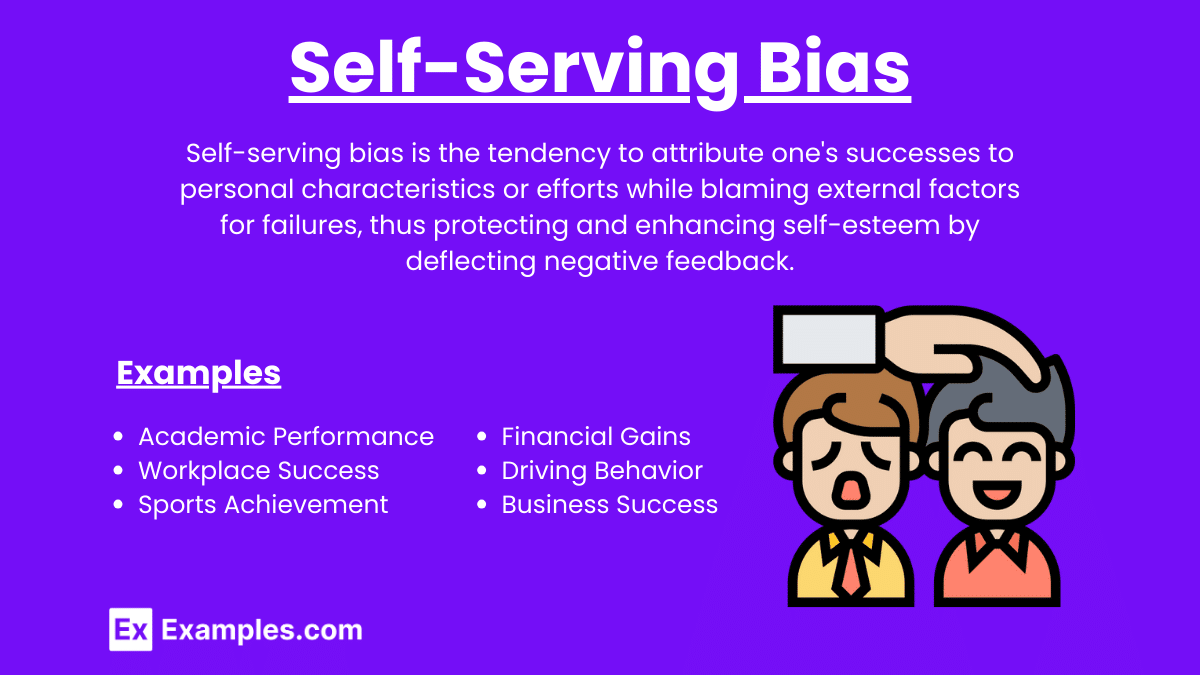
Self-serving bias is the cognitive tendency to attribute successes and positive outcomes to internal factors (your ability, effort, intelligence, decisions) while attributing failures and negative outcomes to external factors (circumstances, other people, bad luck, task difficulty). When you succeed, you tend to think “I succeeded because I’m talented/hardworking/smart.” When you fail, you tend to think “I failed because the situation was unfair/others didn’t help/luck was against me.” This asymmetric attribution protects self-esteem by allowing you to take credit for good outcomes while avoiding blame for bad outcomes.
The phenomenon was identified by psychologists studying attribution theory. Research at University of California, Los Angeles demonstrated that when people explain their own successes and failures, they systematically show this pattern: internal attribution for success, external attribution for failure. This pattern strengthens when outcomes are important (making self-esteem protection more valuable) and when explanations are public (making self-presentation concerns stronger).
According to studies from Northwestern University, self-serving bias operates through both motivational factors (protecting self-esteem feels good) and cognitive factors (success genuinely feels like it resulted from your effort while failure feels like it resulted from external interference). Additionally, you have more information about your own efforts and intentions than about external circumstances, creating genuine ambiguity that you resolve in self-serving directions.
Research from Duke University demonstrates that self-serving bias is particularly strong when: (1) outcomes are important to your self-concept (making bias more motivated), (2) the link between actions and outcomes is ambiguous (allowing multiple interpretations), (3) you’re explaining outcomes publicly (making self-presentation matter), and (4) outcomes are unexpected (making you search harder for explanations). These conditions make self-serving attributions nearly automatic in many achievement contexts.
The Parable of the Farmer and the Failed Harvest
A teaching tale tells of a farmer who prided himself on his agricultural expertise. In years when harvests were abundant, he explained his success to anyone who would listen: “My superior farming techniques, my hard work from dawn to dusk, my careful selection of seeds, my intelligent timing of planting and harvesting—these are why my fields yield so bountifully. I’m simply an excellent farmer.”
But in years when harvests were poor, his explanations changed completely: “The drought was unusually severe this year. My lazy neighbors let weeds spread to my fields. The seeds the merchant sold me were inferior quality. The timing of the rains was wrong. With all these external problems beyond my control, even the best farmer couldn’t produce a good harvest.”
A wise observer who had watched the farmer for many years asked him: “In good years, you credit your own skill and effort. In bad years, you blame weather, neighbors, and seed merchants. But your techniques don’t change much from year to year, the weather affects all farmers equally, and your neighbors are the same people. Why do you think your good harvests reflect your excellence while your poor harvests reflect external problems?”
The farmer was defensive. “Because it’s true! When I work hard and use good techniques, I get good harvests—unless external factors interfere.”
The observer replied gently: “I’ve watched all the farmers in this region. In good years, every farmer claims personal credit: ‘My hard work and skill produced this abundance.’ In bad years, every farmer blames external circumstances: ‘The weather and bad luck ruined my harvest.’ All of you show the same pattern—taking credit for success, denying responsibility for failure.”
He continued: “Consider: if good harvests prove your excellence despite external factors sometimes being unfavorable, shouldn’t bad harvests prove your inadequacy despite external factors sometimes being favorable? You can’t have it both ways—claiming that your skill overcomes obstacles in good years but that obstacles overcome your skill in bad years. More likely, your skill is consistent across years, and variation in harvests reflects variation in external conditions more than you want to admit. Acknowledging this doesn’t diminish your skill—it just means honestly recognizing what you control versus what you don’t.”
Buddhist philosophy addresses self-serving bias in teachings about honest self-examination and avoiding pride. The Buddha taught that attributing success to yourself while attributing failure to others represents the defilements of pride and delusion. Wisdom requires recognizing the complex causes of all outcomes—both internal efforts and external conditions contribute to both success and failure. Taking credit selectively while denying responsibility creates false self-image that prevents growth.
The Bhagavad Gita discusses this through Krishna’s teaching about renouncing the fruits of action. Krishna teaches that you should perform your duties without attachment to outcomes, recognizing that results depend on many factors beyond your control. Self-serving bias represents attachment to outcomes in ways that distort perception: claiming outcomes prove your worth when they’re favorable, denying they reflect on you when unfavorable. Wisdom requires consistent acknowledgment of your role regardless of whether outcomes flatter your ego.
How We Rewrite History to Make Ourselves Look Good
In academic performance and test results, self-serving bias makes students attribute good grades to their intelligence and hard work while attributing poor grades to external factors like unfair tests, bad teaching, or unlucky question selection. Research shows that students getting high marks readily explain “I studied well and understood the material,” but students getting low marks often explain “the test was unfair” or “the teacher doesn’t explain clearly” rather than “I didn’t study enough” or “I didn’t understand the material.” This protects self-esteem but prevents learning from failure.
Studies from Stanford University found that students receiving unexpectedly high grades attributed them to ability and effort, while students receiving unexpectedly low grades attributed them to test difficulty and grading unfairness—despite taking the same test graded by the same standards. The difference in attribution reflected self-serving bias, not actual differences in test fairness. This bias makes students overestimate their academic abilities because they internalize successes but externalize failures.
In workplace performance and career outcomes, self-serving bias makes employees attribute career successes to their competence and hard work while attributing setbacks to external circumstances or others’ failures. Research shows that when projects succeed, team members overestimate their personal contribution (leading to more than 100% of credit being claimed across team members). When projects fail, team members underestimate their personal contribution and attribute failure to circumstances, other team members, or organizational constraints.
Studies demonstrate that managers evaluating why they received promotions versus why they didn’t show stark self-serving patterns: promotions are attributed to merit and performance; lack of promotion is attributed to office politics, favoritism toward others, or organizational problems. This asymmetry makes people genuinely believe they deserve more credit and less blame than objective observers would assign, creating workplace conflicts where everyone feels under-credited for successes and over-blamed for failures.
In sports performance and athletic competition, self-serving bias makes athletes and teams attribute wins to their skill and preparation while attributing losses to external factors like bad officiating, unlucky bounces, or opponent’s lucky plays. Research shows that athletes explaining wins emphasize their superior technique, strategy, and execution, but explaining losses emphasize referee errors, field conditions, or chance events. Both teams in the same game show this pattern, creating contradictory narratives: both credit their own excellence for successes while crediting external factors for losses.
Studies from University of Michigan tracking athlete attributions found that winning teams’ explanations emphasized internal factors (our skills, our preparation, our execution) while losing teams’ explanations emphasized external factors (bad calls, unlucky bounces, circumstances) significantly more than neutral observers’ attributions did. Both teams showed self-serving bias, distorting objective analysis of what actually determined the outcome.
In relationship conflicts and interpersonal problems, self-serving bias makes people attribute relationship successes to their own positive contributions while attributing conflicts and problems to their partner’s faults or external stressors. Research shows that in marital disputes, each partner typically believes they contribute more to household tasks, child-rearing, conflict resolution, and relationship maintenance than their partner does—mathematically impossible if both are right. Each attributes positive relationship outcomes to their efforts and negative outcomes to partner’s behavior or circumstances.
Studies from Yale University found that married couples asked to estimate what percentage of household chores they each do typically provide estimates totaling well over 100% (each claiming they do more than half). Each partner genuinely remembers their own contributions vividly (making them salient) but underestimates partner’s contributions (which are less salient). Self-serving bias makes each feel they’re doing more than their fair share, creating resentment even in equitably balanced relationships.
In interpreting ambiguous information about personal qualities and abilities, self-serving bias makes people evaluate ambiguous evidence in whatever way makes them look best. Research shows that when given ambiguous feedback about performance or personality, people interpret positive aspects as clearly true and accurate while interpreting negative aspects as unclear, inaccurate, or not applicable to them. This selective interpretation maintains positive self-image by accepting flattering information while rejecting unflattering information.
Studies from Harvard University demonstrated this powerfully: when people received personality feedback containing both positive and negative traits, they rated positive feedback as more accurate, more insightful, and more applicable to them than negative feedback—even when the feedback was randomly generated and identical in diagnostic value. Self-serving bias made people selectively credit information that served their self-esteem while discounting information that threatened it.
Accepting Both Credit and Blame Honestly
The most important practice for countering self-serving bias is applying the same attribution standards to successes and failures. When you succeed, acknowledge not just your effort and ability but also helpful circumstances, others’ contributions, and good fortune. When you fail, acknowledge not just bad circumstances and others’ failures but also your own mistakes, insufficient effort, or skill gaps. Symmetric attribution—recognizing both internal and external factors in both successes and failures—provides accurate self-assessment.
Before explaining an outcome in self-serving ways, imagine how a neutral observer would explain it. Self-serving bias makes your explanations biased in your favor compared to how others would see the situation. Ask: “Would an objective outsider agree that my success was mostly my doing and my failure was mostly external factors? Or would they see more external help in my success and more personal contribution to my failure than I’m acknowledging?” Usually the latter.
Test your attributions by reversing them: would you accept the same explanation from someone else? If a teammate attributed a shared success entirely to their efforts while blaming you for a shared failure, you’d object to the unfairness. Apply this same fairness to your own attributions: if you wouldn’t accept these explanations from others, they’re probably self-serving rather than accurate.
Actively seek and acknowledge personal contributions to failures. Self-serving bias makes you focus on external factors when outcomes are bad. Deliberately ask: “What did I do or not do that contributed to this negative outcome? What could I have done differently?” This isn’t about self-flagellation—it’s about honest learning. Most failures involve both your contributions and external factors; acknowledging your part enables improvement.
Share credit for successes and share responsibility for failures. When explaining successes, mention others who helped, fortunate circumstances, or advantages you had. When explaining failures, acknowledge your role alongside external factors. “We succeeded because of good teamwork, favorable conditions, and yes, my contribution” is more accurate than “I succeeded.” “We failed partly because of unfavorable conditions and partly because I made mistakes” is more accurate than “external factors caused our failure.”
Remember Arjun who credited himself for runs and wickets but blamed others for the loss, and the farmer who credited himself in good harvest years but blamed external factors in bad harvest years. Both illustrate how self-serving bias makes us selectively take responsibility—claiming credit when outcomes are flattering, denying responsibility when they’re not.
Self-serving bias can’t be fully eliminated because you genuinely do have more information about your own efforts than about external circumstances, creating real ambiguity you resolve self-servingly. But recognizing the bias allows correction: when you find yourself taking credit for success while denying responsibility for failure, that’s the signal to check for self-serving bias. Ask whether you’re being as generous in acknowledging external help with successes as you are in acknowledging external obstacles causing failures. Usually no—we’re asymmetric, taking more credit than we deserve and less blame than we should. Honest self-assessment requires fighting this natural tendency toward flattering ourselves, acknowledging both our genuine contributions and our genuine shortcomings rather than selectively emphasizing whichever serves our self-image. This honesty is harder on the ego but better for growth, relationships, and actually understanding what drives your outcomes.
Frequently Asked Questions
Isn’t it good for self-esteem to take credit for successes and not blame myself for failures?
Self-serving bias does protect self-esteem short-term, but it undermines growth and accuracy. If you never acknowledge your role in failures, you can’t learn from mistakes or improve. If you overestimate your role in successes, you become overconfident and miss lessons about what actually works. Healthy self-esteem can handle honest assessment: “I contributed to both successes and failures, and I can learn from both.” This is more sustainable than fragile self-esteem requiring constant reality distortion.
How can I tell if I’m being appropriately self-confident versus self-servingly biased?
Check for asymmetry: Do you readily acknowledge your role in successes but rarely in failures? Do you emphasize external help when you fail but not when you succeed? If yes, that’s self-serving bias. Appropriate confidence acknowledges your contributions consistently: “I worked hard and that contributed to success, though other factors helped too” AND “I made mistakes that contributed to failure, though other factors hurt too.” Bias is selective attribution; confidence is consistent honest self-assessment.
Don’t successful people naturally have more successes to credit themselves for?
Yes, but self-serving bias isn’t about how much success you have—it’s about how you explain it. Successful people experience the bias too: they overattribute successes to themselves and underattribute failures to themselves relative to what objective analysis would show. Very successful people often succeed partly through skill and partly through luck/help/circumstances, but self-serving bias makes them overweight skill in their self-narrative. This can make them overconfident and less prepared for setbacks.
What if other people really did cause my failure or contribute to my success?
Others often do contribute to both successes and failures. Self-serving bias isn’t about whether external factors exist—it’s about asymmetry in how readily you acknowledge them. You might say “others helped” about successes as an afterthought while emphasizing “others caused it” about failures as the primary explanation. Honest attribution acknowledges both internal and external factors proportionally in both successes and failures, not selectively emphasizing whichever makes you look better.
Does recognizing self-serving bias mean I should blame myself for everything?
No—it means balanced attribution. Most outcomes result from combination of your actions and external factors. Honest assessment: “This success came from my effort plus helpful circumstances plus others’ contributions” AND “This failure came from my mistakes plus unhelpful circumstances plus others’ mistakes.” Not “success = me, failure = external” (self-serving bias) nor “success = external, failure = me” (depressive realism). Both internal and external factors always contribute; acknowledge both consistently.
Observer Voice is the one stop site for National, International news, Sports, Editor’s Choice, Art/culture contents, Quotes and much more. We also cover historical contents. Historical contents includes World History, Indian History, and what happened today. The website also covers Entertainment across the India and World.

