

Why the Same Truth Sounds Different: How Words Change Our Decisions
The Merchant's Two Prices

In the bustling market of Old Delhi, two sweet shops stood side by side, both selling identical jalebis made from the same ingredients by brothers who learned from the same father. Yet one shop always had longer queues while the other struggled to attract customers.
The secret wasn’t in the jalebis—it was in the signs. The first shop displayed a bold notice: “Fresh jalebis—only 10% of our batch gets rejected for quality!” The second shop’s sign read: “Fresh jalebis—90% quality approved!” Mathematically, these statements said exactly the same thing. If ten percent failed, then ninety percent passed. But customers flocked to the shop emphasizing the ninety percent success while avoiding the one highlighting the ten percent failure.
A young student named Arjun noticed this pattern and asked the successful shopkeeper why he chose those words. The old man smiled knowingly. “Beta, people don’t just buy jalebis—they buy the feeling the jalebis give them. The same truth can make them feel confident or worried depending on how I present it. I choose words that frame our quality positively, even though my brother’s sign says the exact same thing in different words.”
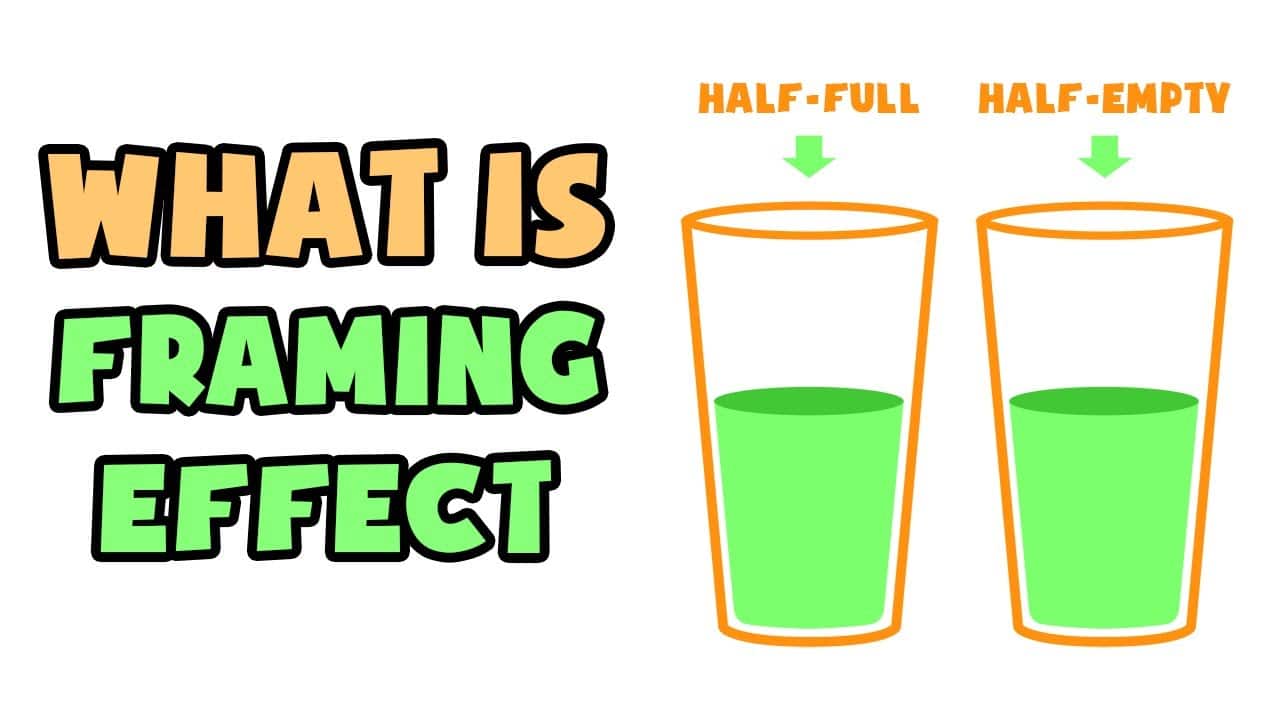
This marketplace wisdom perfectly captures what psychologists call the framing effect—our tendency to draw completely different conclusions from identical information depending on how that information is presented. It’s one of the most powerful forces in human decision-making, affecting everything from medical choices to elections to what we buy for dinner.
What Is the Framing Effect?
The framing effect occurs when the same information, presented in different ways, leads people to different decisions or conclusions. The actual facts don’t change—only the words, context, or perspective used to describe them. Yet these superficial changes dramatically alter how we perceive and respond to the information.
The classic study demonstrating this effect came from psychologists Daniel Kahneman and Amos Tversky, whose work won the Nobel Prize. In their famous experiment at Stanford University, they presented people with a disease outbreak scenario. Six hundred people were at risk, and two treatment programs were proposed.
To one group, they framed the options positively: “Program A will save 200 people. Program B has a one-third chance of saving all 600 people and a two-thirds chance of saving no one.” Most people chose the certain option, Program A.
To another group, they framed the exact same options negatively: “Program A will result in 400 deaths. Program B has a one-third chance of zero deaths and a two-thirds chance of 600 deaths.” Now most people chose the risky option, Program B. The mathematics were identical—saving 200 people means 400 die—but the framing completely reversed people’s preferences.
Research from Harvard University shows that framing effects influence virtually every domain of human judgment. Doctors’ treatment recommendations change based on whether survival rates or mortality rates are emphasized. Consumers’ purchasing decisions shift based on whether discounts or surcharges are highlighted. Voters’ policy preferences reverse based on whether issues are framed as gains or losses.
The Monk’s Two Questions
Buddhist teachings include a parable about a wealthy merchant who approached a wise monk seeking advice about a business opportunity. The merchant explained he could invest ten lakh rupees with either a ninety percent chance of success or a ten percent chance of failure.
“What should I do, Master?” the merchant asked. The monk sat silently for a long moment, then asked, “Would you bet your entire fortune on a dice roll where five of the six sides mean you win?” The merchant replied enthusiastically, “Of course! Those are excellent odds!”
The monk then asked, “Would you risk everything you own when there’s a chance—even a small one—that you could lose it all and leave your family destitute?” The merchant’s face paled. “No, Master. I couldn’t take that risk with my family’s security.”
The monk smiled gently. “I asked you the same question twice. Your answers revealed that you don’t actually need my advice—you need to decide which frame represents your true values. Do you value the opportunity to win, or do you value protecting what you have? The mathematics are the same, but your heart responds differently to different framings.”
This ancient story demonstrates the deep wisdom traditions had about framing effects long before modern psychology studied them. The Bhagavad Gita teaches that maya—illusion—often comes not from false information but from how we perceive and frame true information. Krishna counsels Arjuna to see beyond the surface framing of situations to understand their essential nature.
How Framing Controls Our Daily Lives
In supermarkets, framing effects determine what we buy. Ground beef labeled “90% lean” sells better than identical meat labeled “10% fat,” even though they’re exactly the same product. Research from Yale University found that consumers rate “90% lean” meat as healthier, better tasting, and worth more money than “10% fat” meat in blind tests where they’re eating the same product. The frame changes not just our choice but our actual taste perception.
In medicine, framing effects can literally be life-or-death. When doctors tell cancer patients “this surgery has a 90% survival rate,” most patients choose surgery. When doctors say “this surgery has a 10% mortality rate”—the exact same statistic—significantly fewer patients choose it. The frame emphasizes either what you gain or what you risk losing, triggering different emotional responses and decisions.
Politicians and media outlets expertly manipulate framing to shape public opinion. The same tax policy can be framed as “relief for job creators” or “giveaways to the wealthy.” The same immigration policy becomes either “protecting borders” or “separating families.” The underlying facts remain constant, but public support swings wildly based on which frame dominates the conversation.
In schools, framing affects student motivation profoundly. Teachers who frame difficult material as “a challenge that will make you stronger” inspire more effort than those who frame it as “a difficult topic many students fail.” The difficulty level hasn’t changed, but one frame emphasizes growth while the other emphasizes failure, triggering entirely different student responses.
Advertising uses positive framing constantly while hiding negative frames. A shirt is on sale at “Buy one, get one 50% off!”—which sounds generous. But it’s mathematically identical to “Buy two shirts, get 25% off your total purchase,” which sounds less exciting. Credit card companies advertise “0% interest for 12 months” rather than “You’ll pay 24% interest starting in month 13,” even though both statements describe the same offer.
The Discount That Wasn’t
Priya needed a new laptop for college. She found one priced at forty thousand rupees. The next day, the store advertised a “special discount weekend” with the same laptop marked at fifty thousand rupees with a “20% discount—now only forty thousand rupees!” Even though the price was identical to the day before, Priya felt she was getting an amazing deal and rushed to buy it.
Her brother Rahul, who studied behavioral economics, explained the framing trick. “The store created a fake higher reference price, then framed the original price as a discount. You’re paying exactly what you would have paid yesterday, but the discount frame makes you feel like you’re saving money rather than just spending it.”
Studies from Princeton University confirm this tactic works reliably. Consumers feel better about purchases framed as discounts from inflated “original prices” even when they’re paying normal market rates. Black Friday sales exploit this mercilessly—many “doorbuster deals” are regular prices framed as massive savings from artificially inflated “list prices” that no one ever actually paid.
Seeing Through the Frame
The first step to resisting manipulation through framing is recognizing when you’re being presented with a frame rather than neutral information. Any time someone chooses particular words to describe statistics, policies, or options, ask yourself: how else could this same information be presented? What would the opposite frame sound like?
Practice actively reframing information yourself. When you see “90% success rate,” translate it to “10% failure rate” in your mind. When something is “90% fat-free,” think “10% fat.” When a politician says “tax relief,” consider whether it’s also “reduced public services funding.” This mental exercise reveals how much your initial reaction depends on the arbitrary frame chosen by whoever presented the information.
Look for absolute numbers behind percentages and percentages behind absolute numbers. “200 lives saved” sounds different from “400 deaths” but also different from “one-third of those at risk.” “90% lean” feels different from “10% fat” and different still from “contains 28 grams of fat per serving.” By translating between different true descriptions of the same reality, you reduce the power of any single frame.
Be especially skeptical of frames that trigger strong emotional responses. Frames work by activating our emotional, intuitive thinking rather than our careful, analytical thinking. When a frame makes you feel very positive or very negative, that’s your signal to slow down and examine the underlying facts from multiple angles before deciding.
Ask who benefits from a particular framing. The jalebi seller frames his quality positively because it sells more jalebis. Politicians frame policies to win votes. Companies frame prices to maximize purchases. Understanding the framer’s motivation helps you recognize when you’re being persuaded rather than informed.
Remember that reality exists independently of how it’s described. The surgery has one actual mortality rate—it doesn’t change based on whether the doctor emphasizes survival or death. The meat has one fat content—your health outcomes depend on that fact, not on whether the label says “lean” or “fat.” The shopkeeper’s jalebis have one quality level—your enjoyment depends on the taste, not the sign. By anchoring your decisions to underlying reality rather than surface framing, you make wiser choices that serve your genuine interests rather than the interests of whoever chose the frame.
Frequently Asked Questions
Is framing the same as lying?
Not exactly. Lying presents false information, while framing presents true information in a particular light. “90% lean” and “10% fat” are both factually accurate descriptions of the same meat. However, framing can be ethically questionable when it’s deliberately used to manipulate decisions against someone’s interests, even though it’s technically truthful. The jalebi seller’s frame is honest marketing, but a doctor who only mentions survival rates while hiding mortality rates is arguably being deceptive through selective framing despite stating only truths.
Can positive framing ever be helpful rather than manipulative?
Yes, when it helps people make decisions aligned with their actual goals. Teachers framing challenges positively to encourage learning, doctors framing healthy behaviors as gains rather than deprivations, or parents framing chores as contributions to family rather than burdens can all use framing ethically to motivate beneficial actions. The key is whether the framing serves the decision-maker’s genuine interests or just the framer’s interests. Framing exercise as “getting stronger” is helpful; framing dangerous diet pills as “97% safe” is manipulative.
Why does framing work even when we know about it?
Framing triggers fast, emotional, intuitive thinking that operates before our slower, analytical thinking can intervene. Even when you consciously know “90% lean” and “10% fat” are identical, your brain’s immediate emotional response differs. Knowledge helps us catch and correct these reactions, but it doesn’t eliminate the initial framed response. This is why actively reframing information—deliberately translating it into opposite frames—is more effective than just knowing about the framing effect in abstract.
How do I know which frame is the “right” one?
There usually isn’t one right frame—different frames emphasize different true aspects of reality. The key is considering multiple frames to get a complete picture rather than accepting the first frame presented. For the disease treatment, both “200 saved” and “400 die” are true. The wise approach is considering both frames plus other relevant factors: which 200 might be saved, what quality of life they’ll have, costs, other treatment options. Truth emerges from examining reality from multiple angles, not from finding one correct frame.
Can I use framing to improve my own decision-making?
Absolutely. Before important decisions, deliberately frame the options in multiple ways and notice how each frame makes you feel. If you’re deciding whether to quit a job, frame it as “leaving a secure position” and then as “escaping a dead-end situation.” If you’re considering a purchase, frame it as “getting this item” and then as “giving up money you could use elsewhere.” These different frames activate different values and considerations, helping you make more balanced decisions that account for multiple perspectives rather than just reacting to one frame.
Observer Voice is the one stop site for National, International news, Sports, Editor’s Choice, Art/culture contents, Quotes and much more. We also cover historical contents. Historical contents includes World History, Indian History, and what happened today. The website also covers Entertainment across the India and World.

