

Why Studying Only Successful People Gives You the Wrong Lessons: Survivorship Bias

Seventeen-year-old Rohan was frustrated. He’d read ten biographies of successful entrepreneurs—Steve Jobs, Elon Musk, Bill Gates, Mark Zuckerberg—and noticed they all had something in common: they dropped out of college to pursue their dreams. “The pattern is clear,” Rohan told his parents. “College is a waste of time for entrepreneurs. All the successful ones dropped out. I should do the same.”
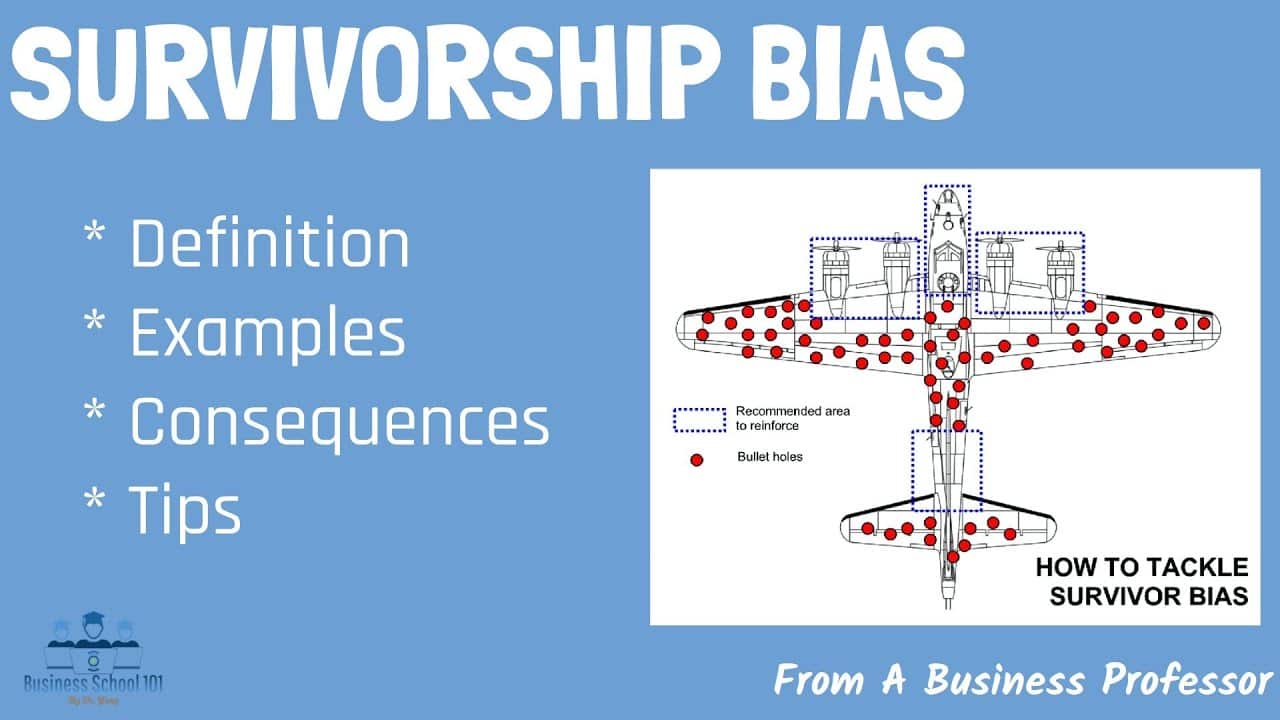
His father, a statistics professor, sat him down with a whiteboard. “Rohan, let me tell you about Abraham Wald and the missing bullet holes. During World War II, the military studied planes returning from combat to determine where to add armor. They looked at where returning planes had bullet holes—mostly on wings and fuselage—and planned to reinforce those areas.”
“But mathematician Abraham Wald said they had it backwards. The bullet holes on returning planes showed where a plane could be hit and still survive. The missing bullet holes—on engines and cockpits—showed where hits were fatal. Planes hit in those areas never returned, so they weren’t in the data. By studying only surviving planes, the military was looking at the wrong places. Wald recommended armoring where returning planes didn’t have holes—the fatal spots invisible because planes hit there didn’t survive to be studied.”
He continued: “Your entrepreneur analysis has the same flaw. You studied successful college dropouts and concluded dropping out causes success. But you didn’t study the thousands of college dropouts who failed and never became famous. Those failures are invisible—they’re not in biographies, not in news stories, not celebrated anywhere. You’re seeing only survivors of the dropout strategy and missing all the casualties. This is survivorship bias—drawing conclusions from visible successes while missing invisible failures.”
Rohan looked stunned. “So maybe the successful entrepreneurs succeeded despite dropping out, not because of it? And for every one who succeeded, there might be hundreds who dropped out and failed but aren’t visible?”
“Exactly,” his father confirmed. “When you study only survivors, you can’t know what caused survival because you’re missing the comparison group of non-survivors. This bias affects everything from business advice to self-help to understanding history.”
What Is Survivorship Bias?
Survivorship bias is the logical error of concentrating on entities that passed a selection process (survived) while overlooking those that did not, typically because of their lack of visibility. When only successful outcomes are visible and studied while failures are hidden or ignored, conclusions drawn from studying survivors will be systematically biased and often completely wrong about what causes success or survival.
The phenomenon was famously illustrated by Abraham Wald’s World War II aircraft armor analysis, as described above. Research at Columbia University extended Wald’s insights, demonstrating that survivorship bias affects countless domains where we study successful outcomes without access to failed attempts that didn’t survive to be counted or studied.
According to studies from University of Pennsylvania, survivorship bias operates because failure is often invisible while success is highly visible. Failed businesses close and disappear. Failed strategies are abandoned and forgotten. Failed artists never gain audiences. Failed investors lose money quietly. Only survivors remain visible to study, creating systematic distortion where we draw lessons from incomplete data that excludes all the failures.
Research from MIT Sloan School of Management demonstrates that survivorship bias is particularly dangerous in domains where: (1) failure rate is high but invisible, (2) success is rare but highly visible, (3) survivors are systematically different from non-survivors in ways we don’t observe, and (4) people make decisions based on studying only visible survivors. These conditions make business advice, investment strategies, and life guidance especially prone to survivorship-biased conclusions.
The Parable of the Wealthy Merchant’s Advice
A teaching tale tells of a wealthy merchant who traveled to villages sharing his success secrets. “I became rich by taking bold risks,” he proclaimed. “I invested everything in a single venture, and it made me wealthy. My advice: be bold, bet everything, don’t diversify. Caution leads to mediocrity!”
Young people in villages, inspired by his testimony, followed his advice. They borrowed money, invested everything in single risky ventures, and hoped to replicate his success. Most lost everything. A few succeeded spectacularly and became wealthy merchants themselves, spreading the same advice.
An elderly scholar observed this pattern and investigated. She tracked down hundreds of people who’d followed the merchant’s advice over the years. The findings were sobering: For every one person who became wealthy through betting everything on a risky venture, ninety-nine lost everything and lived in poverty. The 1% who succeeded became visible wealthy merchants giving advice. The 99% who failed were invisible—they couldn’t afford to travel and share their stories, they were embarrassed by failure, and nobody wanted to hear from them anyway.
The scholar presented her findings to a village considering following a wealthy merchant’s advice. “This merchant stands before you as proof his strategy works,” she explained. “But he’s one survivor among a hundred attempts. The ninety-nine who tried the same strategy and failed aren’t here—they’re too poor to travel, too ashamed to speak, too uninteresting for audiences wanting to hear success secrets. You’re hearing from the lucky one percent, not from the unlucky ninety-nine percent. His strategy might have worked for him through luck, but it destroyed most who tried it. Don’t learn from survivors alone—learn from the full distribution of outcomes including failures too invisible to tell their stories.”
Buddhist philosophy addresses survivorship bias in teachings about incomplete perception of reality. The Buddha taught that humans see only a small portion of reality—usually the visible, dramatic, or pleasant parts—while missing the larger invisible context. Survivorship bias represents this incomplete perception: seeing successful survivors while missing the vast invisible population of failures, then drawing false conclusions from the partial picture.
The Bhagavad Gita discusses this through Krishna’s teaching about karma and the unseen consequences of action. Krishna teaches that visible outcomes (survivors) are supported by vast unseen conditions and that focusing only on visible results while ignoring invisible contributing factors leads to false understanding. Survivorship bias exemplifies this—visible success without recognition of invisible failures creates illusion about what causes success.
How Focusing on Survivors Misleads Us
In business advice and entrepreneurship guidance, survivorship bias makes successful entrepreneur strategies seem universally effective when actually they might be terrible advice. Business books feature companies that succeeded using specific strategies, while identical strategies employed by thousands of failed companies go unstudied. Research shows that risky strategies common among successful companies (aggressive growth, bold bets, rule-breaking) are even more common among failed companies that aren’t in business books.
Studies from Harvard Business School analyzing business strategy advice found that many recommended strategies show no advantage—and sometimes disadvantage—when compared across all companies attempting them, not just survivors. “Disrupt your industry” works great for disruptors who survived, but destroys most who try it. We see only survivors, creating illusion that risky strategies are effective.
In investment and financial advice, survivorship bias makes published fund performance misleading. Mutual fund performance data includes only funds that still exist, excluding funds that failed and closed. This creates illusion that average fund performs better than it does—failed funds with poor performance disappear from data, making surviving funds look better than the full population of attempted funds. Research shows this survivorship bias inflates reported fund performance by 1-3% annually.
Studies demonstrate that when including disappeared funds, average mutual fund underperforms market indexes—opposite of conclusion from studying only surviving funds. The survivorship bias masks the fact that most active management fails, showing only the survivors who succeeded.
In self-help and success advice, survivorship bias makes following your passion, dropping out, taking risks, and ignoring critics seem like universally good strategies because successful people often report doing these things. But millions who followed passion, dropped out, took risks, and ignored critics failed invisibly. Their stories aren’t in bestselling books. Only survivors write success memoirs, creating systematic bias where risky strategies seem safer than they are.
Research on career outcomes shows that conservative strategies (finishing education, building skills gradually, maintaining financial stability) produce better average outcomes than dramatic risky strategies, even though risky strategies produce more visible spectacular successes. The spectacular visible successes dominate advice literature while the more numerous spectacular invisible failures are forgotten.
In understanding history and cultural narratives, survivorship bias makes past eras seem more glamorous than they were. We study surviving art, literature, buildings, and music from historical periods—the best 0.1% that survived centuries. We don’t study the 99.9% of mediocre or poor work that was lost or destroyed. This creates illusion that “people in the past were more talented” when actually we’re comparing our era’s full output to past eras’ curated survivors.
Studies of historical cultural production show that quality distribution was similar across eras—most work in every era is mediocre, small percentage is excellent. Survivorship bias makes past seem better because only excellent work survived to be studied, while contemporary work includes the full distribution of quality.
In product reviews and consumer decisions, survivorship bias makes products seem more reliable than they are. Online reviews come disproportionately from people whose products lasted long enough to form opinions. Products that failed immediately often don’t get reviewed—people return them and move on. This creates positive bias where reviewed products seem more reliable than the full population of products including ones that failed so quickly they disappeared from review pools.
Research on consumer product reliability shows that review-based reliability estimates are systematically optimistic because early failures (products that broke before review period) are underrepresented in review data. The products that survived to be reviewed are inherently more reliable than random products from the production run.
Seeking Out the Invisible Failures
The most important practice for avoiding survivorship bias is actively seeking information about failures, not just successes. When studying what causes success, deliberately find data about failed attempts using the same strategies, not just successful outcomes. If you study successful entrepreneurs who dropped out, also study people who dropped out and failed. Otherwise your conclusions will be survivorship-biased.
Ask “who’s missing from this data?” when evaluating evidence. Published mutual fund returns—who’s missing? Failed funds that closed. Business books—who’s missing? Failed companies using the same strategies. Success stories—who’s missing? Failures attempting the same approach. Recognizing whose absence biases the visible data helps correct for survivorship bias.
Understand that visible survivors are not representative of all who tried. The successful entrepreneur speaking at your school is not representative of all who attempted entrepreneurship—they’re selected from the tiny successful minority. Their advice might be systematically biased by survival. Learning from survivors is valuable if you account for bias by also learning from representative samples including failures.
Look for base rates and population statistics, not just exemplars. Instead of asking “what did successful entrepreneurs do?”, ask “what percentage of people trying each strategy succeeded?” This requires data on the full population attempting strategies, not just visible survivors. Base rates reveal that strategies common among visible successes may have low success rates when attempted by full populations.
Be especially skeptical of advice involving high-risk strategies that “successful people” followed. High-risk strategies produce both spectacular successes (highly visible) and spectacular failures (invisible). Survivorship bias makes high-risk strategies seem safer than they are by hiding failures. When successful people say “I took huge risks and succeeded,” remember: unsuccessful people who took identical risks failed and aren’t giving advice.
Create data systems that track failures, not just successes. Organizations, schools, and individuals should document what didn’t work, not just what did. This prevents institutional survivorship bias where only successful projects are remembered and studied while failed projects are forgotten, leading to repeated mistakes from studying only survivors.
Remember Rohan almost dropping out of college by studying only successful college-dropout entrepreneurs while missing the thousands who dropped out and failed invisibly. Remember Abraham Wald realizing the military was studying bullet holes in the wrong places by looking only at planes that survived. Both illustrate how survivorship bias—studying visible survivors while missing invisible failures—produces systematically wrong conclusions about what causes success.
Survivorship bias isn’t a mistake made only by careless people—it’s inevitable whenever failures are less visible than successes. Success is celebrated, publicized, studied, and remembered. Failure is hidden, forgotten, and avoided. This visibility asymmetry creates systematic bias where we overestimate success rates, attribute success to strategies that might cause failure more often than success, and underestimate the role of luck in separating survivors from non-survivors who tried the same approaches.
Breaking survivorship bias requires effortful search for invisible failures, careful attention to who’s missing from data, and humility about the limits of learning from visible survivors alone. The advice from successful people might be exactly wrong for most people precisely because survival is rare and survivors are unrepresentative. Before following success stories, ask how many failures tried the same approach and disappeared from view. The survivors can teach you something—but only if you also learn from the invisible dead.
Frequently Asked Questions
Does survivorship bias mean we shouldn’t learn from successful people?
No—it means we should learn from successful people while recognizing they’re selected from a larger population including failures, and their strategies might not be what caused their success. Learn from survivors but also learn base rates (how many attempts succeeded vs failed), seek information about failures using similar strategies, and recognize that survivor advice might be systematically biased by having survived. Survivors have valuable experience, but their visibility creates false impression their strategies work reliably.
How can I find information about failures if they’re invisible by definition?
Some ways: (1) Look for academic studies tracking full populations including failures, not just survivor case studies, (2) Search for statistics on base rates and success rates of strategies, not just examples of success, (3) Seek out failure post-mortems and databases documenting what didn’t work, (4) Talk to people in industries about typical outcomes, not just publicized successes, (5) Remember that absence of visible failures doesn’t mean failures don’t exist—it means you need to work harder to find data about them.
Are some domains more affected by survivorship bias than others?
Yes—domains with high failure rates and high visibility asymmetry between success and failure. Entrepreneurship (most startups fail invisibly, rare successes are highly visible), entertainment (most artists fail invisibly, stars are highly visible), investing (most get-rich schemes fail invisibly, rare successes are publicized), and advice industries (people who succeeded share advice, people who failed stay silent) all show strong survivorship bias. Domains with comprehensive data on all attempts (clinical trials, controlled experiments) have less bias.
Can survivorship bias make bad strategies look good?
Absolutely—this is the most dangerous effect. A strategy that fails 95% of the time but produces spectacular successes 5% of the time will have many visible spectacular successes (survivors) and many invisible failures. Studying only survivors makes the terrible 95%-failure strategy look brilliant because you see only the 5% who survived. High-variance strategies (huge wins or losses) are particularly prone to this—survivorship bias makes them look better than they are by hiding the losses.
How did Abraham Wald figure out the survivorship bias if the missing planes were invisible?
Brilliant insight: he realized that the absence of bullet holes in certain areas on surviving planes was the important data, not the presence of holes elsewhere. Surviving planes showed where planes could be hit and still fly home. The areas without holes on survivors must be where hits were fatal—those planes didn’t return to be counted. By thinking about what was missing and why, he corrected for survivorship bias. This same technique—asking “who/what is missing and why?”—helps identify survivorship bias in other domains.
Observer Voice is the one stop site for National, International news, Sports, Editor’s Choice, Art/culture contents, Quotes and much more. We also cover historical contents. Historical contents includes World History, Indian History, and what happened today. The website also covers Entertainment across the India and World.

