

Secretary-General Calls for Renewed Commitment to Nuclear Non-Proliferation Treaty at Review Conference

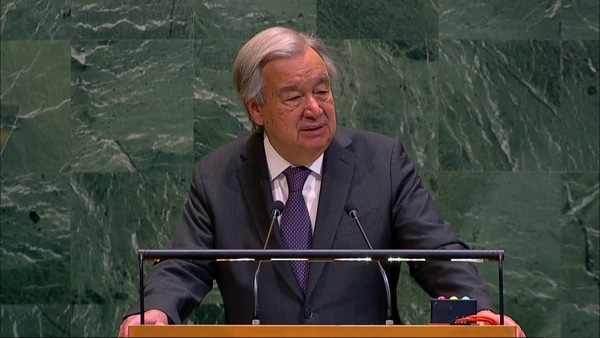
UN Secretary-General António Guterres addressed the eleventh Review Conference of the Parties to the Treaty on the Non-Proliferation of Nuclear Weapons in New York, emphasizing the urgent need to confront the threat of nuclear annihilation. He highlighted the historical context of nuclear disarmament efforts and warned against the rising tide of nuclear armament and military spending. Guterres called for a renewed commitment to the Treaty, urging nations to fulfill their obligations without delay or excuses, and to adapt the Treaty to address modern technological challenges.
Historical Context of Nuclear Disarmament
In his remarks, Guterres reflected on the origins of the global goal to eliminate nuclear weapons, tracing it back to the UN General Assembly’s first resolution in 1946. He lamented the fading memories of past nuclear threats, recalling a time when children were taught to hide under desks during drills for potential missile launches. The Secretary-General pointed out that the nuclear arms race led to the construction of fallout shelters and caused significant environmental destruction through nuclear testing. He warned that society seems to have forgotten the dire consequences of nuclear warfare, as mistrust and the erosion of arms control norms have become prevalent once again.
Guterres noted that global military spending reached an astonishing $2.7 trillion last year, dwarfing development aid and equating to the entire GDP of Africa. He expressed concern that, for the first time in decades, the number of nuclear warheads is increasing, and nuclear testing is being reconsidered by some governments. He posed critical questions about the collective amnesia surrounding the reality that nuclear war cannot be won and that these weapons do not enhance safety.
The Role of the Treaty on the Non-Proliferation of Nuclear Weapons
The Treaty on the Non-Proliferation of Nuclear Weapons (NPT) serves as a cornerstone in the global effort to prevent the spread and use of nuclear weapons. Guterres emphasized that the NPT is not merely a historical document but a vital framework for enhancing global security through multilateral cooperation. He expressed concern that the Treaty has been weakening over time, with many commitments remaining unfulfilled and trust among nations diminishing. The Secretary-General urged the conference participants to revitalize the Treaty, stressing the importance of disarmament and non-proliferation as essential pathways to achieving lasting peace.
He called on countries to honor their commitments under the Treaty without any conditions or delays. Guterres highlighted the need to reinforce the norm against nuclear testing and to strengthen the oversight of the International Atomic Energy Agency (IAEA). He also urged participants to discuss measures that would prevent nuclear war, emphasizing that the Treaty must adapt to the evolving landscape of nuclear threats.
Adapting to Modern Challenges
Guterres pointed out that the current nuclear threat landscape is complicated by emerging technologies such as artificial intelligence and quantum computing. He argued that the NPT should not be viewed as a relic of the past but must evolve to address these new challenges. The Secretary-General stressed that until nuclear weapons are completely eliminated, it is crucial that humanity maintains control over their use. He also advocated for expanding access to the benefits of nuclear science and technology for sustainable development, ensuring that the Treaty remains relevant in a rapidly changing world.
The Secretary-General’s call for adaptation reflects a broader understanding that the challenges of nuclear proliferation are intertwined with advancements in technology. He urged the conference to lay the groundwork for a more robust and responsive Treaty that can effectively address the complexities of modern security threats.
The Urgency of Action
Guterres concluded his remarks by acknowledging the presence of hibakusha, the survivors of the atomic bombings of Hiroshima and Nagasaki, who organized an exhibition outside the conference hall. He recognized their efforts to remind world leaders of the grave responsibilities they bear. The hibakusha’s organization, Nihon Hidankyo, was awarded the Nobel Peace Prize in 2024 for their relentless advocacy for nuclear disarmament and moral leadership.
He emphasized that disarmament should not be seen as a reward for achieving peace but rather as its foundation. Guterres called for immediate action to dispel the collective amnesia surrounding nuclear weapons and to renew faith in the potential for global cooperation. He urged nations to act with urgency to lift the looming threat of nuclear warfare, reinforcing the idea that unity is essential for safeguarding humanity’s future.
Observer Voice is the one stop site for National, International news, Sports, Editor’s Choice, Art/culture contents, Quotes and much more. We also cover historical contents. Historical contents includes World History, Indian History, and what happened today. The website also covers Entertainment across the India and World.
Follow Us on Twitter, Instagram, Facebook, & LinkedIn

