

James Chadwick: Discoverer of the Neutron

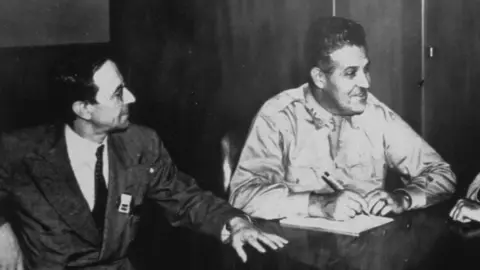
James Chadwick (20 October 1891 – 24 July 1974) was a British experimental physicist who received the Nobel Prize in Physics in 1935 for his discovery of the neutron. He headed the British team on the Manhattan Project during World War II and was knighted in 1945 for his achievements in nuclear physics.
Early Life and Education
Chadwick was born on 20 October 1891 in Cheshire, England, the first child of John Joseph Chadwick, a cotton spinner, and Anne Mary Knowles, a domestic servant. In 1895, his parents moved to Manchester, leaving him with his maternal grandparents. He attended Bollington Cross Primary School and later Central Grammar School for Boys in Manchester after his family could not afford fees at Manchester Grammar School despite his scholarship offer. At age 16, he won two university scholarships.
He entered Victoria University of Manchester in 1908 intending to study mathematics but enrolled in physics by mistake. Ernest Rutherford headed the physics department and assigned him a research project comparing radioactive energy from different sources. Chadwick devised a workable method when Rutherford’s suggested approach proved unworkable, resulting in his first published paper, co-authored with Rutherford in 1912. He graduated with First Class Honours in 1911 and earned his M.Sc. in 1913.
In 1913, Chadwick received an 1851 Exhibition Scholarship to study at the Physikalisch-Technische Reichsanstalt in Berlin under Hans Geiger. Using Geiger’s newly developed Geiger counter, he demonstrated that beta radiation produced a continuous spectrum rather than the discrete lines previously believed. During a laboratory visit, Albert Einstein remarked to him: “I can explain either of these things, but I can’t explain them both at the same time.”
Career and Achievements
Chadwick remained in Germany when World War I began and was interned at Ruhleben internment camp near Berlin for four years. He set up a laboratory in the camp stables and conducted experiments using improvised materials, including radioactive toothpaste, working with Charles Drummond Ellis on ionisation of phosphorus and photochemical reactions. After his release in November 1918, he returned to Manchester and wrote up his findings for the 1851 Exhibition commissioners.
Rutherford offered him a part-time teaching position at Manchester, where Chadwick continued research on nuclear charge. He then followed Rutherford to the Cavendish Laboratory at the University of Cambridge, earning his Doctor of Philosophy degree from Gonville and Caius College in June 1921. For over a decade, he served as Rutherford’s assistant director of research at the Cavendish Laboratory, which was among the world’s foremost physics research centres and attracted students including John Cockcroft, Norman Feather, and Mark Oliphant.
In 1935, Chadwick left Cambridge to become professor of physics at the University of Liverpool. He overhauled the antiquated laboratory and installed a cyclotron, transforming it into an important centre for nuclear physics research. Following his neutron discovery, he measured its mass and anticipated that neutrons would become a major weapon in fighting cancer.
Notable Events and Milestones
Chadwick’s discovery of the neutron was his defining achievement, earning him the 1935 Nobel Prize in Physics. In 1941, he wrote the final draft of the MAUD Report, which prompted the U.S. government to begin serious atomic bomb research efforts. During World War II, he headed the British team working on the Manhattan Project. He was knighted in Britain in 1945 in recognition of his nuclear physics achievements.
Awards and Honors
Chadwick received the Nobel Prize in Physics in 1935 for discovering the neutron. He was knighted in 1945 for his contributions to nuclear physics.
Additional Resources
For further details about Chadwick’s life and scientific contributions, readers can consult biographical archives and Wikipedia, which contain extensive information about his research at Manchester, Cambridge, and Liverpool, as well as his role in nuclear physics development during the twentieth century.
Observer Voice is the one stop site for National, International news, Sports, Editor’s Choice, Art/culture contents, Quotes and much more. We also cover historical contents. Historical contents includes World History, Indian History, and what happened today. The website also covers Entertainment across the India and World.

