

India Enhances EV Standards and Infrastructure for Future Growth

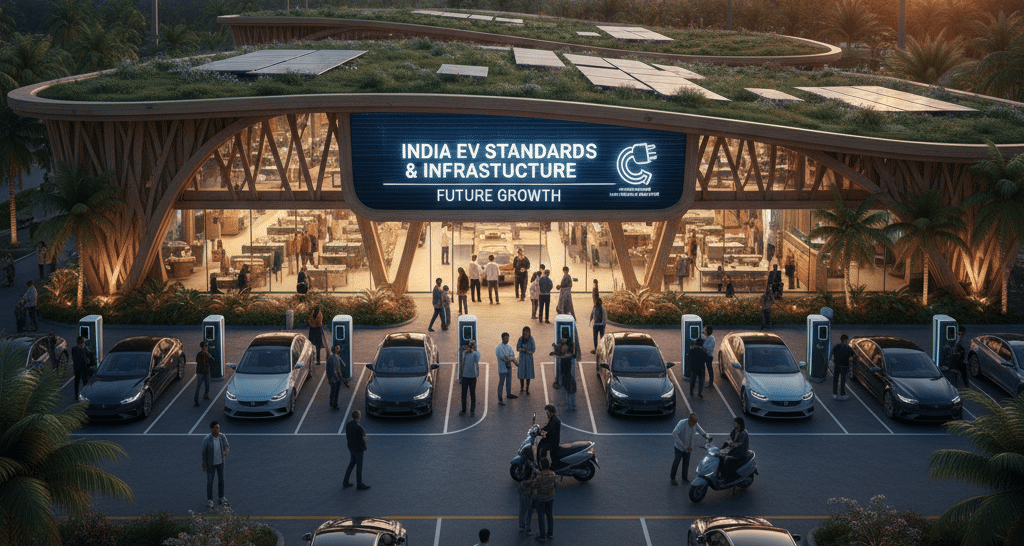
The Ministry of Road Transport and Highways (MoRTH) is taking significant steps to establish and update electric vehicle (EV) battery standards in India. These standards, which are accessible on the MoRTH website, include recent amendments to AIS-156 and AIS-038 that cater to various categories of electric vehicles. Since December 2022, these updated standards have outlined technical requirements aimed at ensuring the safety and reliability of traction batteries used in EVs.
EV prototypes and components are subjected to rigorous testing to ensure their safety. Key evaluations include checks for over-charge and discharge protection, over-current and short-circuit protection, over-temperature protection, voltage cut-off, and the functionality of the Battery Management System.
Safety Standards for Lithium-Ion Batteries
The Bureau of Indian Standards (BIS) has also played a pivotal role by publishing essential safety standards applicable to lithium-ion batteries. These safety requirements and testing protocols include:
- IS 18237: 2023: Safety of Primary and Secondary Lithium Cells and Batteries during Transport.
- IS 16893 (Part 2):2018: Secondary Lithium-Ion Cells for the Propulsion of Electric Road Vehicles: Part 2, Reliability and Abuse Testing.
- IS 16893 (Part 3):2018: Safety Requirements for Secondary Lithium-Ion Cells for Electric Road Vehicles.
- IS 16805: 2018: Safety Requirements for Secondary Lithium Cells and Batteries with Non-Acid Electrolytes for Industrial Applications.
- IS 16046 (Part 2):2018: Safety Requirements for Portable Sealed Secondary Cells and Batteries for Portable Applications.
Investing in EV Infrastructure
The Ministry of Electronics and Information Technology (MeitY) is actively contributing through its Development of Electric Vehicle Sub-Systems (EVSS) programme. This initiative focuses on the indigenous development of various EV subsystems, including motors, controllers, converters, chargers, and Battery Management Systems to cater to different EV segments. The programme includes ongoing research and development projects aimed at enhancing EV charging solutions.
Financial support is also robust, with the FAME-II Scheme allocating Rs.912.50 crore to establish public EV charging stations across the country. In addition, Rs.2,000 crore has been earmarked under the PM E-DRIVE Scheme to bolster EV charging infrastructure nationwide.
Accelerating the Charging Ecosystem
The Ministry of Power is furthering these initiatives by introducing guidelines aimed at accelerating a connected and interoperable EV charging ecosystem, with updates anticipated in January 2025. As of now, India boasts 29,151 EV charging stations, which include 12,033 fast chargers, according to data from BHEL.
Boosting Domestic Manufacturing
The Production Linked Incentive (PLI) scheme under the Ministry of Heavy Industries has allocated Rs.18,100 crore to enhance the domestic manufacturing of Advanced Chemistry Cells, aiming to establish a manufacturing capacity of 50 GWh over the next seven years.
Observer Voice is the one stop site for National, International news, Sports, Editor’s Choice, Art/culture contents, Quotes and much more. We also cover historical contents. Historical contents includes World History, Indian History, and what happened today. The website also covers Entertainment across the India and World.

