

Harriet Beecher Stowe: Author of Uncle Tom’s Cabin

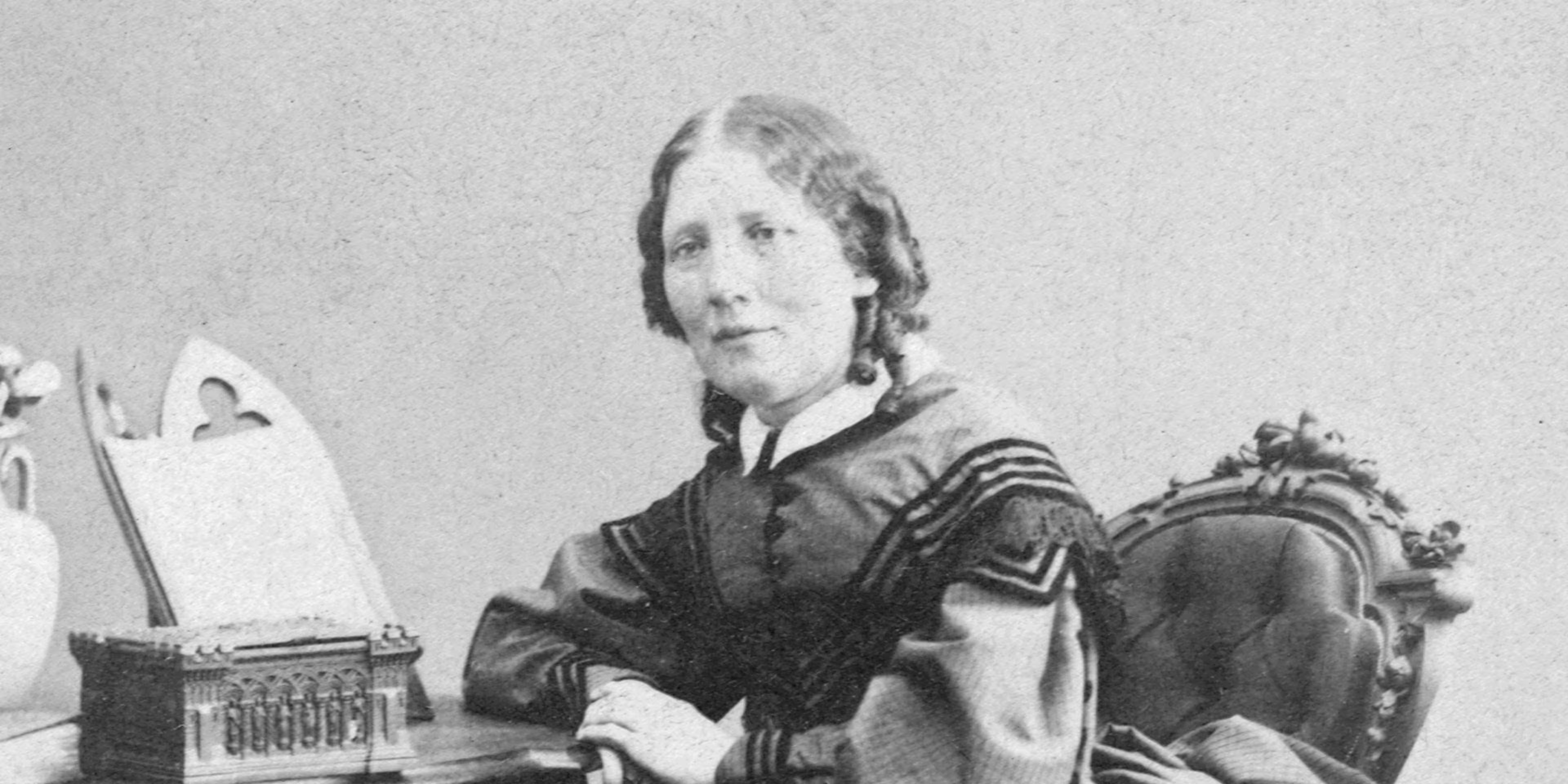
Harriet Elisabeth Beecher Stowe (June 14, 1811 – July 1, 1896) was an American author and abolitionist. She wrote Uncle Tom’s Cabin (1852), a novel depicting the harsh conditions of enslaved African Americans that reached millions of readers and became influential in energizing anti-slavery forces across the United States and Great Britain.
Early Life and Education
Harriet Elisabeth Beecher was born in Litchfield, Connecticut, on June 14, 1811, the sixth of eleven children born to Lyman Beecher, an outspoken Calvinist preacher. Her mother, Roxana Foote, was a deeply religious woman who died on September 25, 1816, when Harriet was five years old. Roxana’s maternal grandfather was General Andrew Ward, who fought in the Revolutionary War.
Her siblings included her sister Catharine Beecher, who became an educator and author, and brothers who entered the ministry, notably the famous preacher and abolitionist Henry Ward Beecher, as well as Charles Beecher and Edward Beecher. Harriet enrolled in the Hartford Female Seminary run by Catharine, where she received an uncommon education for women of the time, focusing on classics, languages, and mathematics. Sarah P. Willis, later known by her pseudonym Fanny Fern, was among her classmates.
Career and Achievements
In 1832, at age twenty-one, Harriet moved to Cincinnati, Ohio, to join her father, who had become president of Lane Theological Seminary. There she joined the Semi-Colon Club, a literary salon whose members included her sister Catharine, Caroline Lee Hentz, Salmon P. Chase (future governor of Ohio and United States Secretary of the Treasury under President Abraham Lincoln), and Emily Blackwell.
Cincinnati’s position on the Ohio River made it a hub for trade and migration, drawing escaped slaves, bounty hunters, and Irish immigrants. In 1829, Irish workers attacked Black residents in riots aimed at eliminating job competition; Harriet met African Americans who had suffered in these attacks, an experience that shaped her later writing on slavery. Similar riots erupted in 1836 and 1841, driven by native-born anti-abolitionists.
The Lane Debates on Slavery, held over eighteen days in February 1834, profoundly influenced her thinking. These debates, decisively won by abolitionists including Theodore Weld, pitted colonization advocates against abolitionists. Though her father and the seminary trustees prohibited further discussion of slavery to prevent violence, the debates’ impact on Harriet was lasting. She met Rev. Calvin Ellis Stowe, a widower and professor of Biblical Literature at the seminary, at the literary club; they married on January 6, 1836, and had seven children, including twin daughters.
Notable Events and Milestones
The Fugitive Slave Act of 1850 prompted Stowe to action. By then living in Brunswick, Maine, where her husband taught at Bowdoin College, she and Calvin were ardent critics of slavery and supporters of the Underground Railroad, temporarily housing fugitive slaves in their home. One fugitive, John Andrew Jackson, later wrote in his narrative The Experience of a Slave in South Carolina (1862) of hiding with Stowe as he fled to Canada.
Stowe claimed to have had a vision of a dying slave during a communion service at Brunswick’s First Parish Church, which inspired her to write his story. The death of her eighteen-month-old son, Samuel Charles Stowe, also deepened her empathy for enslaved people separated from their families. On March 9, 1850, she wrote to Gamaliel Bailey, editor of the anti-slavery journal The National Era, declaring her intention to write about slavery: “I feel now that the time is come when even a woman or a child who can speak a word for freedom and humanity is bound to speak.”
In June 1851, when Stowe was forty, the first installment of Uncle Tom’s Cabin appeared serially in The National Era under the original subtitle “The Man That Was a Thing,” later changed to “Life Among the Lowly.” Weekly installments ran from June 5, 1851, to April 1, 1852, for which Stowe received $400. The book was published on March 20, 1852, by John P. Jewett in an initial print run of 5,000 copies, with illustrations and a title page designed by Hammatt Billings. The novel sold widely and was adapted into a play, reaching millions of readers and provoking widespread anger in the South while energizing anti-slavery forces in the North and in Great Britain.
Additional Resources
Harriet Beecher Stowe wrote over thirty books, including novels, three travel memoirs, and collections of articles and letters, and remained influential for both her writings and her public stances on social issues of her era. Readers seeking more detailed information about her life, works, and historical impact can consult comprehensive biographical resources and archives available through Wikipedia and other scholarly repositories.
Observer Voice is the one stop site for National, International news, Sports, Editor’s Choice, Art/culture contents, Quotes and much more. We also cover historical contents. Historical contents includes World History, Indian History, and what happened today. The website also covers Entertainment across the India and World.

