

Commercial determinants of health: The tobacco, alcohol, and junk food industries killing 8 million people yearly while claiming to care
Commercial determinants of health: How corporations shape whether you live or die

Dr. Rodriguez sat in a public health conference listening to a tobacco company representative explain their commitment to “harm reduction.”
She’d spent the morning reviewing charts of lung cancer patients in her hospital. Watched people struggle to breathe, families devastated, lives cut short.
Now this executive talked about innovative products and responsible marketing while his company’s cigarettes killed 8 million people annually worldwide.
“The disconnect was staggering,” she told me later. “They speak about health concerns while spending billions marketing products designed to addict people to substances that will kill them. That’s commercial determinants of health in action.”
Commercial determinants of health—it sounds academic. But it’s actually about how corporations directly impact whether you live or die, stay healthy or get sick, thrive or struggle.
What Corporate Activities Actually Mean for Your Health
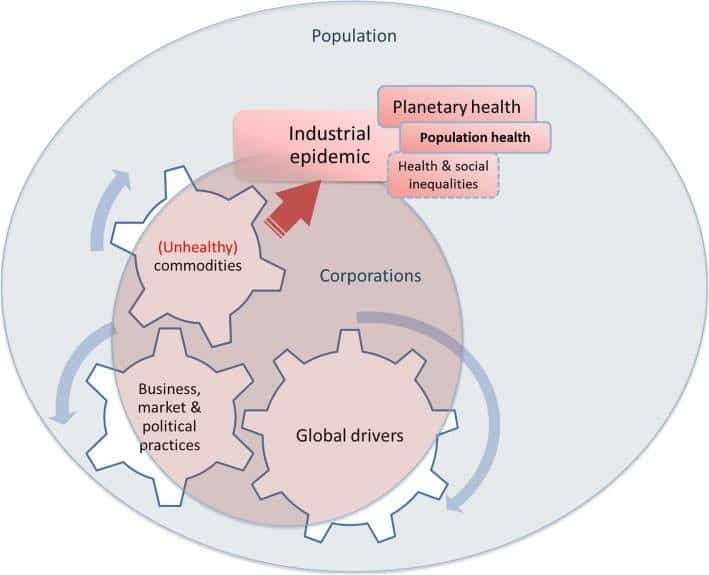
Commercial determinants of health encompass all private sector activities impacting public health—for better or worse.
This includes the obvious things: products sold (cigarettes, alcohol, sugary drinks, ultra-processed foods) and how they’re marketed (especially to children and vulnerable populations).
But it goes much deeper. Working conditions in factories affect worker health. Production processes create pollution harming communities. Political activities like lobbying shape health policies. Misinformation campaigns undermine public understanding. Corporate donations create conflicts of interest.
Some corporations also use their power—economic, political, social—to block public health policies that threaten profits. They fund research designed to cast doubt on science. They write legislation favoring their interests. They sue governments implementing health protections.
Dr. Patel, who studies corporate influence on health policy, explained: “It’s not just about selling unhealthy products. It’s about creating entire systems—economic, political, legal—that enable and protect harmful practices while making regulation nearly impossible.”
The Death Toll in Numbers
Let’s start with tobacco because the evidence is overwhelming and undeniable.
Half of all tobacco users will die from health issues related to these products. Half. That’s 8 million deaths every year globally. Not from some mysterious disease we don’t understand—from a product companies deliberately make addictive and market aggressively.
Alcohol is similarly devastating. Beyond the deaths from liver disease, accidents, and violence, alcohol contributes to over 200 different health conditions. The industry spends billions marketing products that destroy families, end careers, and kill.
Fast food and sugar-sweetened beverage companies have fueled obesity epidemics worldwide. They market junk food to children. They lobby against nutrition labeling. They fund research questioning whether their products cause harm. The resulting diabetes, heart disease, and other conditions kill millions.
Then there’s pesticides. Twenty percent of suicides globally involve pesticide self-poisoning. These are agricultural workers exposed to toxic chemicals, often with inadequate protections, driven to despair.
These harms disproportionately affect the poorest and most vulnerable populations. Low and middle-income countries bear the greatest burden while having the weakest capacity to regulate harmful industries.
The Positive Side We Can’t Ignore
Here’s where it gets complicated: the private sector also creates enormous health benefits.
Pharmaceutical companies develop life-saving medicines and vaccines. The measles vaccine alone has prevented 25.5 million deaths since 2000. COVID-19 vaccines developed by private companies have saved millions more.
Nearly 2 billion people will need assistive devices by 2050—wheelchairs, hearing aids, prosthetics—greatly improving quality of life. Private companies manufacture these products.
Safety devices like seatbelts, child restraints, and helmets significantly reduce serious injuries and deaths. Companies innovate and produce these protections.
The private sector builds hospitals, finances healthcare infrastructure, and delivers services helping achieve universal health coverage. Private innovation drives medical progress.
So we face a fundamental challenge: how do we leverage the benefits of private sector innovation and resources while protecting populations from harm?
The Hidden Structural Problems
The most insidious commercial determinants operate at structural levels most people never see.
Profit shifting allows multinational corporations to avoid taxes in countries where they operate. Money that should fund public health instead enriches shareholders. Low and middle-income countries lose billions annually to these schemes.
Trade agreements often include provisions protecting corporate profits over public health. Countries trying to implement tobacco packaging restrictions or limit marketing of baby formula face lawsuits claiming these policies violate trade rules.
Lobbying gives industries direct access to policymakers. They help write legislation affecting their products. They fund politicians who oppose health regulations. The result: policies favoring corporate profits over population health.
Conflicts of interest are everywhere. Industry-funded research produces convenient results. Scientists with industry ties downplay health risks. Government officials with industry connections make decisions benefiting their former employers.
Dr. Martinez, who tracks corporate political activity, told me: “Industries spend more on lobbying health policies than we spend on implementing those policies. They outgun us financially, politically, and legally.”
The Case of Formula Marketing
Baby formula companies provide a perfect case study of commercial determinants in action.
Breastfeeding provides optimal nutrition for infants. The science is clear. Yet formula companies spend billions marketing products as equivalent or superior to breastmilk.
They give free samples to new mothers, creating dependency when breastmilk supply drops. They sponsor medical conferences and fund pediatricians. They use social media and digital marketing to reach parents with misleading messages.
The result: lower breastfeeding rates globally, particularly in low-income countries where formula preparation with contaminated water causes disease and death.
WHO has tried implementing restrictions on formula marketing for decades. Industry fights every measure, sues governments, and finds loopholes in regulations.
Working Conditions Nobody Talks About
Commercial determinants include how corporations treat workers.
Exposure to long working hours was the key occupational risk attributing to approximately 750,000 out of 1.9 million work-related deaths in 2016.
Factory workers breathe toxic fumes without proper protection. Agricultural laborers are exposed to dangerous pesticides. Warehouse employees work at speeds causing repetitive stress injuries. Gig economy workers lack basic protections or healthcare access.
These aren’t accidents. They’re business decisions prioritizing profit over worker wellbeing.
Agriculture’s Antimicrobial Disaster
Here’s a commercial determinant threatening all of humanity: antimicrobial use in agriculture.
Around 66% of all antimicrobials are used in agricultural practices—often not to treat sick animals but to promote growth and prevent disease in crowded, unsanitary conditions.
This drives antimicrobial resistance, making human infections harder to treat. It creates pandemic risks by facilitating disease transmission between animals and humans.
The agricultural industry knows this. They do it anyway because it’s profitable.
What Actually Works
Some solutions have proven effective where implemented.
Taxation works. Higher tobacco taxes reduce smoking, especially among youth and poor populations. Countries implementing aggressive tobacco taxation have seen consumption drop significantly.
Advertising restrictions work. Banning tobacco advertising, limiting alcohol marketing to children, restricting junk food ads—all reduce consumption of harmful products.
Clear regulations work. Smoke-free policies, nutritional labeling requirements, limits on harmful ingredients—when enforced, these protect health.
The WHO Framework Convention on Tobacco Control provides a model. Countries implementing its MPOWER measures (Monitor tobacco use, Protect people from smoke, Offer help to quit, Warn about dangers, Enforce bans on advertising, Raise taxes) have saved millions of lives.
Why Change Is So Hard
Industries don’t accept regulation quietly.
They fund “independent” research questioning health evidence. They create front groups posing as consumer organizations. They sue governments. They threaten to move operations elsewhere. They donate to politicians opposing regulation.
Tobacco companies spent decades denying smoking caused cancer despite their own research proving otherwise. Alcohol companies fund studies suggesting moderate drinking benefits health. Food companies blame individual choices for obesity while marketing junk food to children.
Dr. Kim, who advises governments on industry interference, described the challenge: “We propose evidence-based policies. Industry mobilizes lawyers, lobbyists, politicians, scientists they’ve funded. They have resources we can’t match. They play a long game, delaying and weakening any regulation that might reduce profits.”
Moving Forward
WHO urges governments to address commercial determinants systematically.
Implement strong regulations on harmful products. Manage conflicts of interest. Reform lobbying rules. Use taxation strategically. Support civil society organizations holding corporations accountable.
Fundamentally, this requires repositioning social outcomes ahead of profit. Alternative economic models. Different metrics of success. Governance reforms.
It means recognizing that some industries make money by harming people, and we need systems preventing that regardless of corporate opposition.
Back at that conference, Dr. Rodriguez watched the tobacco executive finish his presentation to polite applause.
“I thought about my patients,” she said. “People who started smoking as teenagers because of aggressive marketing. Now dying because addiction trapped them. That executive’s salary comes from their suffering. Until we fundamentally change how we let corporations operate, the body count will keep rising.”
Commercial determinants of health. Remember that phrase. Because corporate boardrooms might be deciding your health outcomes as much as your doctor is.
For more information:
- WHO Commercial Determinants of Health
- Framework Convention on Tobacco Control
- Food Systems for Health Initiative
- Commercial Determinants Fact Sheet
Disclaimer: This article is an adaptation of publicly available information from WHO’s Commercial determinants of health topic page (WHO, Geneva. Licence: CC BYNC-SA 3.0 IGO). WHO is not responsible for the content or accuracy of this adaptation. This content is for informational and educational purposes
only and does not constitute medical advice. ObserverVoice.com is a news and information platform
— not a healthcare provider.
Observer Voice is the one stop site for National, International news, Sports, Editor’s Choice, Art/culture contents, Quotes and much more. We also cover historical contents. Historical contents includes World History, Indian History, and what happened today. The website also covers Entertainment across the India and World.

