

Alexander Hamilton: Architect of American Finance

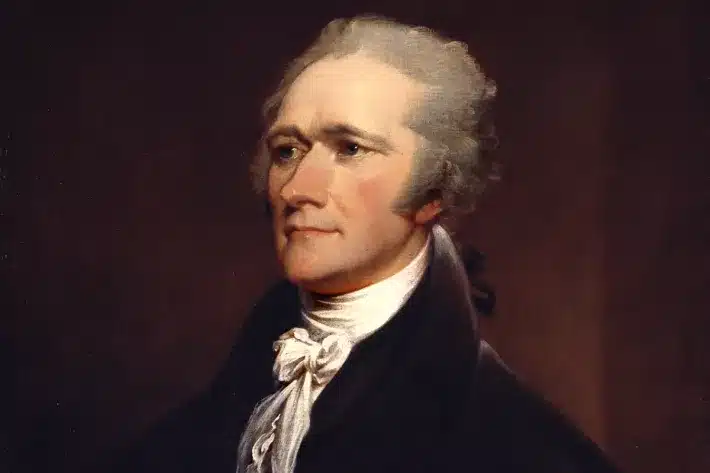
Alexander Hamilton (January 11, 1755 or 1757 – July 12, 1804) was an American military officer, statesman, and Founding Father. He served as the first U.S. secretary of the treasury from 1789 to 1795 and founded America’s first political party, the Federalist Party, in 1789.
Early Life and Education
Hamilton was born in Charlestown, Nevis, in the British Leeward Islands, born out of wedlock to Rachel Lavien and James A. Hamilton, a Scotsman. His maternal grandfather was John Faucette, a French Huguenot planter and medical doctor from the Saintonge province of France who had settled in Nevis. Hamilton’s mother had previously been married to Johann Lavien in Saint Croix and had a son, Peter, before leaving to meet James Hamilton.
As a child, Hamilton received individual tutoring and attended classes at a private school led by a Jewish headmistress. Orphaned young, he was taken in by a prosperous merchant and given a scholarship to pursue his education. He attended King’s College (now Columbia University) in New York City, where despite his youth he became an anonymous but prolific pamphleteer and advocate for the American Revolution.
Career and Achievements
Hamilton served as an artillery officer in the American Revolutionary War, seeing military action in the New York and New Jersey campaign. He then served four years as aide-de-camp to Continental Army commander-in-chief George Washington and fought at the Siege of Yorktown, the war’s climactic battle that secured American independence.
After the war, Hamilton served as a delegate from New York to the Congress of the Confederation in Philadelphia before resigning to practice law. He founded the Bank of New York and in 1786 led the Annapolis Convention, which sought to strengthen the confederation’s powers. The following year he was a delegate to the Philadelphia Convention, which drafted the U.S. Constitution.
As secretary of the treasury under President Washington from 1789 to 1795, Hamilton envisioned a strong central government with an energetic executive, robust national defense, and a diversified economy with expanded industry. He successfully argued that the Constitution’s implied powers allowed the federal government to create the First Bank of the United States as a fiscal agent to assume the states’ war debts. The bank was funded by a tariff on imports and a whiskey tax. In 1790, he persuaded Congress to establish the U.S. Revenue Cutter Service to protect American shipping. He opposed American entanglement with unstable French revolutionary governments and advocated for the Jay Treaty in 1793, which resumed friendly trade relations with Britain.
After resigning in 1795, Hamilton resumed legal and business activities and helped lead the abolition of the Atlantic slave trade. During the Quasi-War fought at sea between 1798 and 1800, President John Adams appointed him major general, though the U.S. Army saw no combat. Hamilton opposed Adams’ 1800 presidential re-election and, despite philosophical differences with Thomas Jefferson, endorsed him over Aaron Burr in the tied electoral college vote.
Notable Events and Milestones
Hamilton authored 51 of the 85 installments of The Federalist Papers, which proved instrumental in securing ratification of the U.S. Constitution and remains the preeminent interpretation of Constitutional intent. His Federalist Party, founded in 1789, opposed the Democratic-Republican Party led by Thomas Jefferson. Hamilton and other Federalists supported the Haitian Revolution, and Hamilton helped draft Haiti’s constitution in 1801.
In 1804, when Aaron Burr ran for Governor of New York, Hamilton opposed his candidacy, arguing he was unfit for office. Burr took offense and challenged Hamilton to a pistol duel in Weehawken, New Jersey, on July 11, 1804. Hamilton was mortally wounded and died the following day, July 12, 1804.
Awards and Honors
Scholars regard Hamilton as an astute and intellectually brilliant administrator, politician, and financier. Historian Paul Johnson wrote in 1997 that Hamilton was a “genius—the only one of the Founding Fathers fully entitled to that accolade.” His ideas are credited with influencing the founding principles of American finance and government.
Additional Resources
For deeper exploration of Hamilton’s life, writings, and lasting influence on American institutions, readers can consult Wikipedia’s comprehensive biography and other historical archives. His Federalist Papers and correspondence remain primary sources for understanding early American constitutional thought and financial policy.
Observer Voice is the one stop site for National, International news, Sports, Editor’s Choice, Art/culture contents, Quotes and much more. We also cover historical contents. Historical contents includes World History, Indian History, and what happened today. The website also covers Entertainment across the India and World.

