

Alexander Jackson Davis: Pioneer of American Gothic Revival

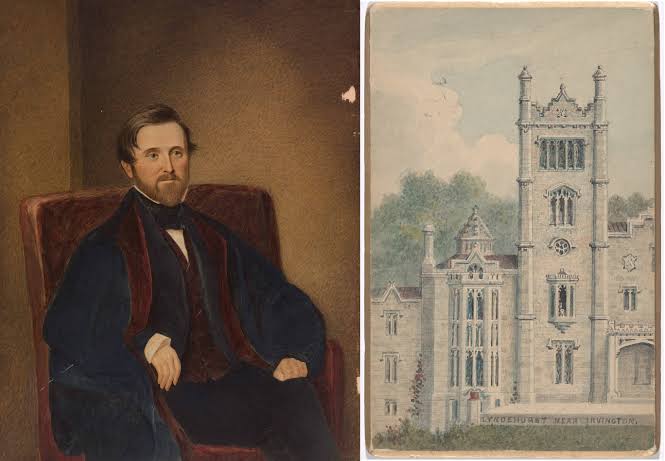
Alexander Jackson Davis (July 24, 1803 – January 14, 1892) was an American architect known particularly for his association with the Gothic Revival style. He designed some of the nation’s most prominent public buildings and country residences, and his pattern books and partnership with Andrew Jackson Downing shaped American domestic architecture for generations.
Early Life and Education
Davis was born in New York City and studied at the American Academy of Fine Arts, the New-York Drawing Association, and from the antique casts of the National Academy of Design. He dropped out of school and became a lithographer. From 1826 he worked as a draftsman for Josiah R. Brady, a New York architect who was an early exponent of the Gothic Revival style.
Career and Achievements
Davis began his independent career as an architectural illustrator in the 1820s before turning to building design. In 1826, he joined the office of Ithiel Town and Martin E. Thompson, the most prestigious architectural firm of the Greek Revival era. There he gained access to the best architectural library in the country and developed a thorough grounding in design principles. From 1829, Davis formed a partnership with Town that became the first recognizably modern architectural office.
During the 1830s and 1840s, Davis designed numerous prominent public buildings. In Washington, he designed the Executive Department offices and, with Robert Mills, the first Patent Office building (1834–1836). He also designed the Custom House of New York City (1833–1842) and consulted on several state capitols, including those in Indiana (1831–1835), North Carolina (1833–1840), and Ohio. With Town’s partner James Dakin, he designed “Colonnade Row” on New York’s Lafayette Street (1833), the first apartments designed for the prosperous American middle class.
From 1835, Davis worked on his only publication, Rural Residences, the first pattern book for picturesque residences in a domesticated Gothic Revival style that could be executed in carpentry. The book also contained the first examples of Italianate “Tuscan” villas with flat roofs and wide overhanging eaves. After the Panic of 1837 interrupted his plans for additional volumes, Davis partnered with Andrew Jackson Downing, illustrating his widely read books on domestic architecture.
The 1840s and 1850s were Davis’s most fruitful decades as a designer of country houses. His villa “Lyndhurst” at Tarrytown, New York, remains his most famous residential work. He designed Blandwood (1846), the home of Governor John Motley Morehead and America’s earliest Italianate Tuscan Villa. Other notable residences include the Greek Revival William Walsh House at Albany, New York, and the Gothic Revival Belmead near Powhatan, Virginia (1845). Davis also designed smaller but well-known structures, including a Carpenter Gothic building for John Cox Stevens in 1845 that became the first clubhouse of the New York Yacht Club.
Notable Events and Milestones
In 1831, Davis was elected an associate member of the National Academy of Design. His work on Rural Residences beginning in 1835 marked a turning point in American domestic architecture, introducing pattern-book designs that made picturesque and Gothic Revival styles accessible to middle-class builders. His partnership with Andrew Jackson Downing, beginning after 1837, extended his influence through Downing’s widely distributed publications on landscape and domestic design. Davis continued his partnership with Ithiel Town until shortly before Town’s death in 1844.
Awards and Honors
Davis was elected an associate member of the National Academy of Design in 1831. The specific details of other formal honors or awards are not documented in available biographical records.
Additional Resources
Alexander Jackson Davis’s legacy endures in the buildings he designed and the architectural traditions he helped establish. His influence on American residential and public architecture can be traced through his publications, his partnership with Downing, and the many structures he designed across the eastern United States. Readers seeking more detailed information about Davis’s life, works, and architectural philosophy can consult comprehensive biographical sources and architectural histories available through Wikipedia and other scholarly archives.
Observer Voice is the one stop site for National, International news, Sports, Editor’s Choice, Art/culture contents, Quotes and much more. We also cover historical contents. Historical contents includes World History, Indian History, and what happened today. The website also covers Entertainment across the India and World.
Follow Us on Twitter, Instagram, Facebook, & LinkedIn

