

The First Enclosure

There is a question older than every religion and every science, and Leibniz asked it in its cleanest form: why is there something rather than nothing? Most people file this away as a puzzle for metaphysicians, a riddle with no stake in ordinary life. I have come to think the opposite. I think it is the most intimate question a person can ask, because each of us has already lived through its answer once, in a country we cannot remember, before we had the words to record the journey.
Every one of us began as almost nothing. A hunger without a name for hunger. A cold without a concept of cold. And then, again and again, that nothing was met by something — a warmth, a pressure, a voice — that did not merely feed the hunger but converted it, turned distress into peace before we had the faintest idea what peace was. We did not experience this as a person arriving to help us. We were too young to know that persons existed. We experienced it as a change in the weather of being itself. The world was unbearable, and then, by no effort of our own, it was bearable. This was our first miracle, and we slept through it.
I want to insist on how strange this is, because we have all agreed to forget it. Before we could think, we were already the recipients of a transformation so total that it built the very floor we would later stand on to do our thinking. Leibniz, in a corner of his work that few people read, wrote about what he called the petites perceptions — the countless tiny impressions that fall beneath the threshold of awareness, that we never consciously register, but that shape us all the same, the way the roar of the sea is made of individual waves no single one of which we could name. Our earliest life is one long petite perception. It left no memory. It left everything else.
What the ego is made of
Freud gave us an unsettling proposition, one I think he did not fully grasp the beauty of. In his work on mourning, he suggested that the self — what he called the ego — is not a thing we are born with, but a residue. A sediment. It is what remains after everything we have loved and lost has passed through us and left its mark. He wrote that the ego is composed of the abandoned attachments of a lifetime, that we are, in some literal sense, a graveyard of everything we could not keep.
Read coldly, this sounds like a diagnosis of despair. I read it as the opposite. It means that nothing we have truly loved is ever fully gone, because it did not stay outside us to be taken away — it was metabolized, folded into the architecture of who we are. The people and places that transformed us are not stored in memory like photographs in a drawer. They are in the walls. They became the shape of the room we now live inside, which is the self.
This is why the loss of something that held us is never experienced as the loss of an external object. It is experienced as a kind of structural collapse, a sudden vertigo, as though a wall of the house had turned out to be load-bearing in ways the blueprint never showed. And it was load-bearing. That is exactly what an enclosure is: the thing that holds the shape of a life until the life can hold its own shape.
The paradox at the center of every attachment
Here is the cruelty, and I do not use that word lightly. The finest enclosure — the one that holds most perfectly, that turns every distress into peace, that asks nothing in return — is built for the sole purpose of being left. Its entire success is measured by its own eventual disappearance. A holding that never released you would not be love; it would be a cage in the ordinary, ugly sense. The whole genius of a true enclosure is that it works to make itself unnecessary. It pours everything into you so that one day you can stand where it used to stand.
This is the paradox that no philosophy has ever dissolved, only described. To be given a world is to be given, in the very same gesture, the certainty of its ending. The gift and the wound arrive together, sealed in one envelope. You cannot accept the transformation without accepting the departure, because the transformation is the preparation for the departure. Attachment and detachment are not opposites here. They are the front and back of a single hand.
The Buddhist traditions saw one half of this with great clarity: that attachment is the root of suffering, that we cling to what is impermanent and are broken on the wheel of our clinging. I honor that insight, but I think it stops one step short of the harder truth. We are not merely afflicted by our attachments. We are made of them. The self that is asked to practice non-attachment is itself the precipitate of every attachment it ever had. There is no clean, unattached observer standing behind the eyes, waiting to be freed. Strip away everything you have ever loved and there is no serene remainder — there is nothing left. The one who would let go is the sum of what it is being asked to release.
The lifelong search we mistake for ambition
Once you have felt this first transformation, you never stop looking for it again. And here is the part we hide from ourselves: almost everything we call ambition, faith, romance, wanderlust, and taste is this search wearing a costume.
We think we want the new house, the new city, the new love, the achievement finally within reach. We tell ourselves a story of desire, of getting. But watch closely and you notice something stranger underneath. We do not want to possess these things so much as we want to surrender to them. We want them to do to us what was done to us at the beginning — to reach in from outside and change our inner weather without our having to lift the change ourselves. The religious believer who trusts that a higher power can remake his whole existence is not being naive. He is remembering something real. He is remembering the first time an outside force made the unbearable bearable, and he is trusting that the structure of the universe still works that way. He may be right. He may be wrong. But he is not making it up.
This same hunger, turned in a darker direction, is the whole psychology of the addict, the fanatic, the gambler. The fanatic is not, at bottom, a person who wants power. He is a person who cannot stop believing that one idea, one movement, one final correction to the world will transform everything — his poverty, his loneliness, his shapeless private ache — all at once, the way it was transformed once before, for free, when he was small. Fanaticism is a memory misfiled as a program. It is the first miracle demanded a second time, by force, from the wrong hands.
The silence, and what we do against it
And yet — set all of this against the plain fact that the universe itself offers us no such promise. This is where Camus refused to blink. We arrive demanding meaning, demanding that our need be met the way our first need was met, and the cosmos returns only silence. That collision — our hunger for sense against the world’s refusal to supply it — is what he called the absurd. It cannot be reasoned away. The mother-warmth of the beginning was real; the indifference of the stars is also real; and no argument reconciles them.
But Camus drew the conclusion that most people miss. He did not say: therefore despair. He said: therefore revolt. Since meaning will not be handed down from above, it must be made, here, by us, in full knowledge of the silence. The dignity is not in being given a world. The dignity is in building one anyway, with our own hands, against a backdrop that promised us nothing. He asked us to imagine Sisyphus happy — not because the boulder gets lighter, but because the choosing of the labor is itself the freedom no god can grant and no death can revoke.
This is the point where Nietzsche walks in and finishes the sentence. He knew that suffering is not an interruption of a good life but the raw material of any deep one. “One must still have chaos in oneself,” he wrote, “to give birth to a dancing star.” His amor fati — the love of one’s fate, not the endurance of it but the love of it, wound and all — is the most difficult thing a human being can attempt. It asks you to say yes not only to the gift but to the loss that came sealed inside it; to affirm the whole envelope. Not because the pain was good. Because the pain and the beauty turned out to be the same event seen from two sides, and you cannot keep one while refusing the other. To love your fate is to stop bargaining with the paradox and start standing inside it.
The blossom
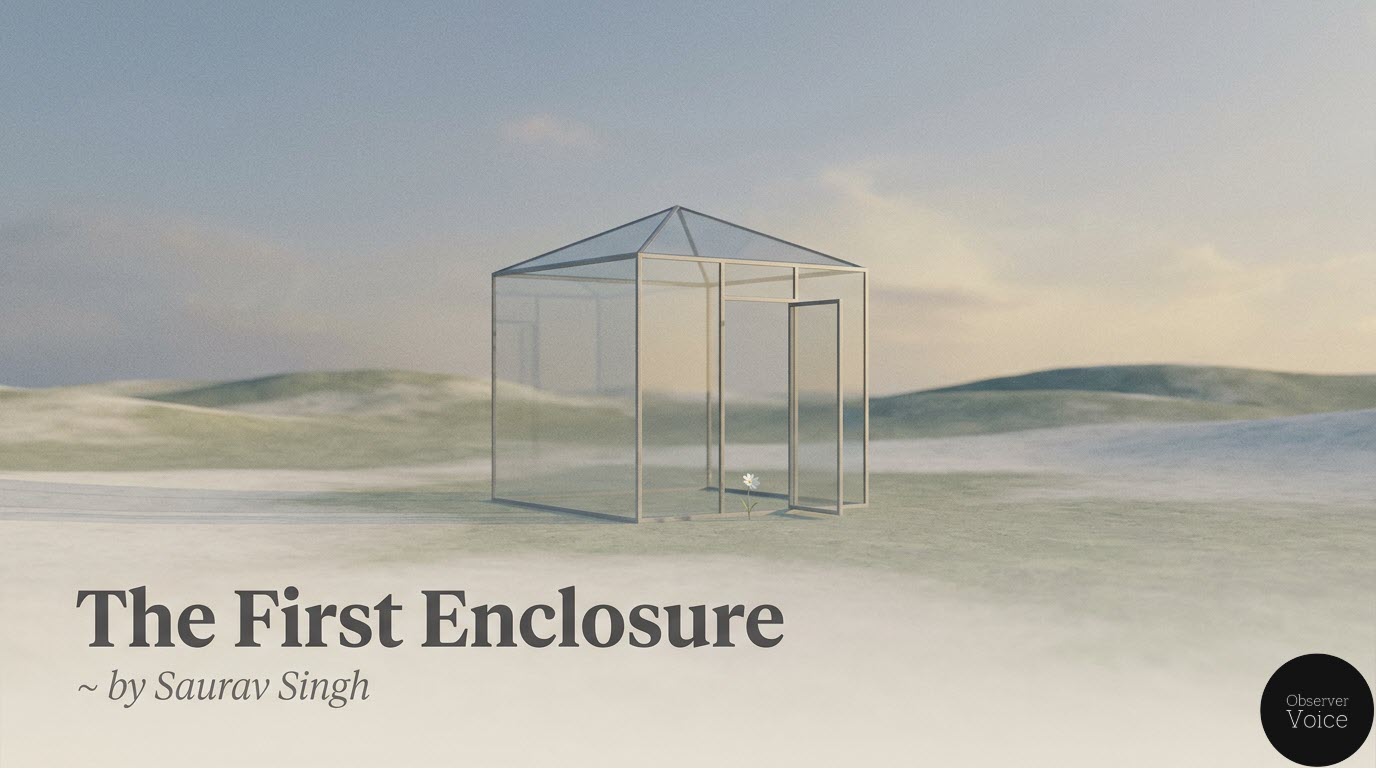
There is an image I keep returning to. A flower held too long in the shelter of the greenhouse never becomes itself. It is the wind and the cold and the open sky — the very things the greenhouse was built to keep out — that call the bloom into its full form. The enclosure protects the seed precisely so that the flower can one day meet the weather that the seed could never have survived. The greenhouse is not betrayed when its door is opened. That was always its purpose. Its love was aimed the whole time at the moment it would no longer be needed.
To grieve an enclosure, then, is a strange and holy confusion. It feels like the loss of shelter. It is also, though we cannot feel it yet, the proof that the shelter worked — because only a self that was truly built can hurt this precisely, mourn this deeply, love this far past the point where the loved thing can answer. The size of the grief is the exact measurement of the size of what was made. You do not weep this much over a wall. You weep this much over a foundation.
What is left
So I return to Leibniz’s question, and I answer it differently than the metaphysicians do. Why is there something rather than nothing? For each of us, personally, the answer is not a proof. It is a debt to a transformation we cannot remember, performed by forces that asked for no repayment and are, most of them, already gone. There is something rather than nothing because something, once, reached into our nothing and made a world.
The task that remains is not to search forever for that first enclosure in disguise — in the next city, the next love, the next belief that promises to remake everything at a stroke. That search, left unexamined, becomes the fanatic’s trap and the addict’s cell. The task is subtler and harder. It is to become, slowly and imperfectly, part of your own weather. To let the walls that once held you turn into horizons. To stay open enough that the world can still transform you — through a piece of music that undoes you, a painting you fall into, a stranger’s unexpected kindness — while no longer demanding that any of it save you.
The love does not stop when the one who gave it is gone. It has nowhere left to go, and so it floods back into the one who received it, and asks to be spent forward, into a life. That is the whole of it, I think. Not to escape the paradox. Not to be cured of the attachment. But to carry what was built into us out into the open air it was always meant for — and, standing in the weather at last, to bloom.
Observer Voice is the one stop site for National, International news, Sports, Editor’s Choice, Art/culture contents, Quotes and much more. We also cover historical contents. Historical contents includes World History, Indian History, and what happened today. The website also covers Entertainment across the India and World.

