

Why We Buy Gym Memberships We Never Use: The Projection Bias Trap

Sixteen-year-old Kavya made a classic mistake. She went grocery shopping on an empty stomach after fasting during Navratri. Walking through the aisles, everything looked delicious. She filled her cart with snacks, sweets, frozen pizzas, instant noodles, and desserts. “I’ll definitely eat all of this,” she thought confidently. “I’m so hungry right now, and these will be perfect for the next few weeks.”
Three weeks later, her mother pointed to the pantry full of untouched junk food. “Why did you buy all this? You’ve been eating home-cooked meals and haven’t touched any of it.” Kavya was confused. “I don’t know… when I bought it, I was certain I’d want it. But now it all seems too heavy, too sweet, too unhealthy. I can’t imagine eating most of this.”
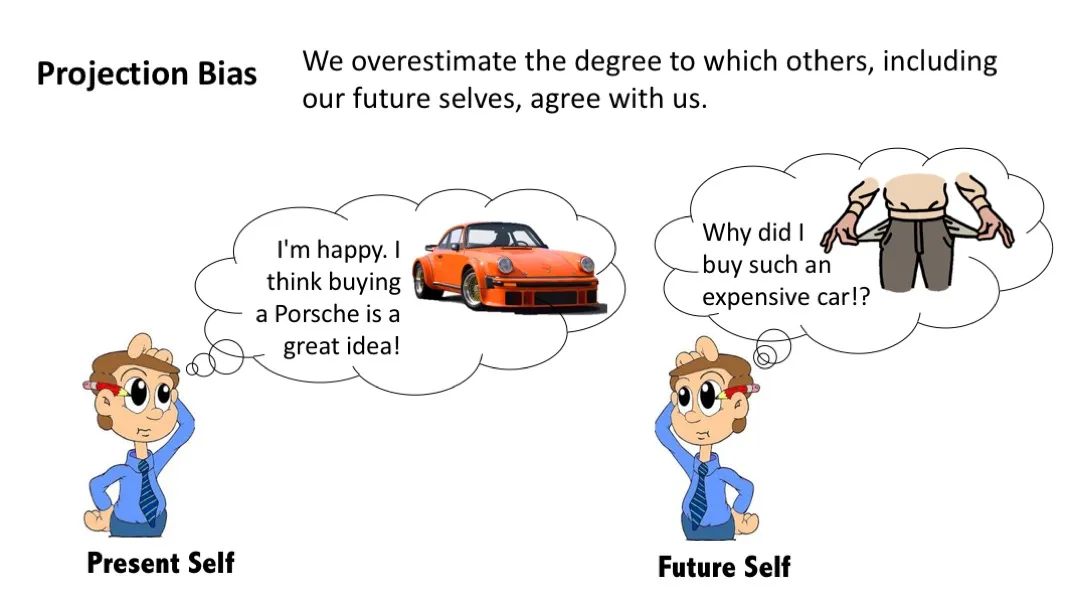
Her economics teacher later explained what had happened: “You experienced projection bias. When you were hungry at the store, you projected that hungry state onto your future self. You assumed ‘future Kavya’ would have the same intense desire for junk food that ‘present hungry Kavya’ felt. But your preferences changed—once you weren’t hungry anymore, those foods stopped being appealing. You bought for a version of yourself that only existed temporarily.”
This psychological bias explains countless poor decisions—gym memberships purchased in January enthusiasm but unused by March, bulk purchases of food that spoils before you want it, career choices based on current mood that don’t match your actual long-term temperament. Understanding projection bias reveals why we consistently make choices that our future selves regret, not because we changed, but because we never accurately imagined how our future selves would actually feel.
What Is Projection Bias?
Projection bias is the tendency to assume our future preferences, desires, and values will match our current ones, even though they’ll likely change. We project our present state—hungry, enthusiastic, angry, in love—onto our future selves, making decisions as if we’ll feel the same way later when actually our feelings, desires, and priorities will shift significantly.
The phenomenon was formally studied by behavioral economists George Loewenstein and Ted O’Donoghue. Research at Carnegie Mellon University demonstrated that people ordering food for delivery tomorrow choose very differently when hungry versus full—hungry people order much more food than they’ll want when it arrives, projecting current hunger onto tomorrow when they’ll likely be satisfied.
According to studies from Harvard University, projection bias causes systematic errors in predicting future utility. When hot, we overestimate how much we’ll value cooling in the future. When cold, we overestimate how much we’ll value warming. When excited about a hobby, we overestimate how much time we’ll devote to it. When angry at someone, we underestimate how quickly we’ll forgive them.
Research from University of Chicago demonstrates that projection bias affects major life decisions severely. People choose careers based on current interests that fade, marry partners based on current feelings that evolve, and move to locations based on current priorities that shift. The bias creates a systematic mismatch between the decisions we make and the preferences we’ll actually have when living with those decisions.
The Farmer Who Planted for Winter in Summer
A teaching tale tells of a farmer who, during a brutal winter, planned his spring planting while shivering by his fire. “This cold is unbearable,” he thought. “When spring comes, I’ll plant only crops that thrive in cool weather. I never want to experience heat—winter has taught me that cold is preferable to heat.”
His neighbor, also suffering through winter, planned differently. “Right now I desperately want warmth, and that’s coloring my judgment. But I know from experience that in summer, I’ll desperately want coolness. I must plan for the actual conditions of each season, not for my current feelings about temperature.”
Spring arrived. The first farmer, now comfortable in mild weather, still remembered his winter suffering and planted cool-weather crops as planned. Summer came with intense heat. His cool-weather crops wilted and failed. He watched his neighbor’s heat-tolerant crops thrive and finally understood his error.
“I planned in winter for what winter-me wanted,” he lamented. “I projected my winter preferences onto my summer self. I forgot that summer-me would have completely different needs than winter-me. My neighbor remembered that our preferences change with circumstances, so he planned based on actual summer conditions, not on winter feelings about summer.”
The wise neighbor explained: “Every season, you’ll feel that the current conditions are what you’ll always want to optimize for. In winter, you want warmth and can’t imagine wanting coolness. In summer, you want coolness and can’t imagine wanting warmth. But seasons change, and your preferences change with them. Wisdom means planning for the actual future conditions your future self will face, not for your current feelings projected forward in time.”
Buddhist philosophy addresses projection bias in teachings about impermanence and non-self. The Buddha taught that there is no permanent self—we’re constantly changing collections of physical and mental processes. Projection bias represents the delusion that there’s a permanent “you” with stable preferences. Understanding that “you” in six months will be substantially different from “you” today helps make better decisions for that future different person.
The Bhagavad Gita discusses this through Krishna’s teaching about the changing nature of the embodied self. Krishna teaches that the self passes through childhood, youth, and old age, constantly changing. Projection bias represents failing to account for this constant change—assuming the “you” making decisions today is identical to the “you” who will live with those decisions later, when actually you’ll have evolved in preferences, values, and priorities.
How Projection Bias Sabotages Our Decisions
In fitness and gym memberships, projection bias creates the classic January signup and March abandonment pattern. Research shows that people judge gym membership value when highly motivated—often January 1st after New Year’s resolutions—and assume they’ll maintain that motivation level. They project current high motivation onto their future selves, signing expensive annual contracts. By March, when motivation naturally decreases and the novelty wears off, they stop going but remain locked into contracts purchased when in a very different mental state.
Studies from Stanford University tracking gym attendance found that people’s predicted usage when signing up exceeds actual usage by 70-100%. Those who predict they’ll go four times weekly average twice weekly, then once weekly, then not at all—but they predicted usage based on their peak motivation state, not their average state.
In bulk shopping and costco trips, projection bias makes people buy quantities they’ll never use. When hungry or in a buying mood, you see a twenty-four-pack of energy bars and think “I’ll definitely eat all these!” projecting current appetite or enthusiasm onto the next several months. Three months later, with twelve bars remaining and expired, you realize that your eating preferences shifted, the flavor got boring, or your routine changed. You bought for a temporary version of yourself.
Research demonstrates that households waste approximately thirty percent of bulk-purchased perishable food because projection bias makes them overestimate how much they’ll consume. The savings from bulk buying are often erased by waste from overestimating future consumption based on present desires.
In career and educational choices, projection bias causes people to commit to paths based on current interests that fade. A student passionate about biology in Class 10 chooses medical school, only to discover in Class 12 that the passion was temporary and they’re now more interested in literature. But they’ve already committed to a science stream based on who they were two years ago, not who they are now.
Studies show that a significant percentage of college students change majors because their interests evolved from when they initially chose. Projection bias made them assume their present interests would remain constant, leading to commitments to future paths that no longer fit by the time they arrive at that future.
In relationships and marriage, projection bias makes people overestimate long-term compatibility based on current feelings. The intense emotions of new relationships feel permanent. People commit to lifelong partnerships assuming they’ll always feel exactly as they do now, projecting current passion and compatibility onto decades into the future when both people will have changed substantially in values, interests, and priorities.
Research shows that one predictor of divorce is unrealistic expectations about how feelings and compatibility will evolve. Projection bias contributes to these unrealistic expectations—the belief that “we’ll always feel exactly like this” when actually both individuals and relationships evolve continuously.
In housing and location decisions, projection bias makes people choose homes based on current life stage without adequately considering how needs will change. Young couples buy houses perfect for their current childless lifestyle, not anticipating how different their needs will be with children. Retirees move to vacation destinations they loved visiting, not anticipating that living somewhere full-time differs dramatically from vacationing there.
Studies demonstrate that a significant percentage of people who relocate for retirement return within five years because the location that seemed perfect based on vacation experiences turns out not to match daily living preferences. Projection bias made them assume vacation-self and daily-life-self have identical preferences.
In technology and device purchases, projection bias makes people buy gadgets based on initial excitement that fades. Someone buys an expensive camera thinking “I’ll use this constantly for my new photography hobby!” projecting the current enthusiasm onto the indefinite future. Six months later, the camera sits unused—the hobby interest was temporary, not permanent as assumed when making the expensive purchase.
Research shows that households own many expensive items purchased during enthusiasm peaks that rarely get used once enthusiasm naturally decreases. Exercise equipment, musical instruments, hobby tools—all frequently purchased with inflated expectations of future use based on temporary present enthusiasm.
Planning for Your Changing Self
The most important practice for countering projection bias is asking: “Have my preferences about this changed in the past?” If your interest in hobbies, foods, activities, or priorities has fluctuated before, it will likely fluctuate again. Don’t assume your current state is your permanent state. Your past variability predicts future variability better than your current conviction that “this time it’s different.”
For major commitments, delay decisions when in extreme states. Don’t sign gym contracts when maximally motivated on January 1st—wait two weeks and sign if you’re still going regularly. Don’t choose a career path when swept up in temporary enthusiasm—give it six months to see if the interest persists. Don’t make big purchases when excited—wait until you’re in a neutral state to reassess whether you really want it.
Build reversibility into decisions when possible. Choose month-to-month gym memberships over annual contracts. Rent equipment for hobbies before buying. Take classes before committing to degree programs. Reversibility protects you from projection bias by letting you exit commitments made by past-self when current-self discovers their preferences have changed.
Consult your past self’s experiences. When considering a gym membership, don’t ask “How motivated am I right now?” Ask “How many times did I actually go to the gym on average over the past year when I had access?” Past behavior predicts future behavior far better than current enthusiasm predicts future enthusiasm.
Specifically plan for preference change. When making decisions, actively imagine scenarios where your preferences shift. “If I get this tattoo and my taste in art changes, will I regret it?” “If I buy this house and have kids, will it still work?” “If I commit to this career and my interests evolve, am I trapped?” Explicitly considering preference change counteracts the bias.
Remember Kavya buying junk food while hungry that she didn’t want once satisfied, and the farmer planting for winter-self’s preferences during summer when they no longer applied. Both made decisions based on temporary states projected onto the future, failing to account for how different they’d feel when that future actually arrived. Projection bias isn’t stupidity—it’s a systematic error our brains make because current feelings are vivid and real while future different feelings are abstract and hard to imagine.
The solution isn’t trying to have stable preferences—you can’t prevent your preferences from evolving. The solution is acknowledging that they will evolve and planning accordingly. The “you” six months from now will be meaningfully different from the “you” today. Make decisions that work for a range of possible future yous, not just for the current you whose preferences are temporary. Your current hunger, enthusiasm, anger, or passion feels like it will last forever. It won’t. It never does. Remembering that simple truth protects you from commitments made by temporary versions of yourself that your future evolved self will regret.
Frequently Asked Questions
How is projection bias different from just changing my mind?
Changing your mind means your preferences genuinely evolve unpredictably. Projection bias means you predictably failed to anticipate that your preferences would change despite evidence they regularly do. If you’ve bought gym memberships you didn’t use multiple times, that’s projection bias—you had evidence your motivation fluctuates but kept projecting peak motivation onto your future self. True mind-changing is when something genuinely unexpected shifts your preferences.
Can I eliminate projection bias or will I always experience it?
You can significantly reduce it through conscious awareness and corrective strategies, but complete elimination is difficult because current states feel so vivid and real while future states are abstract. The goal isn’t elimination but management—building in reversibility, delaying decisions when in extreme states, and consciously reminding yourself that your current feelings are temporary even though they feel permanent.
Why would evolution give us projection bias if it causes bad decisions?
Our ancestors faced immediate threats and opportunities requiring quick action based on current states—if hungry now, secure food now. Distant future planning was less critical to survival and reproduction. Projection bias may be a byproduct of cognitive systems optimized for immediate concerns rather than long-term planning. Modern life requires more long-term decision-making than ancestral environments, exposing the limitations of these ancient systems.
Are some people more susceptible to projection bias than others?
Research suggests modest individual differences. People higher in impulsivity and present-focus show stronger projection bias. People with better self-knowledge and experience tracking how their preferences change show slightly less. However, projection bias is universal—everyone experiences it to some degree. Even people who understand the bias intellectually still experience it emotionally in the moment.
Does projection bias mean I shouldn’t trust my current preferences at all?
No—it means weighting current preferences appropriately while acknowledging they’ll likely change. For short-term decisions (choosing lunch), current preferences are highly relevant. For long-term commitments (choosing careers, permanent body modifications, major purchases), current preferences should be tempered with knowledge that they’ll evolve. The key is matching decision reversibility to the likelihood and timeframe of preference change.
Observer Voice is the one stop site for National, International news, Sports, Editor’s Choice, Art/culture contents, Quotes and much more. We also cover historical contents. Historical contents includes World History, Indian History, and what happened today. The website also covers Entertainment across the India and World.

