

AI: A Catalyst for Economic Growth or Widening Divides?

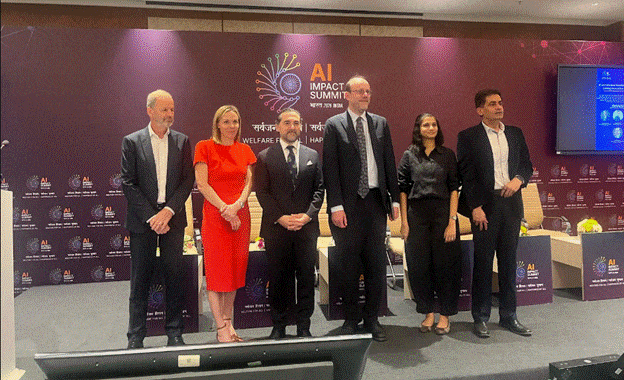
The recent session titled “AI and the New Frontier for Economic Progress: Linking Innovation to Inclusive Growth” at the India AI Impact Summit 2026 gathered esteemed economists, development practitioners, and global policy thinkers to explore a pivotal question for the next decade: will artificial intelligence bridge economic divides or exacerbate them? The discussion centered on the necessary structural conditions for AI-driven growth, emphasizing productivity enhancements, public sector transformations, and the creation of open innovation ecosystems.
Harnessing AI for Emerging Economies
Johannes Zutt, Vice President for the South Asia Region at the World Bank Group, underscored AI’s potential as a transformative tool for development. He noted that for emerging markets, AI could significantly alter the landscape by providing practical solutions rather than solely relying on groundbreaking innovations. Zutt stated, “AI could be a game changer. It offers an opportunity to leapfrog longstanding development challenges and enhance growth and productivity,” and emphasized the need to focus on “small AI” that is affordable and addresses specific local challenges.
Addressing Structural Imbalances
Ufuk Akcigit, Co-Director of Growth and Economy at the University of Chicago, highlighted a crucial imbalance within the innovation ecosystem. Although the application layer of AI enables easier entry for startups and new companies, he warned that the foundational layer, which relies heavily on computational power and data, poses significant barriers that could lead to excessive market concentration. “At the application layer, entry barriers are low, but at the foundational layer, they are very high,” Akcigit explained, raising concerns about the implications for sustained economic growth.
The Role of Public Investment
Michael Kremer, Director of the Development Innovation Lab at the University of Chicago, called attention to the necessity of public investment in high-impact AI use cases. He argued that without governmental and multilateral support, essential applications would struggle to attract private investment. Kremer asserted, “If policymakers take appropriate actions and make appropriate investments, AI has the potential to substantially narrow some of the gaps.”
Ensuring Measurable Impact
Iqbal Singh Dhaliwal, Global Executive Director of J-PAL at MIT, focused on the significance of frontline service delivery within AI productivity discussions. He emphasized the importance of freeing up valuable time for frontline workers like teachers and health officials. “Very few things free up frontline workers’ time. If your AI application frees up time for teachers or health workers, that’s a winner,” he noted, while also urging caution to align technological advancements with labor market demands to prevent increasing inequality.
A Global Perspective on AI Governance
Anu Bradford, Professor of Law and International Organization at Columbia University, provided insights on global governance in the era of AI, emphasizing that sovereignty is now shared across various frameworks. She noted that the Global South has similar interests in establishing AI sovereignty to create rules that better serve their economies. Bradford advocated for collaborative approaches that balance competitiveness with responsible regulation.
The overarching consensus from the session concluded that AI’s true potential may lie in enhancing productivity across various sectors, thus reinforcing public systems and refining targeted development initiatives. However, challenges such as labor displacement and market concentration require immediate policy interventions. Ultimately, the path to inclusive growth in the AI-driven future will depend on purposeful decisions regarding investments, knowledge sharing, entrepreneurship, and robust regulatory frameworks.
Observer Voice is the one stop site for National, International news, Sports, Editor’s Choice, Art/culture contents, Quotes and much more. We also cover historical contents. Historical contents includes World History, Indian History, and what happened today. The website also covers Entertainment across the India and World.

