

Myanmar Launches Defense at International Court of Justice Amid Ongoing Legal Battle

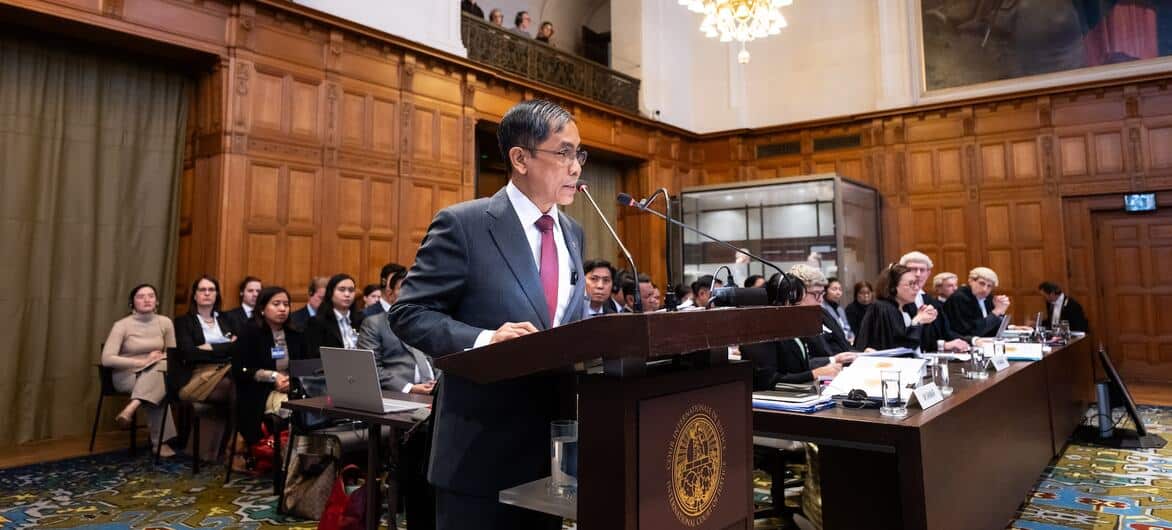
Myanmar has firmly rejected allegations of genocide against the Rohingya people, asserting that The Gambia has not presented sufficient evidence to support its claims. During a session at the International Court of Justice (ICJ), Myanmar’s representative, Ko Ko Hlaing, described the accusations as “unsubstantiated.” The Gambia’s foreign minister, Dawda Jallow, previously argued that Myanmar’s actions aimed to eliminate the minority Muslim population through systematic genocidal policies. This legal battle comes in the wake of a brutal military crackdown in 2017, which resulted in the deaths of thousands of Rohingya and forced over 700,000 to flee to neighboring Bangladesh.
Myanmar’s Defense Against Genocide Claims
In its defense, Myanmar has consistently maintained that its military operations were necessary to combat insurgent threats in Rakhine State, where the majority of Rohingya reside. Hlaing emphasized that the country could not remain passive while facing terrorist activities in the region. He characterized the military’s actions as “clearance operations,” a term used in counter-insurgency efforts. This assertion comes despite a UN report from 2018 that called for investigations into top military officials for genocide and crimes against humanity related to the Rohingya crisis.
The Gambia’s Case and Historical Context
The Gambia initiated its case against Myanmar in 2019, motivated by its own experiences with military governance. Jallow highlighted the long history of persecution faced by the Rohingya, which he described as a campaign of dehumanization followed by violent military crackdowns. The Gambia’s legal team argued that the systematic killing of vulnerable populations, including women and children, cannot be justified under the pretext of combating terrorism. Philippe Sands, representing The Gambia, asserted that the evidence overwhelmingly points to a genocidal intent behind Myanmar’s actions against the Rohingya.
Current Situation of Rohingya Refugees
Today, over a million Rohingya refugees reside in Bangladesh, particularly in the Cox’s Bazar region, which is home to some of the world’s largest and most densely populated refugee camps. Hlaing expressed Myanmar’s commitment to repatriating these individuals but acknowledged that external factors, including the COVID-19 pandemic, have hindered these efforts. He argued that Myanmar’s ongoing initiatives contradict The Gambia’s narrative of intent to destroy or forcibly deport the Rohingya population. The outcome of this case is crucial for Myanmar’s international reputation, as a ruling of genocide would have significant implications for the country and its people.
Future Implications of the ICJ Ruling
The ICJ has allocated three days for witness testimonies, including accounts from Rohingya survivors, although these sessions will be closed to the public and media. A final ruling is anticipated by the end of 2026 and could set a significant precedent for future genocide cases, including one involving South Africa’s accusations against Israel regarding the Gaza conflict. This case is particularly notable as it is the first genocide case to be heard by the ICJ in over a decade, providing an opportunity for judges to clarify the legal definitions surrounding genocide as outlined in the 1948 UN Genocide Convention. This convention defines genocide as actions committed with the intent to destroy, in whole or in part, a national, ethnical, racial, or religious group.
Observer Voice is the one stop site for National, International news, Sports, Editor’s Choice, Art/culture contents, Quotes and much more. We also cover historical contents. Historical contents includes World History, Indian History, and what happened today. The website also covers Entertainment across the India and World.
Follow Us on Twitter, Instagram, Facebook, & LinkedIn

