

Bangladesh Newspaper Employees Escape Fiery Attack as Offices Go Up in Flames

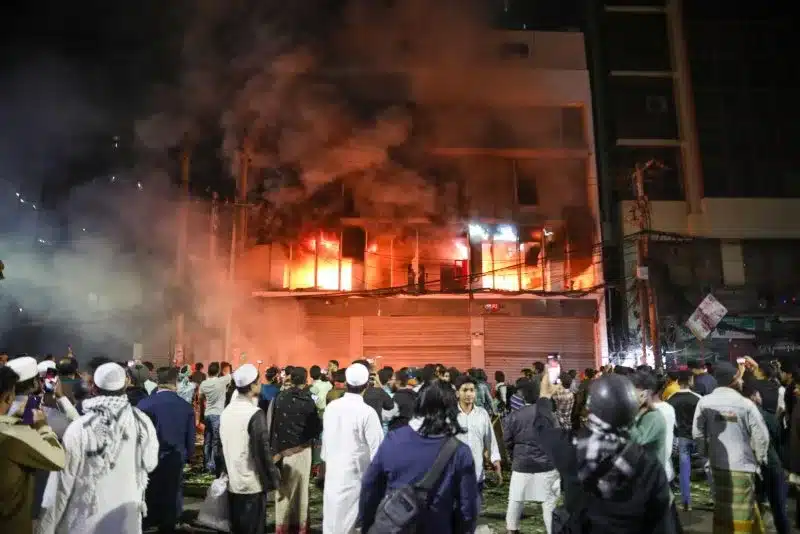
Staff at two prominent Bangladeshi newspapers faced a terrifying ordeal as protesters, incited by the death of a well-known activist, set their offices ablaze. The activist, Sharif Osman Hadi, a significant figure in last year’s anti-government protests, was shot in Dhaka and succumbed to his injuries shortly after. The violent demonstrations targeted The Daily Star and Prothom Alo, leading to extensive damage and raising concerns about the state of independent journalism in Bangladesh.
Protests Erupt Following Activist’s Death
The protests erupted after the death of Sharif Osman Hadi, a 32-year-old leader of the student protest group Inqilab Mancha. Hadi was a prominent voice in the youth movement that played a crucial role in the ousting of former Prime Minister Sheikh Hasina. He was shot by masked assailants while leaving a mosque in Dhaka on December 12, just one day after the announcement of the upcoming elections scheduled for February. Hadi was later transferred to a hospital in Singapore, where he died from his injuries. His death has been described by interim Prime Minister Muhammad Yunus as an “irreparable loss for the nation,” and he condemned the act as a premeditated attack aimed at undermining the electoral process.
The protests began on Thursday night, with hundreds of demonstrators storming the offices of The Daily Star and Prothom Alo. Staff members reported feeling “gasping for air” as they were trapped in the building while it was being attacked. The Daily Star, which has been a critical voice in Bangladeshi journalism, announced that it could not publish its print edition for the first time in 35 years due to the violence. Fortunately, no serious injuries were reported, but significant damage was inflicted on both newspaper offices.
Government Response and Condemnation
In response to the violence, the interim government led by Nobel laureate Muhammad Yunus issued a statement condemning the attacks on journalists. The government emphasized that such acts are assaults on the truth and vowed to ensure that the perpetrators face justice. Yunus highlighted the importance of maintaining a peaceful transition to democracy, stating that the country must not be derailed by those who thrive on chaos. The government has declared a national day of mourning for Hadi, reflecting the gravity of the situation.
The protests continued into the following day, with demonstrators expressing their anger and frustration. The government has faced criticism for its handling of dissent, and the targeting of The Daily Star and Prothom Alo raises questions about press freedom in the country. Both newspapers have been known for their secular and progressive stances, often coming under fire during Hasina’s administration. Their critical reporting on the interim government’s policies may have contributed to the unrest.
Impact on Journalism and Future Elections
The attacks on The Daily Star and Prothom Alo mark a significant moment for independent journalism in Bangladesh. The Daily Star’s consulting editor, Kamal Ahmed, described the events as one of the darkest days for the press in the country. The inability to publish a print edition for the first time in decades underscores the precarious state of media freedom in Bangladesh. As the nation approaches elections in February, the atmosphere remains tense, with concerns about the safety of journalists and the integrity of the electoral process.
Hadi’s involvement in the protests and his plans to run as an independent candidate in the upcoming elections have made his death particularly impactful. His assassination has sparked fears of further violence and instability as the country navigates its political landscape. Investigations into the shooting are ongoing, with several individuals detained in connection with the case. The interim government faces the challenge of restoring order while ensuring that the upcoming elections are conducted fairly and peacefully.
Legacy of Sharif Osman Hadi
Sharif Osman Hadi’s legacy as a leader of the youth movement that contributed to the ousting of Sheikh Hasina will likely resonate in the political discourse of Bangladesh for years to come. His vocal criticism of the government and his aspirations for a democratic future have made him a symbol of resistance against authoritarianism. Hadi’s death has not only galvanized protests but has also raised awareness about the challenges faced by activists and journalists in the country.
As the nation mourns Hadi, the interim government must address the underlying issues that led to his assassination and the subsequent violence. The future of Bangladesh’s democracy hangs in the balance as citizens demand accountability and justice. The upcoming elections will serve as a crucial test for the interim government and its commitment to upholding democratic principles in the face of adversity.
Observer Voice is the one stop site for National, International news, Sports, Editor’s Choice, Art/culture contents, Quotes and much more. We also cover historical contents. Historical contents includes World History, Indian History, and what happened today. The website also covers Entertainment across the India and World.
Follow Us on Twitter, Instagram, Facebook, & LinkedIn

