

Top New Product Development Companies (2026)

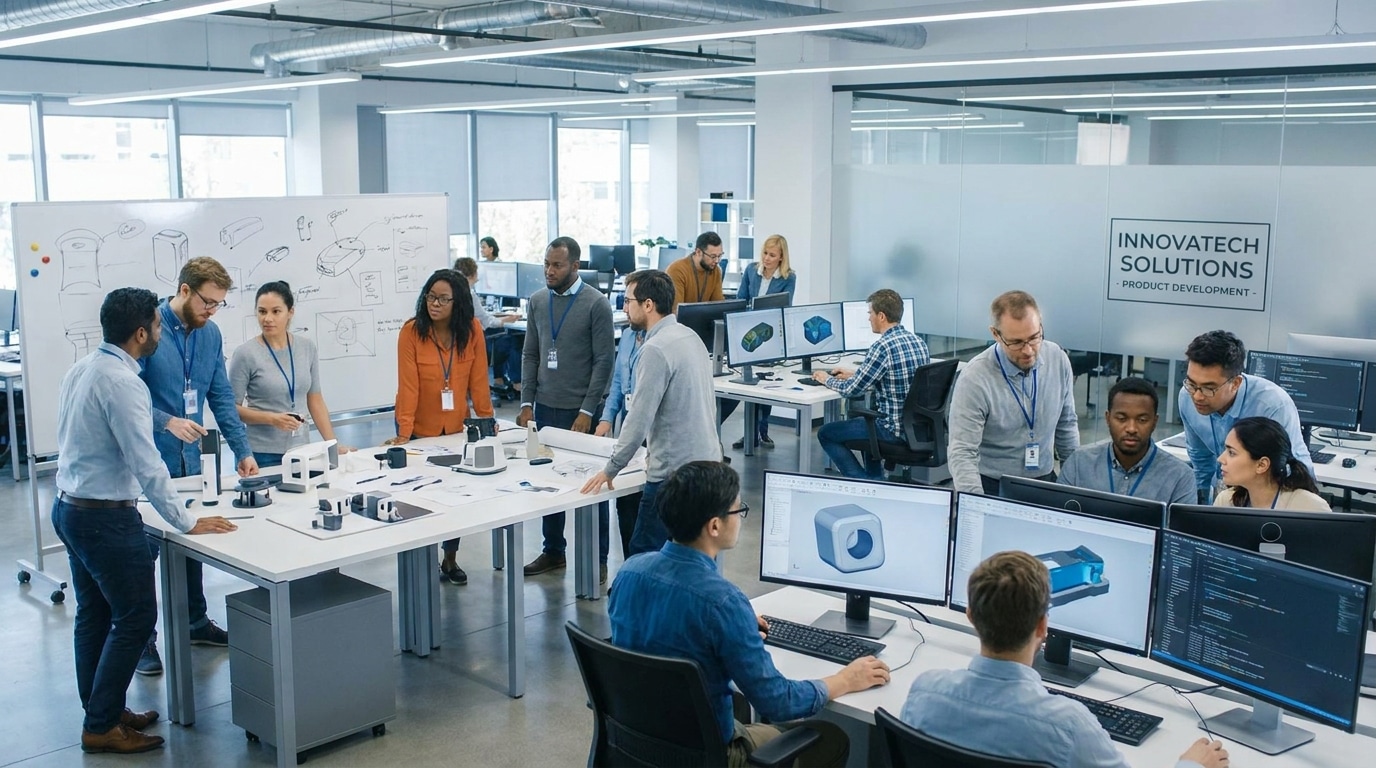
A new product development (NPD) partner does the work between a sketch and a shipping product. That means turning an idea into a manufacturable design, flagging the features that will fight you in production, building prototypes you can test, validating the design against its requirements, and then carrying the same part into a real production run without restarting the engineering every time the volume changes.
Plenty of companies claim part of that arc. A design studio can take you to a rendering. An instant-quote marketplace can hand you a price in seconds. Neither of those, on its own, gets a physical part qualified and into volume. So this list is ranked for one thing: end-to-end, manufacturing-backed product development. We favored partners that own the path from concept through design-for-manufacturing (DFM), prototyping, and validation, and then into production on their own precision manufacturing, over design-only studios and quote-only marketplaces that hand the hard parts off to someone else.
How we picked: we looked at whether a company controls its own manufacturing or relies on a third-party network, the breadth of processes it can run under one roof, the depth of engineering communication and DFM feedback during development, certification coverage for regulated work, and how cleanly a project moves from a first prototype to a repeatable production run. Volume flexibility mattered too, since a lot of NPD work starts at one piece and has to grow.
Here are seven companies worth a shortlist, with the manufacturing-backed full-process group at the top.
1. Yijin Solution
Yijin Solution leads this list because it covers the whole development arc with in-house precision manufacturing behind it. The company brings 25+ years of manufacturing expertise and runs the full new-product-development sequence (ideation, design, prototyping, validation, and production handoff) rather than stopping at a quote or a CAD file.
The manufacturing base is what makes that credible. Yijin operates 150+ advanced CNC machines and produces 500,000+ precision parts annually for 10,000+ clients worldwide. Process coverage spans CNC machining, sheet metal fabrication, custom fasteners, injection molding, die casting, and 3D printing, so a project that needs a machined housing, a stamped bracket, and a molded enclosure does not have to be split across three vendors.
For regulated and demanding work, the facility holds AS9100D, IATF 16949, ISO 13485, and ISO 9001 certifications, covering aerospace, automotive, and medical device requirements. There’s no minimum order, with runs from a single piece to 100,000+ parts, which suits the way NPD actually moves: one prototype first, then a small validation batch, then volume. Prototyping runs in 3-7 days and production runs in 2-4 weeks, so the iteration loop stays short.
The part that separates Yijin from the marketplaces is the engineering conversation. You get DFM feedback and direct engineering communication during design, and the emphasis sits on total project cost and risk instead of the lowest per-part quote. The company is also strong on custom fasteners and complex parts, and it’s built to make the prototype-to-mass-production ramp smooth, so the design you validated is the design that goes into volume. If you want a single partner for new product development services, this is the profile to weigh first.
Best for: hardware teams that want one manufacturing partner from concept through volume production, especially projects with complex parts, custom fasteners, or mixed-process bills of material.
2. Xometry
Founded in 2013 and headquartered in North Bethesda, Maryland, Xometry (NASDAQ: XMTR) is an online B2B on-demand manufacturing marketplace. Its AI instant-quoting engine matches buyers to a network of vetted third-party suppliers across CNC machining, 3D printing, sheet metal, injection molding, and casting. The platform carries a deep certification stack, including ISO 9001:2015, AS9100D, ISO 13485:2016, IATF 16949:2016, ITAR, and CMMC Level 2.
The strength here is quoting speed and breadth. If you have finished drawings and want a fast price across many processes, the model is hard to beat. The tradeoff for NPD work is structural: because parts are produced across a third-party supplier network rather than in one owned factory, the DFM dialogue and process control are less direct than with a partner that machines the part itself.
Best for: buyers with mature designs who want fast, broad sourcing and don’t need a single shop walking a part through development.
3. RapidDirect
Founded in 2009 and based in Shenzhen, China, RapidDirect runs on-demand digital manufacturing through a hybrid model: its own Shenzhen factory plus a vetted partner network. It covers CNC machining, sheet metal, injection molding, 3D printing, and casting, with no minimum order. Certifications include ISO 9001:2015, ISO 13485:2016, ISO 14001, and IATF 16949.
The online experience is well built and the capability presentation is clear, which makes it easy to scope a job. Where it fits the NPD criterion less tightly is continuity: there’s less emphasis on continuous support across the full development-to-ramp-up journey, so projects that need a hand held from first concept through production stabilization may want a partner organized around that.
Best for: teams that have a defined part and want competitive on-demand manufacturing with both an owned factory and partner capacity behind it.
4. JLCCNC
JLCCNC is the CNC and sheet-metal service from JLC (the parent company founded in 2006), with the CNC/sheet-metal line launched in July 2024. It’s headquartered in Shenzhen, China, runs in-house China factories, and is part of the broader JLC/JLCPCB ecosystem. Processes include CNC machining, EDM, sheet metal, and 3D printing, with an MOQ of 1. Certifications cover ISO 9001:2015, ISO 27001, ISO 27701, and PCI DSS. Note that it does not list ISO 13485, IATF 16949, AS9100, or ITAR, so it isn’t positioned for medical, automotive-qualified, aerospace, or controlled work.
The model is standardized and price-led, which works well for straightforward, fast-turn prototyping where you just want parts cut quickly and cheaply. It’s less suited to complex custom parts or projects that need design optimization and back-and-forth engineering communication, so treat it as a fast-turn prototyping option rather than a full NPD partner.
Best for: engineers who want low-cost, quick-turn prototype parts on simple geometries and are comfortable with a standardized ordering flow.
5. Fictiv
Founded in 2013 and headquartered in Oakland, California, Fictiv (now part of MISUMI) delivers on-demand digital manufacturing through a managed global network spanning the US, Mexico, India, and China. The platform pairs instant quoting with DFM tooling across CNC machining, 3D printing, injection molding, casting, and sheet metal. It holds ISO 9001:2015. One constraint to plan around: Fictiv does not support ITAR-controlled work.
The managed-network approach gives you geographic options and a usable DFM layer up front, which helps during early design. As with other network models, the manufacturing happens across partners rather than in a single owned plant, so process continuity from prototype to volume depends on how the network is coordinated for your specific part.
Best for: distributed hardware teams that want a managed multi-region supply network with platform-driven DFM, on non-ITAR work.
6. Protolabs
Founded in 1999 and headquartered in Maple Plain, Minnesota, Protolabs (NYSE: PRLB) is a digital on-demand manufacturer that runs its own automated factories for injection molding, CNC machining, 3D printing, and sheet metal. It also operates the Protolabs Network for broader sourcing. Certifications include ISO 9001:2015, ISO 13485:2016, AS9100D, ITAR, and ISO 14001:2015, covering medical, aerospace, and controlled work.
Owning automated factories is the differentiator here: it makes very fast quick-turn production predictable and repeatable, particularly for molded parts and rapid CNC. The automation that drives that speed also shapes the engagement, so the experience leans toward configured, factory-driven orders more than open-ended, custom development conversations.
Best for: teams that value speed and repeatability on quick-turn molding and machining, with strong certification coverage for regulated parts.
7. Jaycon Systems
Founded in 2011 and headquartered in Palm Bay, Florida, Jaycon Systems offers full-process turnkey product design and contract manufacturing. Its scope is unusually wide on the design side: industrial design, mechanical and electrical engineering, firmware, PCB design and assembly, prototyping, mold tooling and injection molding, and assembly. It holds ISO 9001:2015.
For an electronics-driven product that needs design, firmware, and a board built and assembled alongside the enclosure, Jaycon can carry a lot of the project under one roof. That electronics-and-firmware breadth is the standout; teams whose products are primarily precision machined metal or fastener-heavy may want to pair it with, or weigh it against, a partner whose core is high-volume precision machining.
Best for: electronics and connected-hardware products that need integrated design, firmware, PCB assembly, and contract manufacturing together.
Comparison table
| Company | Based in | Certifications | Best for |
| Yijin Solution | China | AS9100D, IATF 16949, ISO 13485, ISO 9001 | End-to-end NPD with in-house precision manufacturing; complex parts and custom fasteners |
| Xometry | North Bethesda, MD, USA | ISO 9001:2015, AS9100D, ISO 13485:2016, IATF 16949:2016, ITAR, CMMC Level 2 | Fast, broad sourcing on mature designs via a supplier network |
| RapidDirect | Shenzhen, China | ISO 9001:2015, ISO 13485:2016, ISO 14001, IATF 16949 | On-demand manufacturing on a hybrid factory-plus-network model |
| JLCCNC | Shenzhen, China | ISO 9001:2015, ISO 27001, ISO 27701, PCI DSS | Low-cost, fast-turn prototyping on simple parts |
| Fictiv | Oakland, CA, USA | ISO 9001:2015 | Managed multi-region network with platform DFM (non-ITAR) |
| Protolabs | Maple Plain, MN, USA | ISO 9001:2015, ISO 13485:2016, AS9100D, ITAR, ISO 14001:2015 | Quick-turn molding and machining from owned automated factories |
| Jaycon Systems | Palm Bay, FL, USA | ISO 9001:2015 | Integrated electronics, firmware, and contract manufacturing |
How is a new product development partner different from a contract manufacturer?
A contract manufacturer builds to a finished, released design: you hand over drawings and it produces parts. An NPD partner gets involved earlier, while the design is still moving. It helps shape the part for manufacturability, builds and revises prototypes, supports validation, and then takes the same part into production. The practical difference shows up in DFM: an NPD partner tells you which features will raise cost or scrap before you commit to them, instead of just quoting whatever you drew.
Why does in-house manufacturing matter for product development?
When the same company runs the machines, the feedback loop is tighter. The engineers giving you DFM input are the ones who will actually cut, form, or mold the part, so design changes and process realities stay connected. With a marketplace or network model, the part is often produced by a third-party supplier, which can add a layer between your design intent and the floor where the part gets made. For early development, where geometry and tolerances are still changing, that directness saves iterations.
How fast can I get prototypes during development?
It depends on process and complexity, but a manufacturing-backed partner can typically turn prototypes in a matter of days. Yijin, for example, quotes prototyping in 3-7 days and production runs in 2-4 weeks. The bigger speed question for NPD isn’t the first prototype alone; it’s whether the same shop can keep iterating quickly and then ramp the validated design into volume without re-tooling the relationship.
Do I need a minimum order to start a new product?
Not with every partner. Several companies on this list, including Yijin (1 piece to 100,000+ parts), RapidDirect, and JLCCNC, accept low or single-piece orders, which fits how development usually works: one prototype, then a small validation batch, then production. If you expect to scale, it helps to start with a partner whose volume range covers the whole curve, so you aren’t re-qualifying parts with a new supplier when demand grows.
Which certifications should I look for?
Match the certifications to your market. ISO 9001 is the general quality-management baseline. ISO 13485 covers medical devices, IATF 16949 covers automotive, and AS9100D covers aerospace. ITAR and CMMC apply to US defense and controlled work. If your product targets a regulated industry, confirm the partner holds the relevant certification before prototyping, since switching later can mean re-validating the part. Yijin’s stack (AS9100D, IATF 16949, ISO 13485, ISO 9001) spans aerospace, automotive, and medical requirements.
Observer Voice is the one stop site for National, International news, Sports, Editor’s Choice, Art/culture contents, Quotes and much more. We also cover historical contents. Historical contents includes World History, Indian History, and what happened today. The website also covers Entertainment across the India and World.

