

Emergency Fund vs Health Insurance: Do You Need Both?

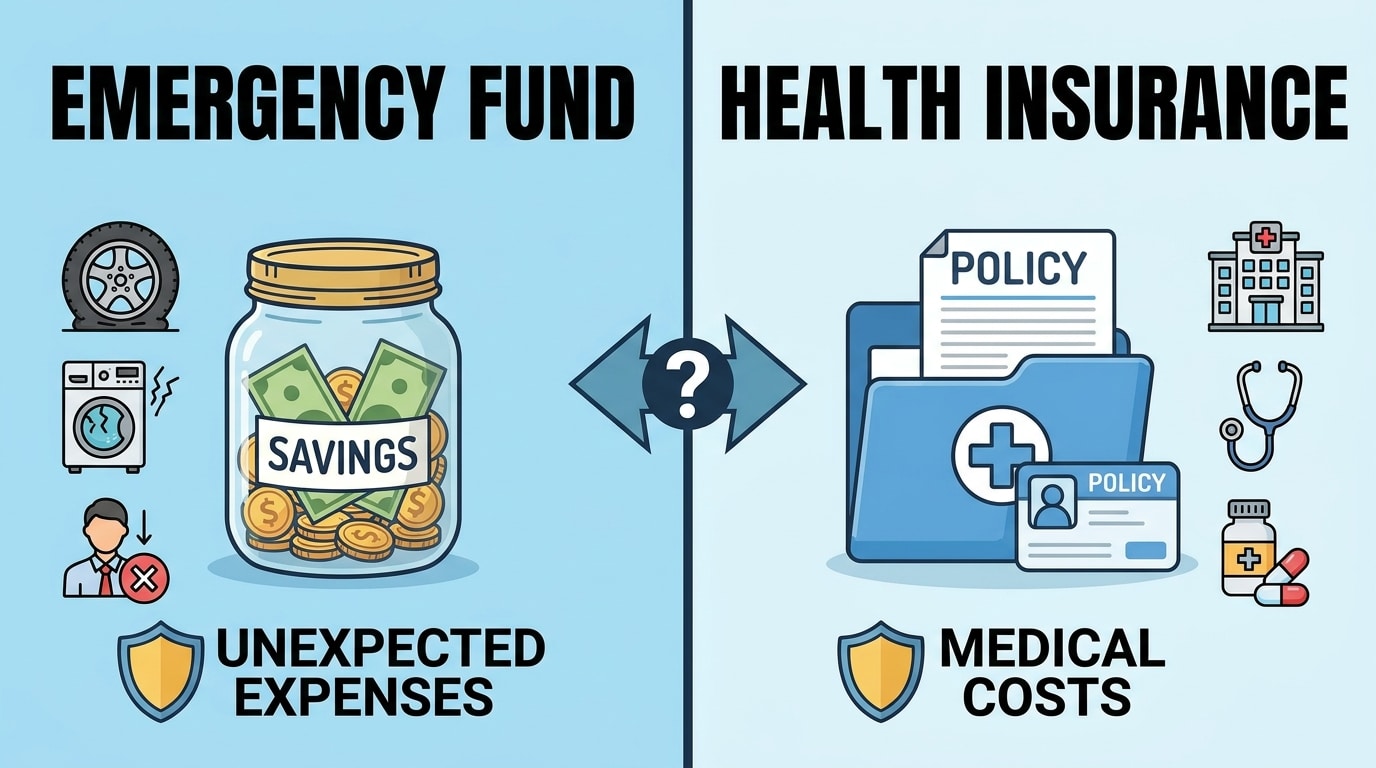
Money stress and health scares don’t wait for perfect timing, which is why people debate: emergency fund or health insurance? Both protect you, but differently. One is your saved backup cash; the other is your medical safety net when things get serious. Mixing the two is where financial planning usually slips, leading to costs later than expected.
What Is an Emergency Fund? (And What It Is Not)
An emergency fund is your financial safety cushion. It’s money set aside for moments when life just randomly goes off-script.
It covers job loss, urgent repairs, sudden travel, or short-term medical needs. Ideally, it should be 3-6 months of expenses kept in a liquid, easy-to-access account.
But here’s the reality check: it’s not unlimited. Once you use it, it drops. And rebuilding it takes time, discipline and a bit of financial recovery mode.
What Is Health Insurance?
Health insurance is your financial bodyguard in a hospital corridor. You pay a premium, and in return, the insurer covers a large chunk of your medical bills when things go wrong.
Modern health insurance plans in India typically cover hospitalisation, surgeries, and pre- and post-treatment costs, depending on the policy. The idea is simple: instead of draining your savings, you transfer the heavy medical risk to the insurer.
And if you choose well, individual health insurance gives you more control over coverage. No dependency on employer policies or family floaters that may not always match your real-life needs.
Emergency Fund vs Health Insurance: Key Differences
Think of it like this: both emergency funds and health insurance are safety nets, but they don’t show up the same way when life hits. One is your own money, ready to use instantly. The other kicks in through a process when a claim is made.
Here’s a clear breakdown:
| Factor | Emergency Fund | Health Insurance |
| Purpose | Your personal wallet backup | Financial protection shield |
| Access | Instant, no rules, no approvals | Claim-based, structured process |
| Flexibility | Fully flexible usage | Defined by policy terms |
| Limit | Limited by your savings | Limited by sum insured |
| Nature | Self-funded survival mode | Risk transfer with conditions |
Why You Need Both Health Insurance and an Emergency Fund
This is where things stop being either-or.
Health insurance handles the heavy lifting, like big hospital bills, surgeries, and major treatments. Emergency funds cover everything insurance does not, such as upfront payments, non-covered expenses, or delays in claim processing.
Together, they create balance. Insurance protects your wealth. Emergency funds protect your liquidity.
One without the other leaves a gap. Both together close it.
How Much Emergency Fund Do You Need If You Already Have Insurance?
Even with strong coverage, you should not go minimal on savings.
A safe benchmark is 6-12 months of living expenses as your core emergency fund. On top of that, keep a small medical savings for those quick healthcare costs that do not wait for approvals or insurance paperwork to catch up.
The exact amount depends on your lifestyle, dependents, and the strength of your health insurance plans.
Why Individual Health Insurance Matters More Than You Think
Group insurance from employers is convenient, but it is not always reliable in the long term.
Individual health insurance gives you control over coverage, continuity, and upgrades. It stays with you even when jobs change or life takes a turn.
Think of it as your personal health security contract that does not get cancelled when your office ID does.
Disclaimer: This article is for informational purposes only and should not be considered financial or insurance advice. Figures and recommendations are general guidelines; consult a certified financial advisor or insurance professional before making decisions based on your individual circumstances.
Observer Voice is the one stop site for National, International news, Sports, Editor’s Choice, Art/culture contents, Quotes and much more. We also cover historical contents. Historical contents includes World History, Indian History, and what happened today. The website also covers Entertainment across the India and World.

