

Why Every Business Launch Needs a Social Media Presence on Day One

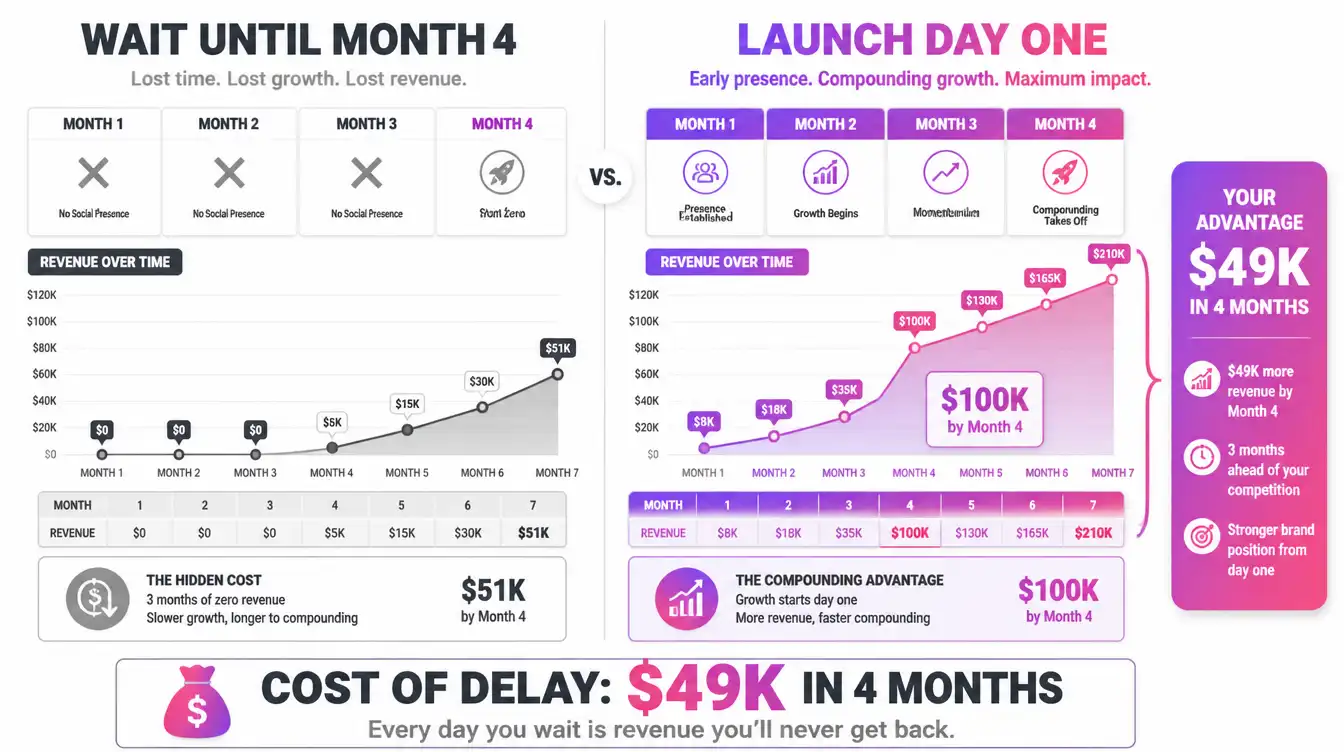
Most new businesses treat social media as an afterthought. The website goes live, the register opens, the first invoices go out — and the Instagram account gets set up “eventually,” once things settle down. That instinct makes sense in the chaos of a launch, when founders are juggling suppliers, staffing, and cash flow. But the evidence on how people actually discover local businesses today suggests that delay carries a real, measurable cost.
According to the Pew Research Center’s most recent research on social media adoption, roughly eight in ten American adults now use at least one social media platform, and usage is highest among the 18-to-49 age bracket that makes up the core customer base for most new consumer and professional-service businesses. For a company that hasn’t built any presence yet, that’s not a marketing nicety — it’s a segment of prospective customers who are already forming opinions about competitors before a new business even opens its doors.
The U.S. Small Business Administration’s own guidance for small businesses treats social media the same way, folding it directly into the marketing plan a new business is encouraged to write before launch — alongside pricing, sales channels, and customer support — rather than treating it as a later add-on. The SBA is blunt about the two-way nature of the channel: an account that only broadcasts promotions, without engaging the audience it’s trying to reach, tends to underperform one that treats followers as a relationship from the start. That distinction matters more at launch than at any later point, because a brand-new account has no goodwill banked to fall back on if its first impression is purely transactional.
The cold-start problem
The core issue founders run into isn’t really about social media specifically — it’s a version of what’s sometimes called the network effect: a new account has no track record, so early visitors have little reason to trust it, which in turn makes it harder to attract the visitors who would build that trust. A business that opens with zero followers looks, to a browsing customer, indistinguishable from any of the thousands of other unproven storefronts online. A business that spent even a few weeks before launch sharing behind-the-scenes updates and building an initial audience starts the race already a lap ahead.
This is a well-studied pattern outside marketing, too — it shows up whenever a new product, app, or platform needs an initial base of users before it becomes useful to anyone else. The practical takeaway for a new business is the same one product teams learn the hard way: the earliest audience is disproportionately valuable, not because those first fifty or hundred followers spend the most money, but because their presence is what makes the account look active and worth following to the next person who lands on it.
Social proof and why follower counts still matter
There’s a reason that dynamic persists even though most people say they don’t care about follower counts. Psychologists call the underlying behavior social proof — the tendency to treat other people’s visible choices as evidence about what’s worth choosing, especially in situations where quality is hard to judge directly. A prospective customer scrolling between two similar local businesses rarely has a reliable way to judge service quality from a website alone; an active, populated social account is one of the few signals available in the ten seconds most people actually spend deciding.
That’s also where the incentive to shortcut the process comes from. A visible follower count is easy to fake and hard to verify at a glance, which is exactly why platforms have invested heavily in detecting inauthentic engagement, and why a purchased follower count that doesn’t translate into comments, shares, or replies tends to look — and eventually perform — worse than a smaller, genuinely engaged one.
How businesses close the gap
In practice, businesses close the cold-start gap in a few overlapping ways: consistent organic posting, modest paid advertising aimed at a defined local or niche audience, and — for founders who’d rather not spend their own limited time building an account from zero — outside help. This is the niche firms offering social media growth services for businesses occupy; they typically handle the early account-building work — content calendars, initial ad spend, engagement — while the owner focuses on running the business. It’s worth being clear-eyed about what that kind of help can and can’t do, though: platforms have gotten considerably better at detecting and penalizing purchased or inauthentic engagement, so outside support is only worth paying for if it’s building genuine reach rather than a hollow follower count that doesn’t convert into customers.
The founders who get the most out of this kind of support tend to treat it as a running start rather than a substitute for their own presence — using the early lift to buy time while they figure out what content their actual audience responds to, rather than outsourcing the account indefinitely.
What a realistic day-one plan looks like
None of this requires an elaborate strategy. The SBA’s own guidance boils it down to a short list: pick the one or two platforms where actual customers spend time (LinkedIn for B2B services, Instagram or TikTok for visual consumer brands, Facebook for local and community-based businesses), set a simple weekly posting rhythm, and track a small number of metrics against cost rather than chasing follower counts for their own sake. Businesses that start this rhythm before or at launch have a body of content and an established account by the time slower-moving competitors are just getting around to it — and on most platforms, an account with a real history is treated more favorably by recommendation algorithms than a brand-new one, which compounds the early advantage over time.
None of this means a business is doomed without a social presence on day one — plenty of companies have built loyal customer bases the old-fashioned way. But the cost of waiting is asymmetric: setting up accounts and posting consistently from the outset costs very little in time or money, while the ground lost to competitors who got there first can take months to make up. For a founder deciding what to prioritize in a chaotic first few weeks, that’s a reasonably persuasive argument for treating social media as part of the launch itself, rather than a task for “later.”
Observer Voice is the one stop site for National, International news, Sports, Editor’s Choice, Art/culture contents, Quotes and much more. We also cover historical contents. Historical contents includes World History, Indian History, and what happened today. The website also covers Entertainment across the India and World.

