Leishmaniasis: Group of diseases caused by protozoan parasites transmitted by sandflies
Leishmaniasis: Parasitic disease transmitted by sandfly bites worldwide


Dr. Fatima Ahmed (Gedaref State, Sudan) watched helplessly as 8-year-old Amina wasted away in the rural health center bed. Six months earlier, Amina had been a healthy, energetic girl who loved school and played with her friends every afternoon. Now she was skeletal, her belly distended from a massively swollen spleen and liver, her fever spiking every evening, her skin darkened from the disease that was killing her—visceral leishmaniasis, known locally as kala-azar, which means “black fever.”
“Amina’s mother brought her to me after she’d been sick for three months. The family lived in a remote village without electricity or proper healthcare. They thought Amina just had malaria at first—fever, weakness, loss of appetite. But antimalarial medicines didn’t help. She kept getting worse—losing weight dramatically, her belly swelling, developing severe anemia. By the time they reached our health center, Amina was critically ill,” Dr. Ahmed recalled.
“I suspected kala-azar immediately. The clinical signs were classic—irregular fever, massive splenomegaly, severe wasting, darkened skin. We did a rapid diagnostic test and it came back positive for visceral leishmaniasis. Amina had been infected with Leishmania parasites transmitted through the bite of an infected sandfly—a tiny insect only 2-3 millimeters long. Those tiny sandflies had delivered parasites that invaded her internal organs and were slowly killing her,” Dr. Ahmed explained.
“The treatment for kala-azar is complex and requires injectable medications given over weeks. It’s expensive, toxic, and must be administered by experienced healthcare workers. We started Amina on liposomal amphotericin B, one of the most effective treatments. But she was so weak, so malnourished from months of illness. Every day was a struggle. If we’d caught it earlier—if her family had known that persistent fever and weight loss could be kala-azar—treatment would have been much more effective. As it was, we were fighting not just the parasites, but the massive damage they’d already caused,” Dr. Ahmed continued, her voice heavy with worry.
According to WHO, the leishmaniases are a group of diseases caused by protozoan parasites from more than 20 Leishmania species. These parasites are transmitted to humans by the bite of an infected female phlebotomine sandfly, a tiny – 2–3 mm long – insect vector. There are three main forms of the disease: cutaneous leishmaniasis (CL), visceral leishmaniasis (VL), also known as kala-azar, and mucocutaneous leishmaniasis (MCL). CL is the most common form, VL is the most severe form and MCL is the most disabling form of the disease.
For more on vector-borne diseases, see our articles on tropical neglected diseases and parasitic infections at ObserverVoice.com.
Forms and Global Burden
Most people who become infected with the parasite do not develop any symptoms during their lifetime. Therefore, the term leishmaniasis refers to the condition of becoming sick due to a Leishmania infection, not to being infected with the parasite. Today, more than 1 billion people live in areas endemic for leishmaniasis and are at risk of infection. An estimated 30,000 new cases of VL and more than 1 million new cases of CL occur annually.
CL usually produces ulcers on the exposed parts of the body, such as the face, arms and legs. There may be many lesions – sometimes up to 200 – which can cause serious disability. When the ulcers heal, they invariably leave permanent scars, which can lead to stigmatization, especially for women and girls. VL is characterized by irregular bouts of fever, substantial weight loss, swelling of the spleen and liver and serious anaemia. If the disease is not treated, the fatality rate can be as high as 100% within 2 years.
MCL produces lesions that can partially or totally destroy the mucous membranes of the nose, mouth and throat cavities and surrounding tissues. This disabling form can also lead to social exclusion. PKDL (post-kala-azar dermal leishmaniasis), a complication of VL, is mainly seen in East Africa and South-East Asia. It is characterized by a discoloured (hypopigmented) flat skin (macular) rash, combined with some slightly elevated (maculopapular) or elevated (nodular) rash, usually in patients who have recovered from VL.
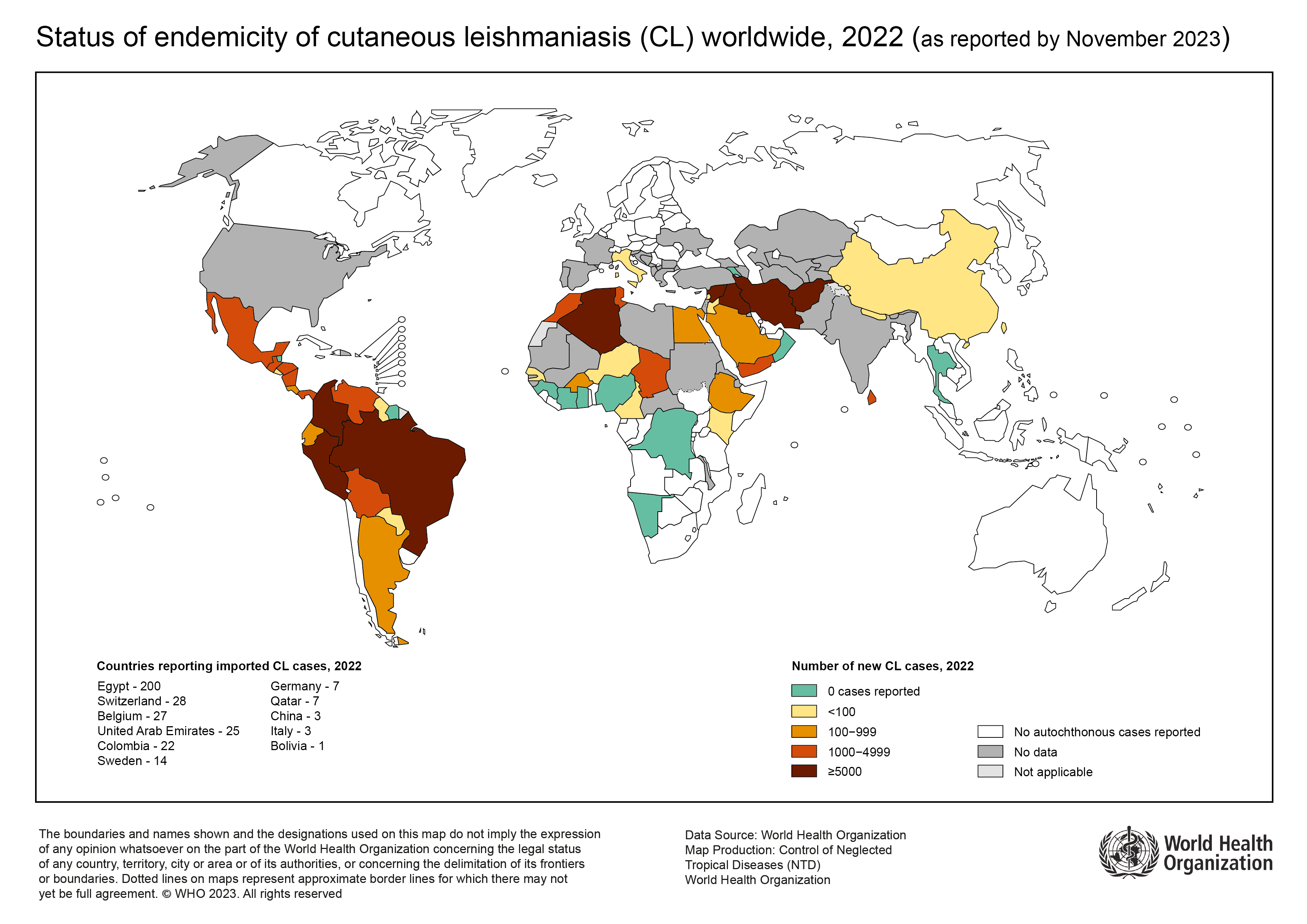
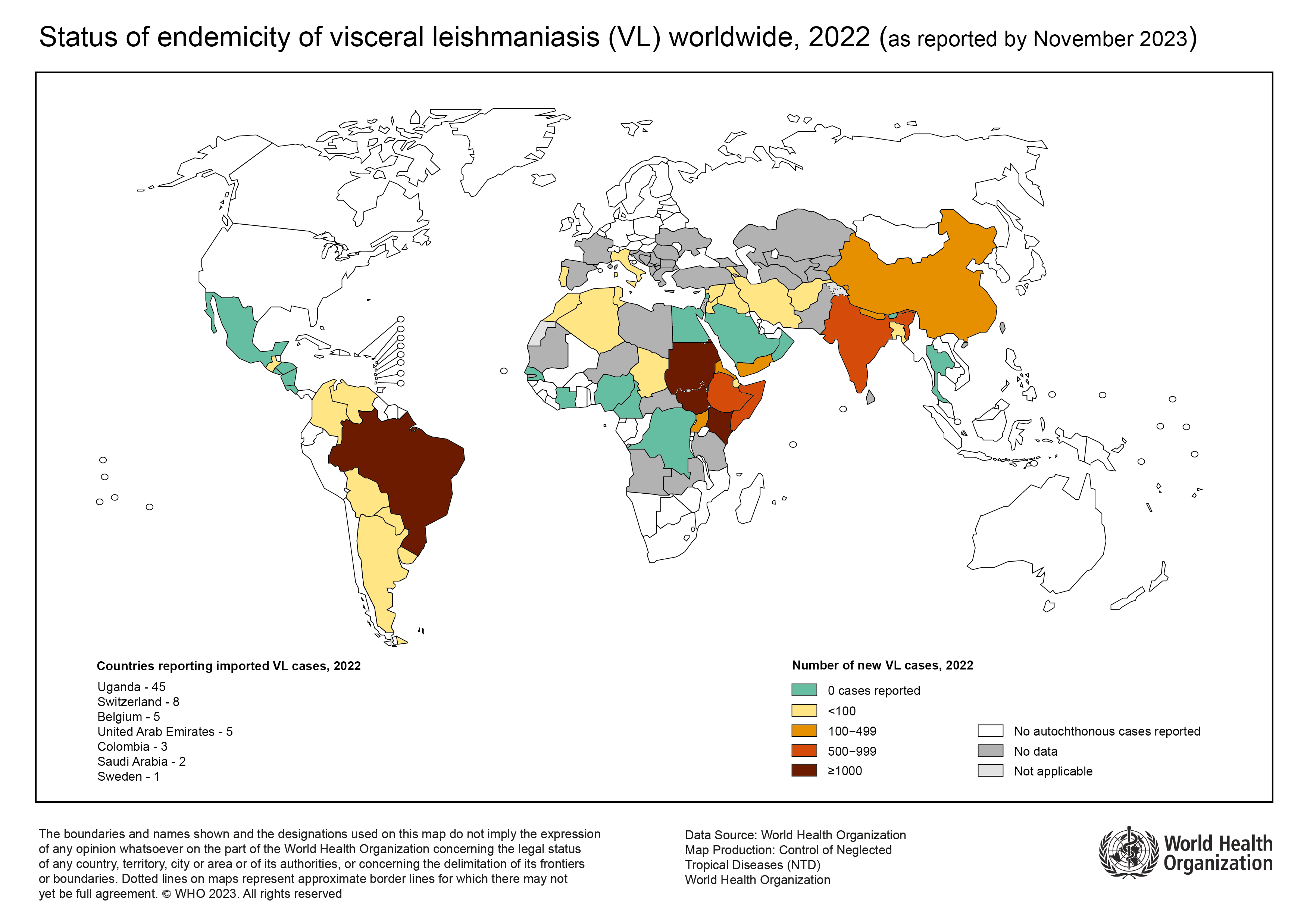
WHO provides Leishmaniasis fact sheet and Frequently asked questions on leishmaniasis. WHO provides maps showing Status of endemicity of cutaneous leishmaniasis, worldwide, 2022 and Status of endemicity of visceral leishmaniasis, worldwide, 2022. WHO provides Data on leishmaniasis (Global Health Observatory), Country profiles, and Essential Maps.
Related topics include Yaws (Endemic treponematoses), Buruli ulcer, Leprosy (Hansen disease), and Lymphatic filariasis (Elephantiasis). For more on neglected tropical diseases, see our article on WHO elimination programs at ObserverVoice.com.
Treatment Challenges
Antileishmanial treatment depends on the causative species and the condition of the patient (e.g. pregnancy, immunosuppression). Regardless of the causative Leishmania species, antileishmanial treatment cannot provide a sterile cure, and the parasite remains in the human body and can cause a relapse when there is immunosuppression. Treatment is complex and should be administered by highly experienced health personnel. Most antileishmanial medicines are injectable.
WHO’s Control of Neglected Tropical Diseases team coordinates efforts. World Health Assembly passed WHA60.13 on Control of leishmaniasis, 2007.
Recent News and Publications
May 2025 WHO reported Progress for NTDs: two resolutions adopted at WHA78. May 2025 WHO reported African Nations unite to eliminate visceral leishmaniasis and boost cross-border collaboration for NTDs. April 2025 WHO reported Global meeting calls for stronger partnerships to tackle skin NTDs. March 2025 WHO reported Second global meeting on skin NTDs focuses on advancing integration and innovation.
December 2025 WHO published Leishmaniasis: Epidemiological report on the Region of the Americas. No. 14, December 2025. December 2025 WHO published Leishmaniasis: 20 years of progress towards elimination in the WHO African Region. November 2025 WHO published Global leishmaniasis surveillance updates 2024: consolidating gains and new initiatives. WHO offers training courses on Visceral leishmaniasis East Africa and Post-kala-azar dermal leishmaniasis: training of health workers on skin-NTDs.
WHO Activities and Events
WHO works on Implementing a global surveillance system for leishmaniasis, Supplying antileishmanial medicines to the most vulnerable populations, Capacity-building for health workers dealing with leishmaniasis, Eliminating visceral leishmaniasis as a public health problem in the South-East Asia Region, and Promoting the integrated approach to skin-related neglected tropical diseases.
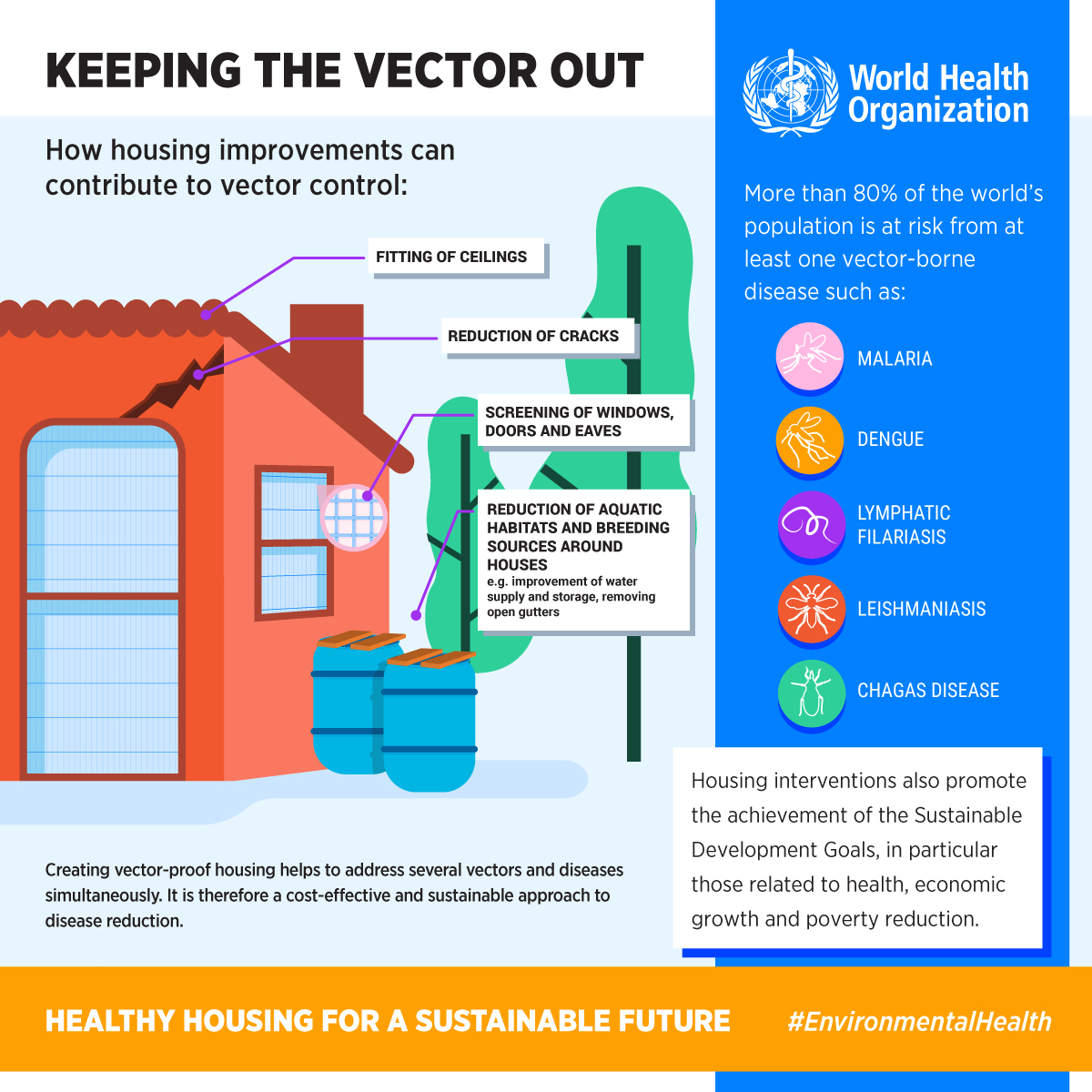
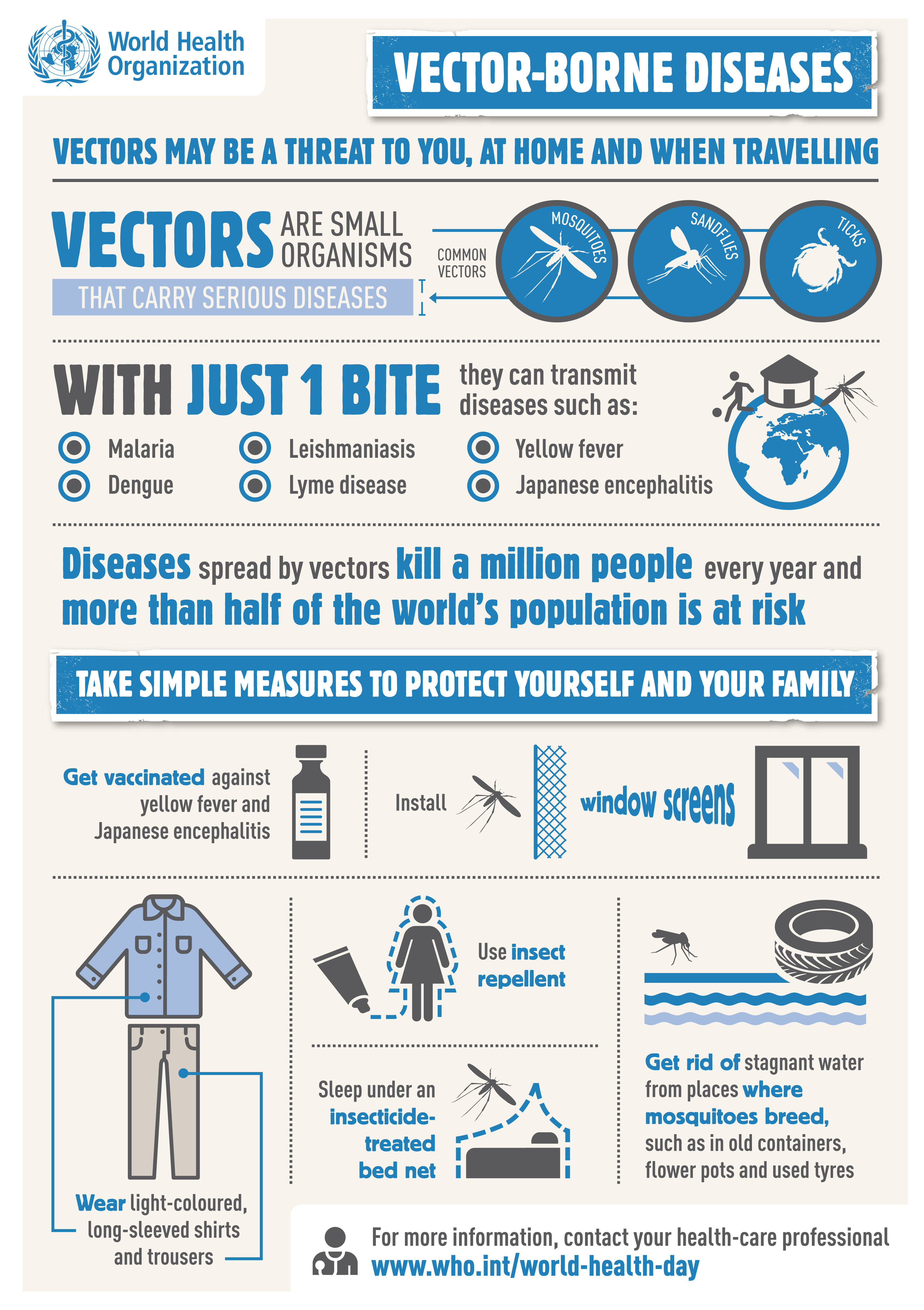
October 2025 WHO hosted Sustaining gains, expanding horizons – From a 20-year journey of regional kala-azar elimination commitment and innovation. WHO provides Interactive timeline of leishmaniasis facts. WHO provides infographics showing Keeping the vector out, Vector-borne diseases, and Unveiling the neglect of leishmaniasis.
Recovery and Elimination Efforts
Amina survived her kala-azar infection, but it took five weeks of intensive treatment. The injectable medications were painful, caused side effects, required daily clinic visits. Her family struggled to afford the costs—travel to the health center, lost agricultural work, medicines. But WHO-supported programs provided free antileishmanial medicines and technical support that saved Amina’s life.
“When Amina finally recovered enough to go home, she was still weak, still recovering. But she was alive. Many children with kala-azar die—the fatality rate approaches 100% within two years if untreated. Even with treatment, complications can occur. Some patients develop PKDL after recovery—skin lesions that can persist for years. The parasite never truly leaves the body—it remains dormant, can reactivate if the immune system weakens,” Dr. Ahmed explained.
“After Amina’s case, I became passionate about leishmaniasis prevention and control. WHO’s elimination efforts in East Africa focus on early case detection, prompt treatment with effective medicines, and vector control—reducing sandfly populations through insecticide spraying, bed nets, environmental management. WHO coordinates surveillance systems, ensures medicine supplies reach remote areas, trains healthcare workers to recognize and treat kala-azar. In Sudan and neighboring countries, WHO supports cross-border collaboration since sandflies and infected people move across borders,” Dr. Ahmed continued.
“May 2025 WHO reported that African Nations are uniting to eliminate visceral leishmaniasis and boost cross-border collaboration. This is transformative—kala-azar doesn’t respect political boundaries. Coordinated regional elimination efforts are essential. WHO’s South-East Asia Region has made tremendous progress—several countries have eliminated kala-azar as a public health problem. We can achieve this in Africa too,” Dr. Ahmed emphasized.
“December 2025 WHO published 20 years of progress towards elimination in WHO African Region—documenting successes, identifying challenges. More than 1 billion people remain at risk for leishmaniasis globally. 30,000 new visceral cases and over 1 million cutaneous cases occur annually. Cutaneous leishmaniasis causes permanent scarring, stigmatization—especially devastating for women and girls. Mucocutaneous leishmaniasis destroys facial tissues, causes severe disability and social exclusion. These aren’t just statistics—they’re children like Amina, families devastated by preventable disease,” Dr. Ahmed noted.
“Amina is now 10 years old, back in school, healthy and thriving. She’s one of the lucky ones. WHO’s work on leishmaniasis—surveillance systems, medicine supply programs, healthcare worker training, vector control guidance, regional elimination initiatives—is saving lives across endemic regions. My mission is ensuring every child with kala-azar receives early diagnosis and effective treatment. Leishmaniasis is preventable and treatable. With WHO’s leadership and coordinated global action, we can eliminate it as a public health problem worldwide.”
For more information, visit WHO’s leishmaniasis topic page or explore related content at ObserverVoice.com.
Frequently Asked Questions (FAQs)
The leishmaniases are group of diseases caused by protozoan parasites from more than 20 Leishmania species. These parasites are transmitted to humans by bite of infected female phlebotomine sandfly, tiny insect vector 2–3 mm long. There are three main forms: cutaneous leishmaniasis (CL), visceral leishmaniasis (VL) also known as kala-azar, and mucocutaneous leishmaniasis (MCL). CL is most common form, VL is most severe form and MCL is most disabling form. Most people who become infected with parasite do not develop any symptoms during their lifetime. Today, more than 1 billion people live in areas endemic for leishmaniasis and are at risk of infection. Estimated 30,000 new cases of VL and more than 1 million new cases of CL occur annually. WHO provides Leishmaniasis fact sheet and FAQs on leishmaniasis. Related: Yaws, Buruli ulcer.
CL usually produces ulcers on exposed parts of body, such as face, arms and legs. There may be many lesions – sometimes up to 200 – which can cause serious disability. When ulcers heal, they invariably leave permanent scars, which can lead to stigmatization, especially for women and girls. VL is characterized by irregular bouts of fever, substantial weight loss, swelling of spleen and liver and serious anaemia. If disease is not treated, fatality rate can be as high as 100% within 2 years. MCL produces lesions that can partially or totally destroy mucous membranes of nose, mouth and throat cavities and surrounding tissues. This disabling form can also lead to social exclusion. PKDL (post-kala-azar dermal leishmaniasis), complication of VL, is mainly seen in East Africa and South-East Asia. It is characterized by discoloured flat skin rash, usually in patients who have recovered from VL. WHO provides maps showing Status of endemicity of cutaneous leishmaniasis, worldwide, 2022 and visceral leishmaniasis, worldwide, 2022. Related: Leprosy, Lymphatic filariasis.
Antileishmanial treatment depends on causative species and condition of patient (e.g. pregnancy, immunosuppression). Regardless of causative Leishmania species, antileishmanial treatment cannot provide sterile cure, and parasite remains in human body and can cause relapse when there is immunosuppression. Treatment is complex and should be administered by highly experienced health personnel. Most antileishmanial medicines are injectable. WHO works on Supplying antileishmanial medicines to most vulnerable populations and Capacity-building for health workers dealing with leishmaniasis. WHO offers training on Visceral leishmaniasis East Africa and Post-kala-azar dermal leishmaniasis training. WHO’s Control of Neglected Tropical Diseases team coordinates efforts. Related: Buruli ulcer.
May 2025 WHO reported African Nations unite to eliminate visceral leishmaniasis and boost cross-border collaboration. December 2025 WHO published Leishmaniasis: 20 years of progress towards elimination in WHO African Region. November 2025 WHO published Global leishmaniasis surveillance updates 2024: consolidating gains and new initiatives. December 2025 WHO published Leishmaniasis: Epidemiological report on Region of the Americas. WHO works on Eliminating visceral leishmaniasis as public health problem in South-East Asia Region. May 2025 WHO reported Progress for NTDs: two resolutions adopted at WHA78. World Health Assembly passed WHA60.13 on Control of leishmaniasis, 2007. Related: Yaws, Leprosy.
WHO works on Implementing global surveillance system for leishmaniasis, Supplying antileishmanial medicines to most vulnerable populations, Capacity-building for health workers, Eliminating visceral leishmaniasis in South-East Asia Region, and Promoting integrated approach to skin-related neglected tropical diseases. April 2025 WHO reported Global meeting calls for stronger partnerships to tackle skin NTDs. March 2025 WHO reported Second global meeting on skin NTDs focuses on advancing integration and innovation. October 2025 WHO hosted 20-year journey of regional kala-azar elimination. WHO provides Data on leishmaniasis (GHO) and Interactive timeline. Related: Lymphatic filariasis.
- WHO Leishmaniasis Topic Page
- Global Leishmaniasis Surveillance Data
- WHO Control of Neglected Tropical Diseases
- Leishmaniasis Interactive Timeline
- Leishmaniasis Country Profiles
Disclaimer: This article is an adaptation of publicly available information from WHO’s Leishmaniasis
health topic page (WHO, Geneva. Licence: CC BYNC-SA 3.0 IGO). WHO is not responsible for the
content or accuracy of this adaptation. This content is for informational and educational purposes
only and does not constitute medical advice. ObserverVoice.com is a news and information platform
— not a healthcare provider.
Observer Voice is the one stop site for National, International news, Sports, Editor’s Choice, Art/culture contents, Quotes and much more. We also cover historical contents. Historical contents includes World History, Indian History, and what happened today. The website also covers Entertainment across the India and World.