

China’s Export Surge Raises Concerns in Europe as G7 Nations Consider Response to ‘China Shock 2.0’

China’s exports are raising alarms in Europe, prompting leaders of the Group of Seven (G7) to discuss strategies to tackle increasing trade imbalances. Concerns are growing that Europe may experience a “China Shock,” reminiscent of the disruptions faced by the U.S. in the early 2000s, as Chinese goods continue to flood the market. Despite U.S. tariffs aimed at curbing its manufacturing dominance, China reported a record global trade surplus of approximately USD 1.2 trillion last year.
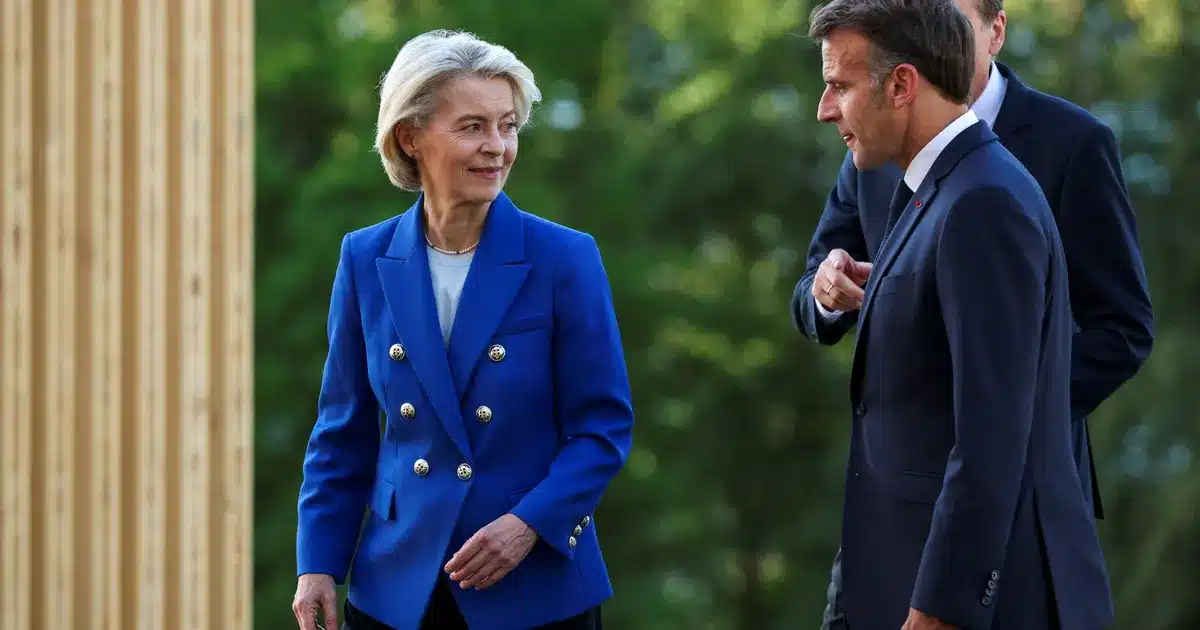
French President Emmanuel Macron has warned that Chinese exports are severely impacting European industry, acknowledging that Europe has been slow to respond to this challenge. Discussions at the recent G7 summit in France reflected these concerns, with leaders noting the persistence and widening of global imbalances, a statement widely interpreted as a critique of China’s trade practices.
Europe weighs stronger trade barriers
European policymakers are contemplating stricter trade measures against Chinese imports. Currently, the European Union imposes relatively low tariffs on most Chinese goods, although certain sectors, such as electric vehicles, face duties of up to 35%. Maurice Obstfeld, a senior fellow at the Peterson Institute for International Economics, cautioned that China’s export surge could trigger a global wave of protectionism against Chinese products. He emphasized that ongoing geopolitical tensions, such as those related to the Iran conflict, could exacerbate this situation.
HSBC economist Taylor Wang also warned that escalating trade tensions between China and Europe could jeopardize Chinese exports, particularly in high-demand sectors like electric vehicles, solar panels, and lithium-ion batteries.
A different kind of ‘China Shock’
The current trade dynamics differ significantly from the first “China Shock” that followed China’s accession to the World Trade Organization in 2001. At that time, low-cost Chinese goods gained access to Western markets, contributing to the loss of approximately 2.4 million American jobs, according to research by economists David Autor, David Dorn, and Gordon Hanson. Today, China dominates global manufacturing and exports more sophisticated products, accounting for 16% of global goods exports, up from just 4% in 2000.
Cornell University economist Eswar Prasad noted that this second wave of competition is impacting advanced economies, particularly in high-tech sectors like electric vehicles and robotics, which many developed nations had hoped would drive industrial growth.
Germany among hardest hit
Germany, as Europe’s largest economy, has faced significant challenges due to increased competition from Chinese firms in sectors traditionally led by German manufacturers, such as automobiles and industrial machinery. The German economy contracted in 2023 and 2024, with only a modest expansion of 0.2% last year. Chinese exports to the European Union surged by 16.4% from January to May compared to the previous year, exacerbating trade deficits, particularly for France.
Economists suggest that Chinese policies continue to promote manufacturing growth while suppressing domestic consumption, leading to excess production aimed at foreign markets. Former U.S. trade negotiator Wendy Cutler stated that Beijing has relied on international markets to absorb its overcapacity, a strategy that may soon face challenges if the EU and other regions follow the U.S. in restricting Chinese imports.
Observer Voice is the one stop site for National, International news, Sports, Editor’s Choice, Art/culture contents, Quotes and much more. We also cover historical contents. Historical contents includes World History, Indian History, and what happened today. The website also covers Entertainment across the India and World.

