

China Imposes Export Controls on Construction Equipment: Impact of Restrictions on Tunnel-Digging Machines and Potential Effects on India

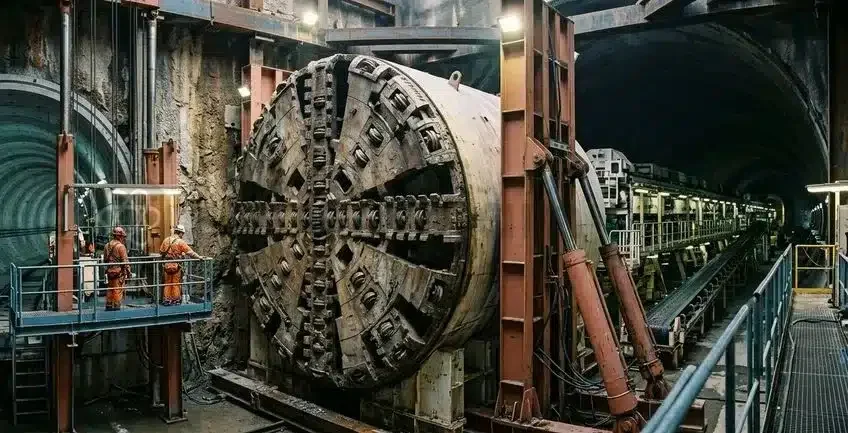
China is tightening its export controls on construction equipment, specifically targeting tunnel-boring machines and related machinery. This move could significantly impact India’s infrastructure projects, raising concerns about the country’s reliance on Chinese machinery. The new restrictions, which will take effect later this month, cover specialized equipment used in tunnel construction for roads, railways, and metro networks, as well as machines for high-altitude concrete spraying.
Beijing has cited both military and civilian applications for these machines, warning that “sensitive countries and regions with disputes with China” will face stricter export rules. India, a major customer for tunnel-boring equipment, is expanding its infrastructure along the Himalayan border, where a longstanding territorial dispute with China exists. The restrictions also encompass components, complicating not only new procurement but also the maintenance of existing machinery.
Implications for India’s Infrastructure
China dominates the global tunnel-boring machine market, accounting for approximately 70% of it, according to state media figures. Its leading manufacturer, China Railway Engineering Equipment Group Co Ltd, supplies machinery to 36 countries, including Denmark and France. India has previously experienced delays in acquiring Chinese-made tunneling equipment, notably in 2024 when China stalled sales by German manufacturer Herrenknecht AG for projects like the Ahmedabad-Mumbai bullet train and the Delhi Metro.
The new export controls could hinder the supply of spare parts, which are crucial for maintaining existing machinery. Ajay Srivastava, founder of the Global Trade Research Initiative in New Delhi, noted that while India could reallocate equipment between priority projects, restrictions on components could pose challenges for ongoing operations. He emphasized the need for a regular supply of parts due to wear and tear on the machines.
India’s Push for Domestic Manufacturing
As these restrictions unfold, India is actively seeking to bolster its domestic manufacturing capabilities for high-value construction equipment. The government is considering a $1.2 billion incentive scheme aimed at manufacturers of tunnel-boring machines, firefighting systems, and elevators. This initiative is expected to attract around $1.8 billion in new investments over seven years and will include local value-addition targets for currently imported machinery.
State-run BEML and private firms like Larsen & Toubro and Johnson Lifts could benefit from these proposed incentives. India’s infrastructure expansion is projected to drive demand for specialized equipment, with Road Transport and Highways Minister Nitin Gadkari stating that the country plans to invest up to $9.6 billion in tunneling over the next five years.
Challenges in Domestic Production
Larsen & Toubro is developing its own tunnel-boring machine prototype, with plans to manufacture machinery for its projects and potentially for other buyers. However, R Shankar Raman, president of the company, cautioned that India’s manufacturing sector is still in its infancy compared to China’s established large-scale production capabilities. He warned that if Indian manufacturers cannot compete on price with Chinese imports, they will struggle to gain market traction.
Bloomberg Economics indicated that the new restrictions could slow some infrastructure projects, particularly those along the disputed Himalayan border. However, they also noted that tighter Chinese export controls might enhance India’s position as an alternative manufacturing base, potentially attracting foreign equipment makers to invest in local production.

